(Re)configuration based on model generation
Reconfiguration is an important activity for companies selling configurable products or services which have a long life time. However, identification of a set of required changes in a legacy configuration is a hard problem, since even small changes in the requirements might imply significant modifications. In this paper we show a solution based on answer set programming, which is a logic-based knowledge representation formalism well suited for a compact description of (re)configuration problems. Its applicability is demonstrated on simple abstractions of several real-world scenarios. The evaluation of our solution on a set of benchmark instances derived from commercial (re)configuration problems shows its practical applicability.
💡 Research Summary
The paper addresses the problem of re‑configuration for long‑lived configurable products and services, where a legacy configuration must be adapted to new customer or system requirements while minimizing change costs. The authors propose a solution based on Answer Set Programming (ASP), a declarative logic programming paradigm that supports compact modeling, non‑monotonic reasoning, and built‑in optimization.
A re‑configuration task is formalized as a new configuration‑generation problem. The knowledge base is split into two parts: (1) a description of the new configuration problem instance, consisting of a set of logical requirements (REQ) and a solution schema (PS) that enumerates the predicates used to describe a configuration, and (2) transformation knowledge (T) that maps facts of the legacy configuration to facts in the ontology of the new instance. Transformation rules express three possible actions for each legacy element—reuse, deletion, or creation—and each action is associated with a numeric cost.
The ASP encoding follows a “bounded type” pattern. For each entity type (person, thing, cabinet, room) lower and upper bounds on the number of individuals are declared. Domain predicates (e.g., cabinetDomain) generate the admissible identifiers, while symmetry‑breaking rules prevent redundant permutations during grounding. Relationships such as cabinet‑to‑thing or room‑to‑cabinet are expressed with cardinality constraints and conditional literals, allowing concise representation of “exactly one”, “at most”, or “at least” constraints.
Costs are modeled by atoms of the form cost(create(p(X)),W). The objective function is declared with ASP’s #minimize statement, which sums all cost atoms in a candidate answer set. Consequently, any answer set that satisfies all logical constraints and yields the minimal total cost corresponds to an optimal re‑configuration.
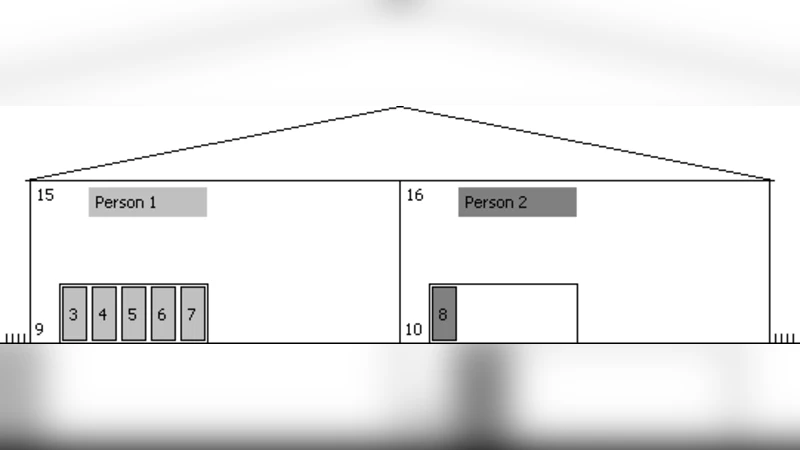
The authors illustrate the approach with a toy scenario: two customers own several items that must be placed in cabinets and rooms under capacity constraints. When new requirements (e.g., distinguishing long and short items, introducing high vs. small cabinets) are added, the legacy configuration becomes inconsistent. By adjusting the cost parameters, the ASP solver produces different optimal solutions—either modifying existing cabinets, adding new ones, or deleting some—demonstrating the flexibility of the cost model.
Experimental evaluation uses a benchmark suite derived from real industrial re‑configuration cases (approximately 30 instances). All instances are solved with standard ASP solvers (e.g., clingo) within seconds, showing that the method scales to realistic problem sizes. Moreover, by varying the cost assignments, the solver can be guided to respect business policies such as “creating a new high cabinet is cheaper than upgrading an existing small cabinet”.
In summary, the paper contributes:
- A formal logical definition of (re)configuration problems using Herbrand models and a solution schema.
- A systematic ASP modeling pattern that captures bounded entity types, cardinality constraints, and transformation knowledge.
- An optimization framework that integrates change‑costs directly into the ASP program, enabling automatic generation of cost‑optimal re‑configurations.
- Empirical evidence of practical applicability to industrial scenarios.
Future work suggested includes dynamic cost updates, multi‑objective optimization (e.g., balancing cost against performance), and distributed ASP techniques for handling very large‑scale re‑configuration tasks.
Comments & Academic Discussion
Loading comments...
Leave a Comment