Linear topologies on $Z$ are not Mackey topologies
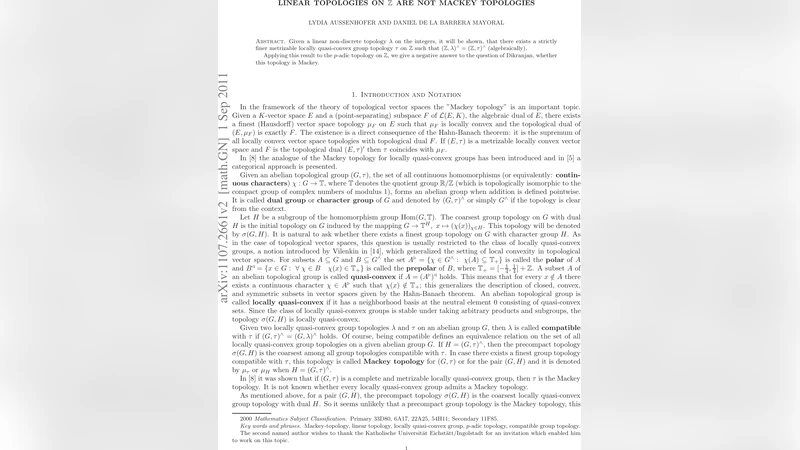
In this article it is shown that to every non-discrete Hausdorff linear topology on $\Z$ other metrizable locally quasi-convex group topologies can be associated which are strictly finer than the linear topology and such that the character groups coincide. Applying this result to the $p$-adic topology on $\Z$, we give a negative answer to the question of Dikranjan, whether this topology is Mackey.
💡 Research Summary
The paper investigates the Mackey problem for locally quasi‑convex (LQC) group topologies on the additive group of integers ℤ. In the setting of topological vector spaces, the Mackey topology is the finest locally convex topology that yields a prescribed dual space. An analogous notion exists for LQC groups: given an abelian topological group (G,τ) with character group G^∧, the Mackey topology µ_τ is the finest LQC topology on G whose dual coincides with G^∧. The authors focus on the class of linear topologies on ℤ, i.e. those whose neighbourhood basis at 0 consists of open subgroups.
A linear topology λ on ℤ can be described by a strictly increasing sequence of positive integers b = (b_n) with b_0 = 1, b_n | b_{n+1} and b_n ≠ b_{n+1}. The family {b_nℤ} forms a neighbourhood basis, and the topology is denoted λ_b. Such a topology is always precompact, and its character group is the subgroup H_b = ⟨ξ_{b,n} : n∈ℕ⟩ ⊂ T = ℝ/ℤ, where ξ_{b,n}(k) = k·b_n + ℤ. A crucial observation is that every equicontinuous subset of H_b is finite; consequently, the weak topology σ(ℤ,H_b) coincides with λ_b.
The main construction proceeds as follows. Assume b belongs to D_∞, i.e. the ratios b_{n+1}/b_n tend to infinity (this holds, for example, for the p‑adic sequence b_n = p^n). Define the set S_b = {1/b_n + ℤ : n∈ℕ} ⊂ T. This set is a quasi‑convex null‑sequence inside the Prüfer group ℤ(p^∞) ⊂ T. The authors introduce the topology τ_b of uniform convergence on S_b: a neighbourhood basis at 0 is given by
U_n = {x∈ℤ : χ(x) ∈
Comments & Academic Discussion
Loading comments...
Leave a Comment