Modelling Concurrency with Comtraces and Generalized Comtraces
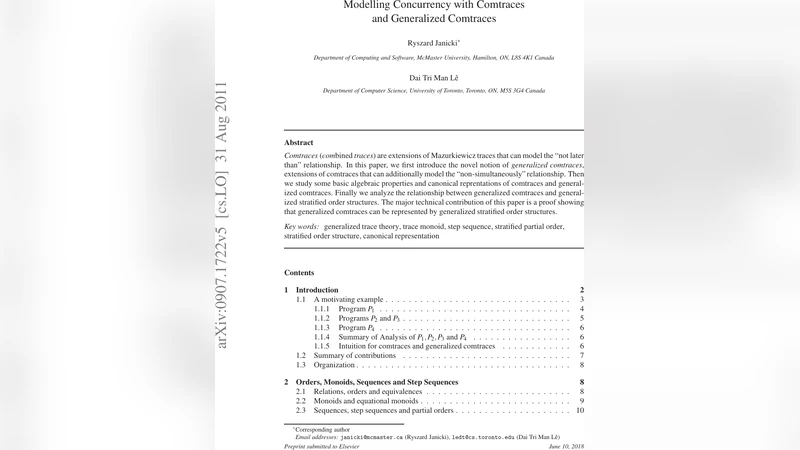
Comtraces (combined traces) are extensions of Mazurkiewicz traces that can model the “not later than” relationship. In this paper, we first introduce the novel notion of generalized comtraces, extensions of comtraces that can additionally model the “non-simultaneously” relationship. Then we study some basic algebraic properties and canonical reprentations of comtraces and generalized comtraces. Finally we analyze the relationship between generalized comtraces and generalized stratified order structures. The major technical contribution of this paper is a proof showing that generalized comtraces can be represented by generalized stratified order structures.
💡 Research Summary
The paper addresses a notable limitation of Mazurkiewicz traces and their extension, comtraces, by introducing a richer formalism called generalized comtraces (g‑comtraces). While comtraces can capture the “not later than” (pre‑order) relationship in addition to simultaneity, they lack the ability to express a “non‑simultaneous” (mutual exclusion) constraint that frequently appears in real‑world concurrent systems such as real‑time embedded controllers, distributed transaction processing, and multi‑core memory models.
The authors first formalize g‑comtraces. A g‑comtrace is defined over a finite alphabet Σ together with three binary relations:
- I – the simultaneity relation (symmetric, reflexive on independent events),
- ≤ – the not‑later‑than (pre‑order) relation (reflexive, transitive), and
- ⧧ – the non‑simultaneous relation (irreflexive, antisymmetric).
These relations are required to satisfy natural compatibility conditions (e.g., if a ⧧ b then a and b cannot belong to the same simultaneity cluster). Strings over Σ are considered equivalent under a congruence ≡_GC generated by three elementary rewrites: swapping adjacent independent events (I), moving an event forward when a not‑later‑than constraint permits (≤), and forbidding adjacent placement of mutually exclusive events (⧧). The resulting equivalence classes constitute the g‑comtrace monoid. The paper proves that ordinary comtraces embed as a special case where ⧧ is empty, establishing a proper hierarchy of expressive power.
Algebraically, the set of g‑comtrace classes together with concatenation forms a monoid: concatenation is associative, the empty word ε acts as the identity, and the congruence guarantees well‑definedness. Although a full inverse does not exist (as in any trace‑based model), the authors discuss partial inverses in the presence of certain acyclicity conditions. Two canonical normal forms are introduced: the lexicographically minimal form (extremal left‑most ordering) and the reverse‑lexicographic minimal form (extremal right‑most ordering). Both are shown to be unique for each g‑comtrace, providing a deterministic representation useful for algorithmic manipulation and state‑space reduction.
The central technical contribution is a representation theorem linking g‑comtraces to generalized stratified order structures (g‑SOS). A g‑SOS consists of a set X of events equipped with a stratified partial order ⪯ (capturing “not later than”) and a binary incompatibility relation ⊥ (capturing “non‑simultaneous”). The authors construct a bijective mapping φ from any g‑comtrace C to a g‑SOS S(C) by extracting maximal simultaneity clusters, ordering these clusters according to the ≤ relation, and recording incompatibilities via ⧧. Conversely, a mapping ψ builds a g‑comtrace from a given g‑SOS by linearising each stratum while allowing any permutation inside a cluster, then quotienting by the g‑comtrace congruence. The theorem φ∘ψ = id_{g‑SOS} and ψ∘φ = id_{g‑comtrace} is proved by careful induction on the depth of the stratification and by exploiting the uniqueness of the normal forms. This result demonstrates that every g‑comtrace can be faithfully represented as a g‑SOS and vice versa, thereby unifying two previously separate formalisms.
The paper concludes with a discussion of practical implications. Because g‑comtraces can encode mutual exclusion directly, they enable more precise modeling of timing constraints (e.g., “event A must occur before B and cannot occur together with C”) without resorting to auxiliary variables or ad‑hoc encoding. The canonical normal forms support efficient implementation in model‑checking tools: the state space can be collapsed onto the stratified order structure, dramatically reducing the number of explored interleavings. The authors illustrate the approach with a small case study involving a distributed transaction protocol, showing how the g‑SOS representation yields a compact partial‑order graph that respects both causality and exclusive access constraints.
In summary, the work extends the theoretical foundation of trace theory by adding a third primitive relation, provides rigorous algebraic properties, establishes a unique normal form, and proves a representation equivalence with generalized stratified order structures. These contributions open the door to more expressive and scalable verification techniques for concurrent and real‑time systems.
Comments & Academic Discussion
Loading comments...
Leave a Comment