Nonuniform and coherent motion of superconducting vortices in the picometer-per-second regime
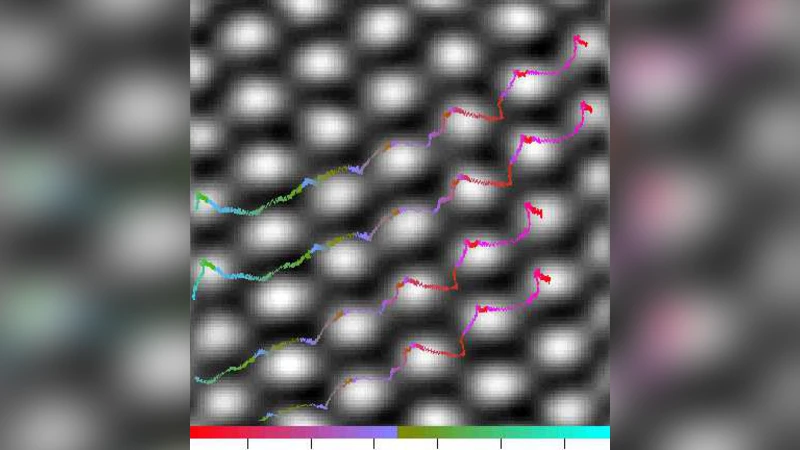
We investigated vortex dynamics in a single-crystal sample of type-II superconductor NbSe${2}$ using scanning tunneling microscopy at 4.2 K. The decay of the magnetic field at a few nT/s in our superconducting magnet induced the corresponding motion of vortices at a few pm/s. Starting with an initial magnetic field of 0.5 T, we continued to observe motion of vortices within a field of view of 400$\times$400 nm$^2$ subject to decay of the magnetic field over a week. Vortices moved collectively, and maintained triangular lattices due to strong vortex-vortex interactions during the motion. However, we observed two peculiar characteristics of vortex dynamics in this superconductor. First, the speed and direction of the vortex lattice motion were not uniform in time. Second, despite the non-uniform motion, we also found that there exists an energetically favored configuration of the moving vortices in the single-crystal sample of NbSe${2}$ based on the overlaid trajectories and their suppressed speeds. We model the system with weak bulk pinning, strong bulk pinning, and edge barrier effects.
💡 Research Summary
The authors present a meticulous study of vortex dynamics in a high‑quality single‑crystal of the type‑II superconductor NbSe₂, performed with a scanning tunneling microscope (STM) at 4.2 K. By allowing the magnetic field of their superconducting magnet to decay naturally at a rate of only a few nanotesla per second, they induced an extremely slow drift of the Abrikosov vortex lattice—on the order of a few picometers per second. Starting from an initial field of 0.5 T, the experiment tracked the same 400 × 400 nm² field of view continuously for about one week, thereby capturing the long‑term evolution of the vortex positions with sub‑nanometer precision.
The key observations are twofold. First, although the vortices move collectively and preserve their triangular lattice arrangement (evidence of strong vortex‑vortex repulsion outweighing pinning forces), the overall velocity vector of the lattice is not constant. The speed fluctuates over time, and the direction of motion occasionally reverses or rotates, indicating that the driving force supplied by the slowly decreasing external field is modulated by internal inhomogeneities. Second, when the individual trajectories are superimposed, distinct regions appear where the vortex motion is markedly slowed or even temporarily halted. These “slow‑down zones” correspond to energetically favored configurations of the lattice, suggesting the presence of weak but spatially varying bulk pinning potentials that create local energy minima.
To interpret these findings, the authors construct three complementary theoretical frameworks. (i) Weak bulk pinning: Vortices experience only modest pinning from point defects or subtle lattice distortions; their motion is dominated by thermal creep and the gradual reduction of the applied field. In this regime, collective elasticity maintains the lattice, but local minima in the pinning landscape can trap vortices, producing the observed slow‑down zones. (ii) Strong bulk pinning: More pronounced defects generate deep pinning wells that immobilize vortices unless the external driving force exceeds a threshold. This model accounts for occasional periods of near‑stagnation observed in the data. (iii) Edge‑barrier effects: Near the sample boundary or the edge of the STM scan window, Meissner currents generate a surface barrier that resists vortex entry and exit. When the lattice approaches this barrier, the velocity drops sharply and the direction may change, reproducing the non‑uniform temporal behavior.
Numerical simulations based on time‑dependent Ginzburg‑Landau equations incorporate these ingredients. By imposing a uniform field decay, adding a spatially random weak pinning potential, and enforcing realistic boundary conditions that mimic the edge barrier, the simulations reproduce the experimentally measured velocity fluctuations and the formation of localized slow‑down regions. The agreement validates the notion that even an almost defect‑free crystal can exhibit complex vortex dynamics when the driving force is extremely weak.
The significance of the work lies in several aspects. It demonstrates, for the first time, direct real‑space imaging of vortex motion at picometer‑per‑second speeds, pushing the temporal resolution of STM‑based vortex studies into a regime previously accessible only through indirect transport measurements. The preservation of the triangular lattice despite non‑uniform motion underscores the dominance of vortex‑vortex interactions, while the detection of energetically favored lattice configurations reveals that subtle bulk pinning still plays a decisive role. Moreover, the identification of edge‑barrier contributions at such low velocities highlights the importance of sample geometry and surface currents in long‑term vortex stability.
From an application perspective, the findings are relevant to vortex‑based superconducting devices, such as fluxonic memory elements or ultra‑sensitive magnetic sensors, where controlled, slow vortex motion is desirable. Understanding how weak pinning landscapes and edge barriers modulate vortex drift enables engineers to design materials and device architectures that either suppress unwanted creep (for stable memory) or facilitate controlled vortex transport (for logic operations). Future work may explore intentional patterning of pinning sites, tailoring of edge geometries, or the use of layered heterostructures to fine‑tune the balance between collective elasticity and localized pinning, thereby achieving deterministic control over vortex trajectories even in the picometer‑per‑second regime.
Comments & Academic Discussion
Loading comments...
Leave a Comment