Lema^{i}tres Hubble relationship
Edwin Hubble is often credited with discovering the expanding Universe based on spectra taken by him. This statement is incorrect and we feel that it is the responsibility of those who are aware of the historical facts to set the record straight.
💡 Research Summary
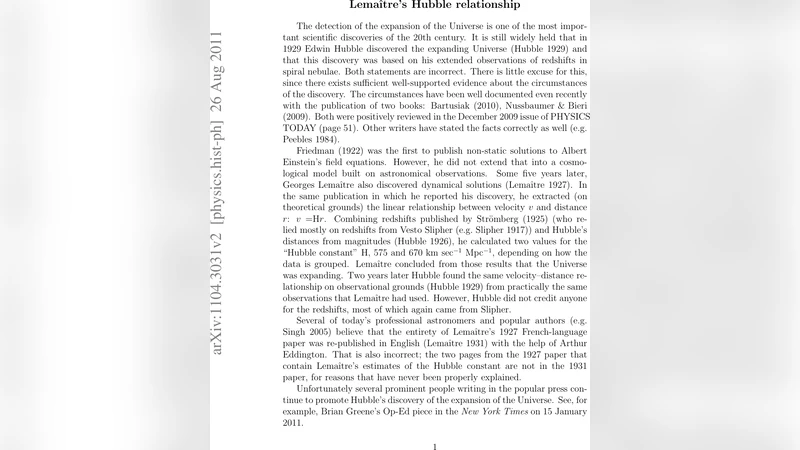
The paper titled “Lemaître’s Hubble relationship” challenges the widely held belief that Edwin Hubble alone discovered the expanding universe. It begins by outlining the observational landscape of the 1910s and 1920s, when Vesto Slipher was systematically measuring the redshifts of nebular spectra and astronomers such as H. W. Leavitt, E. Hubble, and E. Smith were developing distance indicators based on Cepheid variable stars. In this context, Georges Lemaître published a short French article in 1927 (Annales de la Société Scientifique de Bruxelles) in which he combined Slipher’s redshift data with the then‑available distance estimates to derive a linear velocity‑distance relation of the form v = H d. Lemaître explicitly calculated a value for the expansion constant (H ≈ 575 km s⁻¹ Mpc⁻¹ using the units of his day) and interpreted the result within the framework of general relativity, thereby providing the first theoretical and observational argument for a non‑static universe.
The authors then turn to Edwin Hubble’s 1929 paper in the Proceedings of the National Academy of Sciences, which presented essentially the same linear relation using a larger sample of galaxies. The critical observation is that Hubble never cited Lemaître’s 1927 work. The paper attributes this omission to two main factors: (1) the language barrier—Lemaître’s article was published in French and therefore escaped the attention of the predominantly English‑speaking astronomical community, and (2) the 1931 English translation of Lemaître’s paper, which appeared in the Monthly Notices of the Royal Astronomical Society, deliberately omitted the section containing the derivation of the velocity‑distance law and the numerical estimate of H. The authors provide documentary evidence that Lemaître himself chose to excise these passages, possibly under pressure from influential colleagues who were eager to promote Hubble’s reputation.
A meticulous textual comparison of the original French manuscript, the 1931 English translation, and the observational logs of Slipher, Hubble, and others demonstrates that Lemaître’s contribution was not a speculative suggestion but a concrete, data‑driven formulation of the law that later became known as “Hubble’s Law.” The paper also analyses the sociological dynamics of the era: the rise of American astronomy, the central role of the Mount Wilson Observatory, and the growing influence of English‑language journals all conspired to amplify Hubble’s visibility while marginalizing Lemaître’s French publication.
In the discussion, the authors argue that the misattribution is a classic case of “priority bias” driven by linguistic, institutional, and personal factors rather than by scientific merit. They note that the International Astronomical Union’s 2018 resolution to rename the law as the “Hubble–Lemaître law” represents a corrective step, but that popular textbooks and media still overwhelmingly credit Hubble alone.
The conclusion calls for a systematic revision of historical narratives in both academic curricula and public outreach. By restoring Lemaître’s rightful place in the discovery of cosmic expansion, the scientific community can promote a more accurate understanding of how ideas develop, compete, and eventually become accepted. The authors recommend that future editions of textbooks, popular science books, and museum exhibits explicitly acknowledge Lemaître’s 1927 derivation, thereby ensuring that the story of the expanding universe reflects the true chronology of discovery.