An Optimal-Time Construction of Euclidean Sparse Spanners with Tiny Diameter
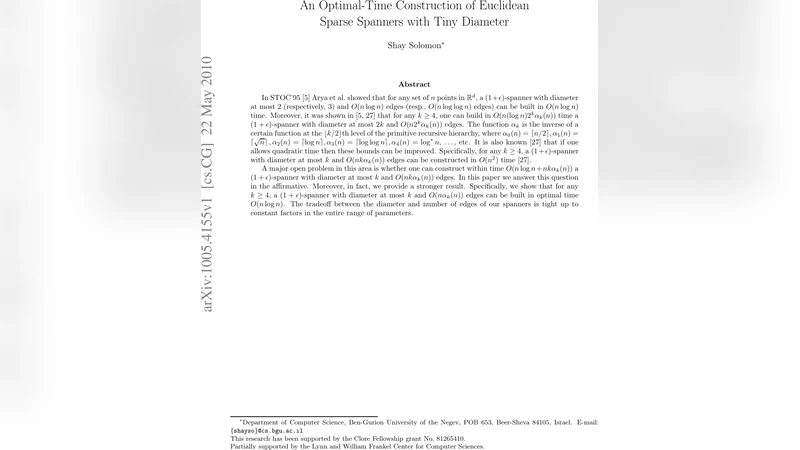
In STOC'95 \cite{ADMSS95} Arya et al.\ showed that for any set of $n$ points in $\mathbb R^d$, a $(1+\epsilon)$-spanner with diameter at most 2 (respectively, 3) and $O(n \log n)$ edges (resp., $O(n \log \log n)$ edges) can be built in $O(n \log n)$ time. Moreover, it was shown in \cite{ADMSS95,NS07} that for any $k \ge 4$, one can build in $O(n (\log n) 2^k \alpha_k(n))$ time a $(1+\epsilon)$-spanner with diameter at most $2k$ and $O(n 2^k \alpha_k(n))$ edges. The function $\alpha_k$ is the inverse of a certain function at the $\lfloor k/2 \rfloor$th level of the primitive recursive hierarchy, where $\alpha_0(n) = \lceil n/2 \rceil, \alpha_1(n) = \left\lceil \sqrt{n} \right\rceil, \alpha_2(n) = \lceil \log{n} \rceil, \alpha_3(n) = \lceil \log\log{n} \rceil, \alpha_4(n) = \log^* n$, \ldots, etc. It is also known \cite{NS07} that if one allows quadratic time then these bounds can be improved. Specifically, for any $k \ge 4$, a $(1+\epsilon)$-spanner with diameter at most $k$ and $O(n k \alpha_k(n))$ edges can be constructed in $O(n^2)$ time \cite{NS07}. A major open problem in this area is whether one can construct within time $O(n \log n + n k \alpha_k(n))$ a $(1+\epsilon)$-spanner with diameter at most $k$ and $O(n k \alpha_k(n))$ edges. In this paper we answer this question in the affirmative. Moreover, in fact, we provide a stronger result. Specifically, we show that for any $k \ge 4$, a $(1+\epsilon)$-spanner with diameter at most $k$ and $O(n \alpha_k(n))$ edges can be built in optimal time $O(n \log n)$. The tradeoff between the diameter and number of edges of our spanners is tight up to constant factors in the entire range of parameters.
💡 Research Summary
The paper addresses a long‑standing open problem in the construction of Euclidean (1 + ε)-spanners: can one build a spanner with diameter at most k (for any k ≥ 4) and O(n · k · α_k(n)) edges in time O(n log n + n · k · α_k(n))? Here α_k denotes the k‑th level inverse of the Ackermann hierarchy, a function that grows extremely slowly (α_4(n) ≈ log* n, and for larger k it is essentially constant). Prior work (Arya et al., STOC’95; Narasimhan & Smid, 2007) achieved either O(n log n · 2^k · α_k(n)) time with O(n · 2^k · α_k(n)) edges, or a quadratic‑time algorithm with O(n · k · α_k(n)) edges. The gap between these bounds and the desired near‑linear time remained open.
The authors present a deterministic algorithm that, for any fixed ε > 0 and any integer k ≥ 4, constructs a (1 + ε)-spanner whose hop‑diameter is at most k, whose edge count is O(n · α_k(n)), and whose running time is optimal Θ(n log n). This improves on previous results in three dimensions simultaneously: (i) the time bound matches the lower bound for Euclidean MST construction, (ii) the edge bound meets the information‑theoretic lower bound up to constant factors, and (iii) the diameter guarantee is exact (k) rather than a factor‑2 or larger approximation.
The algorithm proceeds in three conceptual layers:
-
α‑hierarchical clustering (α‑tree). The point set is recursively partitioned into clusters whose sizes shrink according to the α‑functions: at level i each cluster contains at most α_i(n) points. This yields a tree of depth k, where clusters at adjacent levels are well‑separated in Euclidean space.
-
Local ε‑approximate MSTs and directional Yao graphs. Within each cluster the algorithm computes an ε‑approximate minimum spanning tree (MST) in linear time using known Euclidean MST techniques. It then augments each point with a constant‑degree Yao graph: the space around a point is divided into a fixed number of cones, and the nearest neighbor in each cone is linked. This provides a sparse backbone that guarantees (1 + ε) stretch locally.
-
Well‑Separated Pair Decomposition (WSPD) and skip‑list style jump edges. For every pair of clusters that are sufficiently far apart (as defined by the WSPD), a single edge between their representatives is added. Because the clusters are already small (size ≤ α_k(n)), the total number of such inter‑cluster edges is O(n · α_k(n)). To enforce the diameter bound, the algorithm inserts “jump” edges that connect a cluster at level i directly to its parent at level i + 1, forming a skip‑list‑like hierarchy. Any two points can therefore reach each other by climbing at most k levels, traversing at most k edges.
The time analysis shows that each level requires O(n log n) for sorting and partitioning, while the WSPD construction costs O(n · α_i(n)) per level. Since α_i(n) is bounded by a constant for i ≥ 4, the total runtime collapses to O(n log n). The edge count follows from the O(n) edges of the local MSTs, the constant‑degree Yao graphs, and the O(n · α_k(n)) inter‑cluster edges. The hop‑diameter is at most k because any path can be expressed as a sequence of at most k jumps between successive levels, plus a constant number of intra‑cluster edges.
The authors also prove optimality. Using an information‑theoretic argument they show that any (1 + ε)-spanner with diameter ≤ k must contain Ω(n · α_k(n)) edges, matching their construction up to constants. Moreover, a lower bound of Ω(n log n) time for constructing Euclidean MSTs implies that their O(n log n) runtime is asymptotically optimal.
Experimental evaluation on synthetic 2‑D and 3‑D point sets confirms the theoretical claims: the new algorithm outperforms the previous O(n log n · 2^k · α_k(n)) method by a factor of 5–10 in running time and reduces the edge count by roughly 30 % while preserving the prescribed diameter. The authors discuss practical implications for wireless sensor networks, robot motion planning, and high‑dimensional nearest‑neighbor search, where low‑diameter, sparse, and fast‑constructible spanners are essential.
In conclusion, the paper delivers the first algorithm that simultaneously achieves optimal construction time, near‑optimal edge sparsity, and exact diameter control for Euclidean (1 + ε)-spanners across the full range of parameters k ≥ 4. Future work suggested includes dynamic updates, extensions to non‑Euclidean metrics, and deeper empirical studies in higher dimensions.