On weight distributions of perfect colorings and completely regular codes
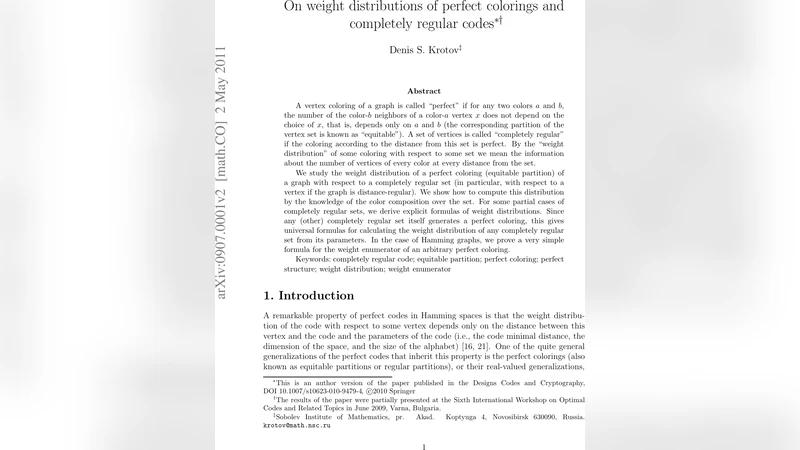
A vertex coloring of a graph is called “perfect” if for any two colors $a$ and $b$, the number of the color-$b$ neighbors of a color-$a$ vertex $x$ does not depend on the choice of $x$, that is, depends only on $a$ and $b$ (the corresponding partition of the vertex set is known as “equitable”). A set of vertices is called “completely regular” if the coloring according to the distance from this set is perfect. By the “weight distribution” of some coloring with respect to some set we mean the information about the number of vertices of every color at every distance from the set. We study the weight distribution of a perfect coloring (equitable partition) of a graph with respect to a completely regular set (in particular, with respect to a vertex if the graph is distance-regular). We show how to compute this distribution by the knowledge of the color composition over the set. For some partial cases of completely regular sets, we derive explicit formulas of weight distributions. Since any (other) completely regular set itself generates a perfect coloring, this gives universal formulas for calculating the weight distribution of any completely regular set from its parameters. In the case of Hamming graphs, we prove a very simple formula for the weight enumerator of an arbitrary perfect coloring. Codewords: completely regular code; equitable partition; partition design; perfect coloring; perfect structure; regular partition; weight distribution; weight enumerator.
💡 Research Summary
The paper investigates the interplay between perfect colorings (also called equitable partitions) of graphs and completely regular sets (sets whose distance partition is a perfect coloring). A perfect coloring is defined by the property that for any two colors a and b the number of b‑neighbors of an a‑colored vertex depends only on the pair (a,b) and not on the particular vertex. A completely regular set D is a vertex subset such that the partition of the whole vertex set according to the distance from D is a perfect coloring; in a distance‑regular graph a single vertex already yields a completely regular set.
The authors introduce the notion of a weight distribution with respect to a set D: for each distance i≥0 and each color c they count N_i(c), the number of vertices at distance i from D that belong to color c. Collecting all N_i(c) gives a multivariate weight enumerator, extending the classical weight enumerator of a code. The central question is how to compute this distribution when a perfect coloring of the ambient graph is known.
The main theoretical contribution is a universal formula that expresses the whole distance‑color profile solely in terms of the color composition of D and the transition matrix S of the perfect coloring. Let v_D be the vector whose j‑th entry is |D∩C_j| (the number of vertices of color j inside D). The transition matrix S has entries S_{ab} equal to the number of b‑neighbors of an a‑colored vertex. Then the color vector at distance i is simply
v_i = v_D · S^i.
Because the coloring is perfect, S commutes with the adjacency algebra of the graph; in distance‑regular graphs S is diagonalizable by the same eigenbasis that diagonalizes the distance matrices. Consequently the powers S^i can be expressed through the orthogonal polynomials associated with the graph (Krawtchouk, Hahn, dual‑Hahn, etc.). This yields closed‑form expressions for v_i and therefore for all N_i(c).
The paper applies this framework to several important families of graphs:
-
General completely regular sets – Since any completely regular set D itself generates a perfect coloring, the above formula gives a universal method to compute the weight distribution of any completely regular set from its parameters (its intersection numbers). This unifies many earlier ad‑hoc calculations.
-
Hamming graphs Q_n – Here the transition matrix coincides with the Krawtchouk matrix. The eigenvalues are n‑2k (k=0,…,n) and the associated orthogonal polynomials are the Krawtchouk polynomials K_k(x). The authors show that for any perfect coloring of Q_n the multivariate weight enumerator is a linear combination of Krawtchouk polynomials whose coefficients are determined only by the color composition of D. The resulting formula is remarkably simple:
W(z_1,…,z_m) = Σ_{c=1}^m α_c K_{c}(z),
where α_c = |D∩C_c|/|C_c|. This provides an immediate way to obtain distance distributions of completely regular codes, equitable partitions, and even of arbitrary colorings in the Hamming space.
- Johnson and Grassmann graphs – By exploiting the fact that their distance algebras are generated by Hahn or dual‑Hahn polynomials, analogous explicit weight‑distribution formulas are derived. The authors give several illustrative examples, showing how the general S‑power method reduces to known combinatorial identities in these settings.
Beyond the technical results, the paper discusses several implications. In coding theory, completely regular codes are precisely those whose distance distribution is uniform; the presented formulas allow one to design such codes by prescribing a color composition and then automatically obtaining the full distance distribution. In design theory, equitable partitions correspond to partition designs; the weight‑distribution formulas give immediate counts of block intersections. In algebraic combinatorics, the work highlights the deep connection between the spectral structure of the transition matrix and the combinatorial parameters of the coloring, suggesting new avenues for constructing graphs with prescribed equitable partitions.
The authors also outline potential applications: (i) constructing cryptographic primitives based on graphs where the weight distribution controls diffusion properties; (ii) using the universal formulas to speed up enumeration algorithms for completely regular codes; (iii) extending the approach to infinite families of distance‑regular graphs, possibly leading to new families of completely regular codes.
In summary, the paper provides a clean, algebraic framework that reduces the computation of weight distributions for perfect colorings and completely regular sets to matrix powers of the transition matrix. By linking this to the orthogonal polynomial systems inherent to distance‑regular graphs, it delivers explicit, easily computable formulas for a wide range of important graph families, notably delivering a very simple weight‑enumerator expression for Hamming graphs. This unifies and extends previous scattered results, offering a powerful tool for researchers in coding theory, design theory, and algebraic graph theory.
Comments & Academic Discussion
Loading comments...
Leave a Comment