Deciding first order logic properties of matroids
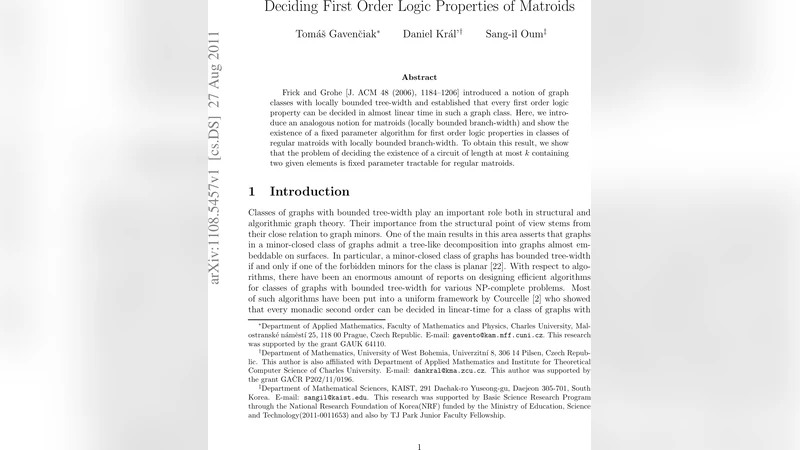
Frick and Grohe [J. ACM 48 (2006), 1184-1206] introduced a notion of graph classes with locally bounded tree-width and established that every first order logic property can be decided in almost linear time in such a graph class. Here, we introduce an analogous notion for matroids (locally bounded branch-width) and show the existence of a fixed parameter algorithm for first order logic properties in classes of regular matroids with locally bounded branch-width. To obtain this result, we show that the problem of deciding the existence of a circuit of length at most k containing two given elements is fixed parameter tractable for regular matroids.
💡 Research Summary
The paper extends the celebrated framework of Frick and Grohe, which shows that every first‑order (FO) property can be decided in almost linear time on graph classes of locally bounded tree‑width, to the realm of matroids. Since matroids lack a natural notion of vertex distance, the authors introduce a new locality concept based on circuits, defining “locally bounded branch‑width” for a class of matroids: for each element and each integer d, the sub‑matroid induced by all elements that belong to a circuit of length at most d containing the given element must have branch‑width bounded by a function f(d). They prove that if a graph class has locally bounded tree‑width, then the corresponding class of cycle‑matroids has locally bounded branch‑width, establishing the appropriateness of the definition.
The main algorithmic result is that for any class of regular matroids (those representable over every field) with locally bounded branch‑width, every FO property is fixed‑parameter tractable (FPT) when the input matroid is given by an independence oracle. The algorithm follows the paradigm of locality: an FO formula is transformed into a prenex normal form with a bounded number of quantifier alternations; each quantifier is evaluated within a “neighbourhood” defined by circuit distance. Because the neighbourhoods have bounded branch‑width, they can be decomposed efficiently, and the evaluation reduces to checking a constant‑size sub‑matroid, which can be done by brute force.
A crucial sub‑problem is deciding, for two given elements e₁ and e₂ and an integer k, whether there exists a circuit of length at most k that contains both e₁ and e₂. In general binary matroids this problem is W
Comments & Academic Discussion
Loading comments...
Leave a Comment