Thermal and mechanical denaturation properties of a DNA model with three sites per nucleotide
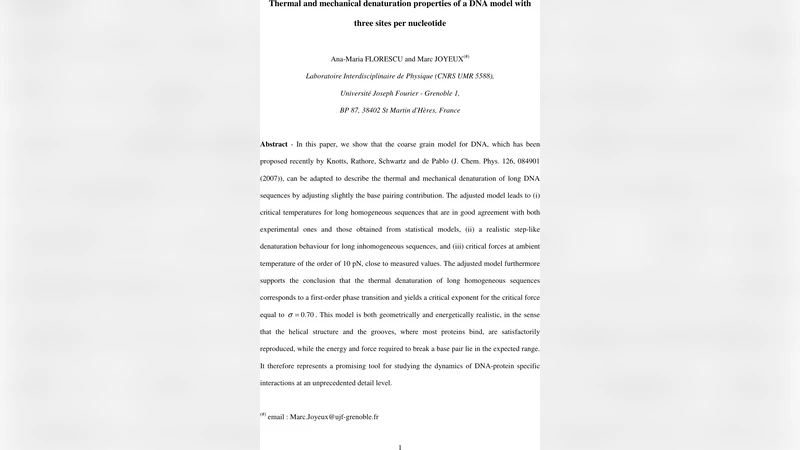
In this paper, we show that the coarse grain model for DNA, which has been proposed recently by Knotts, Rathore, Schwartz and de Pablo (J. Chem. Phys. 126, 084901 (2007)), can be adapted to describe the thermal and mechanical denaturation of long DNA sequences by adjusting slightly the base pairing contribution. The adjusted model leads to (i) critical temperatures for long homogeneous sequences that are in good agreement with both experimental ones and those obtained from statistical models, (ii) a realistic step-like denaturation behaviour for long inhomogeneous sequences, and (iii) critical forces at ambient temperature of the order of 10 pN, close to measured values. The adjusted model furthermore supports the conclusion that the thermal denaturation of long homogeneous sequences corresponds to a first-order phase transition and yields a critical exponent for the critical force equal to sigma=0.70. This model is both geometrically and energetically realistic, in the sense that the helical structure and the grooves, where most proteins bind, are satisfactorily reproduced, while the energy and force required to break a base pair lie in the expected range. It therefore represents a promising tool for studying the dynamics of DNA-protein specific interactions at an unprecedented detail level.
💡 Research Summary
In this work the authors revisit the coarse‑grain DNA model introduced by Knotts, Rathore, Schwartz and de Pablo (KRSdP) in 2007, which represents each nucleotide by three interaction sites (phosphate, sugar and base). While the original model successfully reproduces several static properties of short oligonucleotides, it was not calibrated for the thermal and mechanical denaturation of long DNA sequences. The authors therefore modify the model in two essential ways. First, they restrict the base‑pairing potential (bp V) to act only between the two bases that belong to the same complementary pair, eliminating the unphysical situation where a single base could simultaneously bond to two partners. Second, they adjust the strength of the hydrogen‑bonding term for AT and GC pairs (raising AT to 3.90 kcal mol⁻¹ and GC to 4.37 kcal mol⁻¹) in order to recover realistic melting temperatures for homogeneous sequences.
Using Langevin dynamics with a time step of 10 fs and a modest friction coefficient (γ = 5 ns⁻¹), the authors simulate 480‑base‑pair strands, which they argue are sufficiently long to approximate the thermodynamic limit for the observables of interest. Thermal denaturation is probed by initializing a half‑melted configuration and monitoring the net rate of base‑pair opening versus closing as a function of temperature. The temperature at which the net rate vanishes is identified as the critical (melting) temperature. With the adjusted parameters, the model yields T_c ≈ 335 K for an A‑rich homopolymer and T_c ≈ 374 K for a G‑rich homopolymer, values that agree closely with predictions from the statistical Poland‑Scheraga‑type model (Blossey‑Carlon parameters) under 50 mM Na⁺ conditions.
The authors also examine the kinetic aspects of melting. They find that the opening/closing rates increase linearly with the temperature excess (T − T_c), consistent with a first‑order transition. However, the absolute rates are about two orders of magnitude larger than experimental measurements on short oligoribonucleotides, which they attribute to the low friction coefficient used for computational efficiency. By analyzing the three‑dimensional diffusion coefficient of a 367‑bp duplex as a function of γ, they estimate that a realistic γ would be on the order of 5 × 10¹¹ s⁻¹ (≈ 500 ns⁻¹), i.e., roughly 100 times larger than the value employed in the production runs.
Mechanical denaturation is investigated by applying a constant pulling force at ambient temperature (298 K). The model predicts a critical unzipping force of roughly 10 pN, in line with single‑molecule force‑spectroscopy experiments. Moreover, the force–temperature phase boundary follows a scaling law F_c ∝ (T_c − T)^σ with a critical exponent σ ≈ 0.70. This exponent deviates from the σ = 0.5 expected for a simple first‑order transition, indicating that the inclusion of nonlinear elastic terms and stacking interactions modifies the universality class of the transition.
Geometrically, the three‑site representation faithfully reproduces the B‑form double helix, including major and minor grooves, and the electrostatic interactions are modeled with screened Coulomb potentials using the appropriate dielectric constant of water and Debye length for 50 mM monovalent salt. Consequently, the model captures both the structural realism required for DNA‑protein interaction studies and the energetic realism needed to reproduce experimentally observed melting temperatures and unzipping forces.
In summary, by modestly retuning the base‑pairing energy and restricting the pairing potential to a single complementary partner, the authors transform the KRSdP coarse‑grain model into a quantitatively accurate tool for studying the thermal and mechanical denaturation of long DNA molecules. The model predicts first‑order melting behavior, realistic critical temperatures, and a force‑induced unzipping transition with an exponent σ ≈ 0.70. Its ability to represent the helical geometry and groove architecture while maintaining correct energetic scales makes it a promising platform for high‑resolution simulations of DNA‑protein specific interactions, including processes that involve local strand opening such as transcription initiation, replication fork progression, and protein‑mediated DNA bending.
Comments & Academic Discussion
Loading comments...
Leave a Comment