Higher categories, colimits, and the blob complex
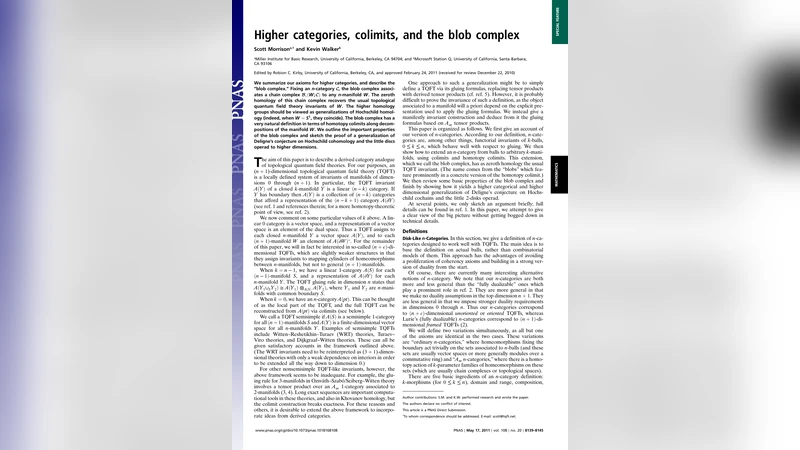
We summarize our axioms for higher categories, and describe the blob complex. Fixing an n-category C, the blob complex associates a chain complex B_*(W;C)$ to any n-manifold W. The 0-th homology of this chain complex recovers the usual topological quantum field theory invariants of W. The higher homology groups should be viewed as generalizations of Hochschild homology (indeed, when W=S^1 they coincide). The blob complex has a very natural definition in terms of homotopy colimits along decompositions of the manifold W. We outline the important properties of the blob complex, and sketch the proof of a generalization of Deligne’s conjecture on Hochschild cohomology and the little discs operad to higher dimensions.
💡 Research Summary
The paper “Higher categories, colimits, and the blob complex” by Scott Morrison and Kevin Walker develops a new framework that unifies higher‑category theory with the construction of topological quantum field theory (TQFT) invariants. The authors begin by proposing a definition of “disk‑like n‑categories” that is based directly on actual k‑balls (k‑dimensional disks) rather than on combinatorial models such as simplices or globes. For each 0 ≤ k ≤ n they assign a set (or, in the enriched case, a vector space, chain complex, or topological space) C_k(B) to every k‑ball B, together with natural boundary maps, strict gluing maps, and product/identity morphisms. Five basic axioms (morphisms, boundaries, gluing, strict associativity, product/identity) and two additional axioms (extended isotopy invariance in dimension n for ordinary n‑categories, and a homotopy‑coherent action of families of homeomorphisms for A∞‑n‑categories) guarantee that these data behave like a weak higher category while still enjoying strict associativity because the “Moore‑loop” style of using many morphisms eliminates the need for higher coherence constraints.
Having fixed such an n‑category C, the authors then explain how to extend it from balls to arbitrary k‑manifolds (k ≤ n). The key combinatorial device is a “permissible decomposition” of a manifold W into a collection of balls together with a refinement partial order. The poset D(W) of all permissible decompositions is defined, and a functor ψ_{C;W}: D(W) → Set (or Vect, ChainComplex, etc.) is constructed by taking, for each decomposition, the product over the constituent balls of the sets C_k(B) subject to the condition that boundary data agree on the glued interfaces. This product is a fibered product in the enriched setting.
The blob complex B_(W; C) is defined as the homotopy colimit of ψ_{C;W} over the poset D(W), equipped with a natural chain‑complex structure. Intuitively, one thinks of each ball as a “blob” and the homotopy colimit assembles all possible ways of gluing blobs together, keeping track of higher homotopies that arise from different refinement sequences. The 0‑th homology H_0(B_(W; C)) recovers the usual TQFT invariant associated to W (the value of the extended n‑category on the whole manifold). Higher homology groups are interpreted as higher‑dimensional analogues of Hochschild homology: when W = S^1 the blob complex reduces to the Hochschild chain complex of the underlying algebraic object, and for general W the homology measures how the local data encoded by C fail to glue strictly, providing derived‑type corrections.
The authors list several fundamental properties of the blob complex:
- Independence of decomposition – because the construction is a homotopy colimit, any two permissible decompositions give quasi‑isomorphic complexes; thus the invariant is truly topological.
- Gluing formula – if W = W_1 ∪Y W_2 along a common (n‑1)-manifold Y, then B(W; C) is quasi‑isomorphic to the derived tensor product (or A∞‑tensor product) of B_(W_1; C) and B_(W_2; C) over B_(Y; C). This generalizes the usual TQFT gluing rule to a derived setting.
- Action of homeomorphism groups – in the A∞ case, singular chains on the group of homeomorphisms fixing the boundary act on the blob complex, providing an explicit A∞‑module structure.
- Functoriality – maps of manifolds induce chain maps between blob complexes, compatible with composition and with the higher‑category structure.
Finally, the paper sketches a higher‑dimensional version of Deligne’s conjecture. The classical conjecture (now a theorem) states that the Hochschild cochain complex of an associative algebra carries an action of the little 2‑disk operad (E_2). Using the blob complex, the authors argue that for an n‑category C the cochain complex governing deformations of C carries an action of the little n‑disk operad (E_n). The proof proceeds by interpreting the operadic composition as a particular pattern of gluing blobs inside a higher‑dimensional ball, and then invoking the strict associativity and homotopy‑coherent homeomorphism actions to construct the required operadic maps. This yields a conceptual bridge between higher‑categorical TQFT data and operadic algebraic structures, suggesting that the blob complex provides a natural home for derived‑type invariants in any dimension.
In summary, Morrison and Walker introduce a robust, homotopy‑theoretic construction—the blob complex—that extends an n‑category from local ball data to global manifold invariants, recovers traditional TQFT values at degree zero, and produces higher homology groups that generalize Hochschild homology. Their framework resolves coherence issues by using strict gluing of many morphisms, accommodates derived tensor products via homotopy colimits, and connects to operadic actions, thereby opening a pathway to a derived, higher‑dimensional TQFT theory.
Comments & Academic Discussion
Loading comments...
Leave a Comment