To Switch or Not To Switch: Understanding Social Influence in Recommender Systems
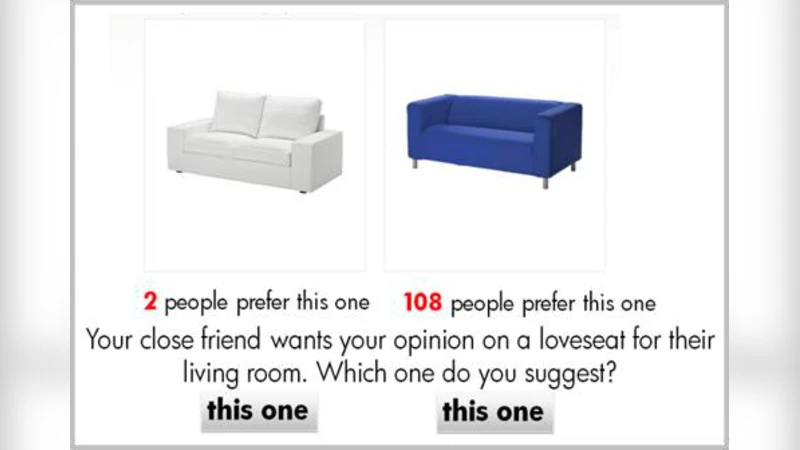
We designed and ran an experiment to test how often people’s choices are reversed by others’ recommendations when facing different levels of confirmation and conformity pressures. In our experiment participants were first asked to provide their preferences between pairs of items. They were then asked to make second choices about the same pairs with knowledge of others’ preferences. Our results show that others people’s opinions significantly sway people’s own choices. The influence is stronger when people are required to make their second decision sometime later (22.4%) than immediately (14.1%). Moreover, people are most likely to reverse their choices when facing a moderate number of opposing opinions. Finally, the time people spend making the first decision significantly predicts whether they will reverse their decisions later on, while demographics such as age and gender do not. These results have implications for consumer behavior research as well as online marketing strategies.
💡 Research Summary
The paper investigates how social influence within online recommender systems can cause users to reverse their initial choices. Drawing on two competing psychological processes—self‑confirmation (the tendency to stick with one’s original opinion) and social conformity (the tendency to align with the group)—the authors designed a controlled online experiment to quantify the relative strength of each under varying conditions.
Experimental Design
A 2 × 3 × 4 between‑subjects factorial design was employed. The first factor was item type (baby pictures vs. loveseat pictures). The second factor manipulated “confirmation pressure” through three timing conditions: (1) strong confirmation – participants made a second decision immediately after the first, (2) weak confirmation – a mean delay of 11.5 seconds was inserted before the second decision, and (3) a control condition where no social information was shown at all. The third factor varied the ratio of opposing to supporting opinions presented to participants during the second decision (2:1, 5:1, 10:1, 20:1).
Participants (N ≈ 600) were recruited via Amazon Mechanical Turk and randomly assigned to one of six condition blocks (baby‑strong, baby‑weak, baby‑control, loveseat‑strong, loveseat‑weak, loveseat‑control). In the first phase, each participant performed 23–24 pairwise comparisons, indicating which of two images they preferred. In the second phase, depending on the assigned condition, the same pairs were shown again together with aggregated “crowd” preferences that either opposed the participant’s original choice (for the strong/weak confirmation conditions) or were omitted (control). To ensure data quality, fourteen “noise” pairs and a two‑item honesty test (requiring consistent answers across swapped positions) were interleaved.
Measures and Analyses
The primary dependent variable was “reversal”: a binary indicator of whether the participant’s second choice differed from the first. Logistic regression and ANOVA were used to assess the effects of timing, opinion ratio, item type, and demographic covariates (age, gender).
Key Findings
-
Timing Effect – When the second decision was delayed (weak confirmation), 22.4 % of participants reversed their original choice, significantly higher than the 14.1 % reversal rate observed when the second decision was made immediately (strong confirmation) (p < 0.01). This suggests that memory decay weakens self‑confirmation and makes users more susceptible to social cues.
-
Opinion Ratio Effect – Reversal rates followed a non‑linear pattern across the four opposition ratios. The highest reversal occurred at the moderate 5:1 ratio; both lower (2:1) and higher (10:1, 20:1) ratios produced smaller effects. The authors interpret this as evidence that excessive majority pressure can trigger reactance, reducing conformity.
-
Decision‑Time Predictor – The amount of time participants spent on the initial choice positively predicted reversal (p < 0.05). Longer deliberation indicates weaker initial confidence, rendering users more pliable to later social information.
-
Demographic Variables – Age and gender showed no significant influence on reversal likelihood, implying that the observed social influence mechanisms operate broadly across these demographic groups.
-
Item Type – No substantial difference in reversal rates was found between baby and loveseat images, suggesting that the effects are not limited to a specific content domain.
Implications for Recommender Systems and Marketing
The findings have direct practical relevance. First, presenting peer opinions after a short delay rather than instantly may increase the persuasive power of recommendations. Second, designers should calibrate the visibility of dissenting opinions; moderate levels of opposition (e.g., showing that a minority disagrees) appear most effective, whereas overwhelming dissent may backfire. Third, tracking how long a user hesitates on an initial selection could enable adaptive interventions—e.g., prompting “See what others think?” for users who take longer, thereby leveraging their higher susceptibility to social influence.
Limitations
The study’s stimuli (baby and loveseat pictures) are emotionally charged and may not generalize to typical e‑commerce products. The participant pool is skewed toward younger, U.S.-based MTurk workers, limiting cross‑cultural applicability. Moreover, the opposing opinions were algorithmically generated rather than derived from authentic user reviews, raising questions about ecological validity when confronting real‑world “fake” or low‑trust reviews.
Conclusion
By systematically varying temporal distance and the magnitude of opposing crowd opinions, the authors quantitatively demonstrate that social influence can substantially overturn users’ prior preferences, especially when memory of the original choice is weakened and the dissent is moderate. The work bridges a gap between psychological theory and HCI practice, offering actionable guidance for the design of more persuasive recommender interfaces while also highlighting avenues for future research on diverse product categories, cultural contexts, and authentic social feedback.
Comments & Academic Discussion
Loading comments...
Leave a Comment