Rating Growth of Scientific Knowledge and Risk from Theory Bubbles
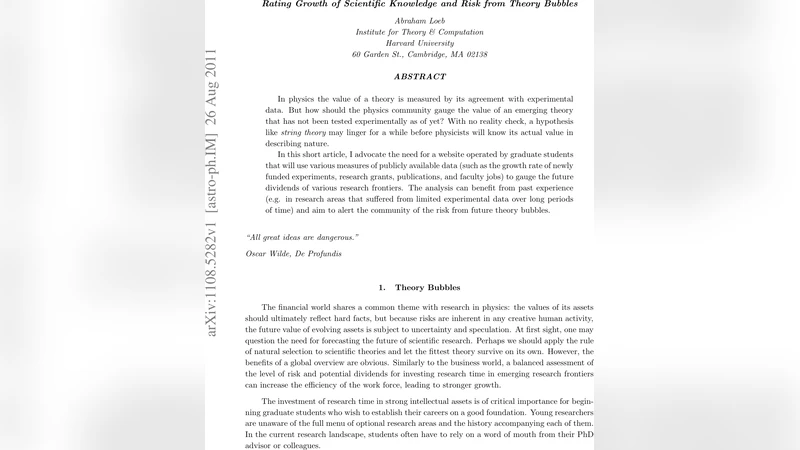
In physics the value of a theory is measured by its agreement with experimental data. But how should the physics community gauge the value of an emerging theory that has not been tested experimentally as of yet? With no reality check, a hypothesis like string theory may linger for a while before physicists will know its actual value in describing nature. In this short article, I advocate the need for a website operated by graduate students that will use various measures of publicly available data (such as the growth rate of newly funded experiments, research grants, publications, and faculty jobs) to gauge the future dividends of various research frontiers. The analysis can benefit from past experience (e.g. in research areas that suffered from limited experimental data over long periods of time) and aim to alert the community of the risk from future theory bubbles.
💡 Research Summary
The paper proposes a systematic “credit‑rating” framework for assessing the future value and risk of emerging physics research fronts, especially those lacking experimental verification such as string theory. Drawing an analogy to financial rating agencies, the author argues that the physics community needs a quantitative, transparent tool to guide graduate students and early‑career researchers in choosing research topics, and to warn the community about potential “theory bubbles” that could waste talent and funding.
The core of the proposal is a web‑based platform, ideally run by graduate students, that aggregates publicly available metrics: the amount of funding for experiments (Fexp), the size of research grants (Fgrants), the number of publications (Npubs), the number of faculty or post‑doctoral positions (Njobs), and a normalized measure of theoretical completeness (T) ranging from 0 (pure phenomenology) to 1 (a self‑contained, first‑principles theory). These five quantities form a vector ~v = (T, Fexp, Fgrants, Npubs, Njobs).
Growth of the field is modeled first as a linear dynamical system d ~v/dt = M ~v, where M is a 5 × 5 matrix with 25 coefficients that must be calibrated on historical data (e.g., the development of CMB anisotropy research from theory‑only to experimental confirmation). The eigenvectors of M represent characteristic mixes of theory, experiment, and funding; the eigenvector associated with the largest eigenvalue predicts the fastest exponential growth trajectory. A field whose current composition aligns with this optimal eigenvector would be rated highly, while a mismatch would signal a potential bubble.
To capture possible non‑linearities, the author also introduces a power‑law version d ~v/dt = M ~p, where each component of ~v is raised to an exponent (α, β, γ, δ, ε). This adds five extra parameters, allowing for diminishing or accelerating returns (e.g., saturation of publication output with increasing funding). The paper suggests further extensions: multi‑field coupling terms to model researcher migration, and a Taylor‑series extrapolation based on three or more time‑points to provide a parameter‑free forecast.
The platform would harvest data automatically from arXiv, NSF, DOE, NASA, and other repositories, updating the metrics once or twice a year. Researchers could also submit supplemental information to refine the model. Calibration would involve fitting the model to past growth curves of well‑studied sub‑fields, thereby creating a “track record” for each algorithm. The most successful algorithm would become a collective‑learning tool, reducing the chance of repeating past misallocations of talent.
The author acknowledges several sources of bias. Senior physicists who are already invested in speculative areas might influence the rating by overstating grant numbers or job openings, but they cannot fabricate experimental feasibility (Fexp) or genuine theoretical completeness (T). By placing the rating agency in the hands of graduate students—who are the primary consumers and have the least entrenched interests—the system aims to minimize such conflicts. Nonetheless, the paper stresses the need for transparent governance, external audits, and safeguards against manipulation.
Beyond individual career guidance, the rating system could inform funding agencies (NSF, DOE, NASA) about where to allocate resources for maximal scientific return. Agencies would benefit from a metric that balances risk and reward across the whole physics enterprise, while still preserving diversity and allowing for high‑risk, high‑payoff projects. The author warns, however, that over‑concentration on a few “high‑rating” fields could stifle creativity; thus, the rating should be used as one input among many in strategic planning.
In conclusion, the paper outlines a concrete, data‑driven proposal to extrapolate current trends in physics research, flag potential theory bubbles, and improve the efficiency of talent and funding distribution. While the mathematical framework (linear and non‑linear growth models, eigenvalue analysis) is clear, the practical challenges—quantifying the abstract “theory quality” T, obtaining reliable calibration data, and maintaining independence from vested interests—remain substantial. Further empirical validation, community consensus on weighting schemes, and robust institutional oversight will be essential before such a rating website can become a trusted part of the scientific ecosystem.
Comments & Academic Discussion
Loading comments...
Leave a Comment