A Set and Collection Lemma
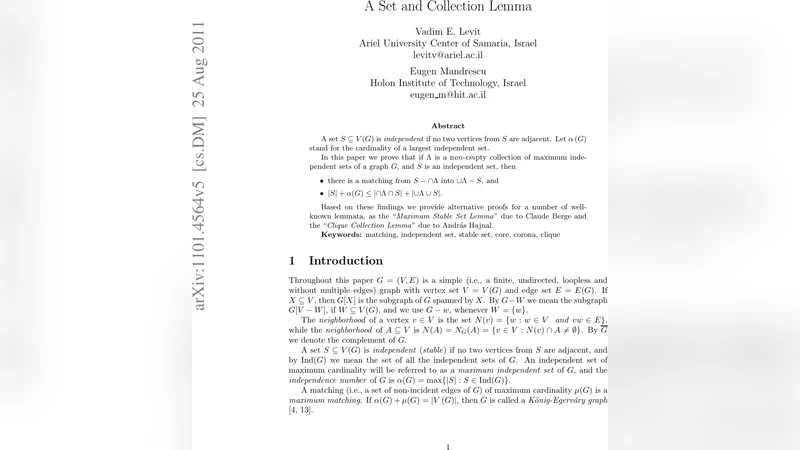
A set S is independent if no two vertices from S are adjacent. In this paper we prove that if F is a collection of maximum independent sets of a graph, then there is a matching from S-{intersection of all members of F} into {union of all members of F}-S, for every independent set S. Based on this finding we give alternative proofs for a number of well-known lemmata, as the “Maximum Stable Set Lemma” due to Claude Berge and the “Clique Collection Lemma” due to Andr'as Hajnal.
💡 Research Summary
The paper introduces a new structural result for graphs, called the “Set and Collection Lemma,” which unifies and strengthens several classic statements about independent sets, matchings, and cliques.
Let G=(V,E) be a simple graph, α(G) its independence number, and Ω(G) the family of all maximum independent sets. The authors define core(G)=∩Ω(G) and corona(G)=∪Ω(G). For any non‑empty subfamily Λ⊆Ω(G) and any independent set S⊆V, they prove two main facts:
-
Matching Lemma – There exists a matching that pairs every vertex of S that is not in the common core of Λ (i.e., S∖∩Λ) with a distinct vertex outside S but inside the union of Λ (i.e., ∪Λ∖S). The proof uses Hall’s marriage theorem; a minimal counter‑example leads to a contradiction because it would create an independent set larger than a maximum one. From this they also obtain matchings from S∖X to X∖S for any X∈Λ and from (S∩X)∖∩Λ to ∪Λ∖(X∪S).
-
Set and Collection Lemma – From the matching above they derive the inequality
\
Comments & Academic Discussion
Loading comments...
Leave a Comment