The positive real lemma and construction of all realizations of generalized positive rational functions
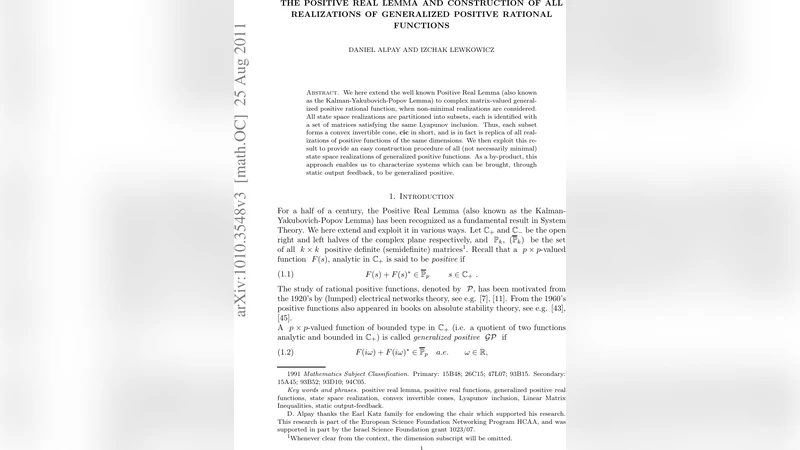
We here extend the well known Positive Real Lemma (also known as the Kalman-Yakubovich-Popov Lemma) to complex matrix-valued generalized positive rational function, when non-minimal realizations are considered. We then exploit this result to provide an easy construction procedure of all (not necessarily minimal) state space realizations of generalized positive functions. As a by-product, we partition all state space realizations into subsets: Each is identified with a set of matrices satisfying the same Lyapunov inclusion and thus form a convex invertible cone, cic in short. Moreover, this approach enables us to characterize systems which may be brought to be generalized positive through static output feedback. The formulation through Lyapunov inclusions suggests the introduction of an equivalence class of rational functions of various dimensions associated with the same system matrix.
💡 Research Summary
The paper presents a substantial generalization of the classical Positive Real Lemma (PRL), also known as the Kalman‑Yakubovich‑Popov Lemma, by extending its scope to complex matrix‑valued generalized‑positive (GP) rational functions and by allowing non‑minimal state‑space realizations. In the traditional setting, PRL asserts that a rational transfer matrix is positive real if and only if there exists a positive‑definite solution to a Lyapunov equation associated with a minimal realization. The authors replace the equality with a Lyapunov inclusion (i.e., a matrix inequality) and drop the minimality requirement, thereby covering a much broader class of systems.
Generalized‑positive functions and Lyapunov inclusions
A GP rational function (F(s)) satisfies (\Re{F(j\omega)}\ge0) for all frequencies where it is defined, but it may have poles on the imaginary axis and need not be strictly proper. For any state‑space representation ((A,B,C,D)) of such a function, the authors prove that there exists a Hermitian positive‑semidefinite matrix (X) such that
\
Comments & Academic Discussion
Loading comments...
Leave a Comment