(Non-)Koszulness of operads for n-ary algebras, galgalim and other curiosities
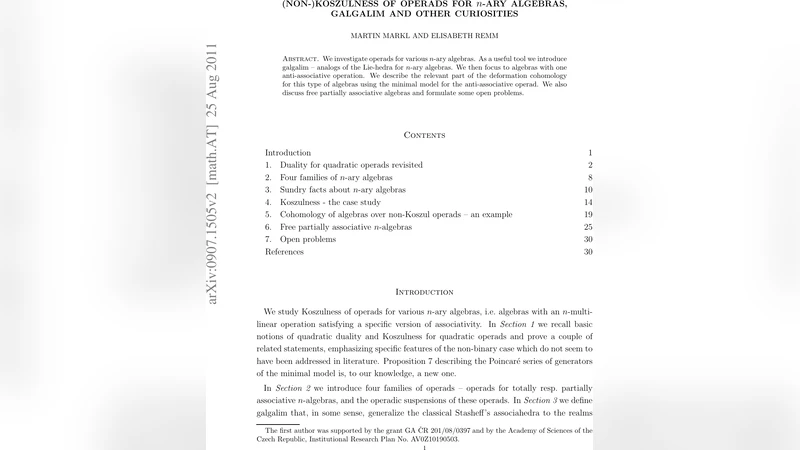
We investigate operads for various n-ary algebras. As a useful tool we introduce galgalim - analogs of the Lie-hedra for n-ary algebras. We then focus to algebras with one anti-associative operation. We describe the relevant part of the deformation cohomology for this type of algebras using the minimal model for the anti-associative operad. We also discuss free partially associative algebras and formulate some open problems.
💡 Research Summary
The paper investigates the Koszul property of operads governing various n‑ary algebraic structures and introduces a new combinatorial polytope, called galgalim, to visualize and manage the higher‑order relations that appear in these operads. After a concise review of operads, Koszul duality, and the classical results for binary (2‑ary) operads, the authors extend the discussion to n‑ary cases, emphasizing that the combinatorial complexity grows dramatically with the arity. To handle this, they construct galgalim, an n‑ary analogue of the Lie‑hedra. In galgalim each vertex corresponds to a particular bracketing of an n‑ary product, and edges encode elementary re‑bracketing moves (associativity‑type permutations). Higher‑dimensional faces represent higher homotopies among these moves, and the cellular chain complex of galgalim reproduces the quadratic relations of the operad. This geometric viewpoint makes it possible to read off the Koszul complex directly from the cell structure and to detect obstructions to Koszulness.
The core of the paper focuses on algebras equipped with a single anti‑associative operation, i.e. an operation µ satisfying (µ(a,b),c)=−µ(a,µ(b,c)). The corresponding operad, denoted As⁻, is shown to be non‑Koszul. The authors construct the minimal model of As⁻ by first forming a free cooperad generated by a degree‑1 element representing the anti‑associative relation and then defining a differential that encodes the relation (ab)c+ a(bc)=0. They compute the first few terms of the minimal model explicitly, obtaining generators in arities 2, 3 and 4 and a differential that reflects the sign‑twisted associativity. Using this model they derive the deformation cohomology of an anti‑associative algebra: the second cohomology group classifies infinitesimal deformations of the operation, while the third group controls the obstructions. Notably, the third cohomology does not vanish, confirming the failure of the operad to be Koszul. The paper also compares this cohomology with the classical Hochschild cohomology of associative algebras, highlighting the appearance of “higher‑order” Massey‑type operations that are absent in the associative case.
In a second major section the authors turn to partially associative n‑ary algebras, where only a subset of the possible associativity relations are imposed. By selectively deleting certain faces of galgalim they obtain a cellular model for the corresponding operad. This leads to an explicit description of the free partially associative algebra on a set of generators. The authors compute its Hilbert series and show that, unlike the fully associative case, the growth is not governed by a simple rational function; instead it reflects the combinatorial complexity of the remaining galgalim faces. They prove that for even arities the operad remains Koszul, while for odd arities non‑Koszul phenomena appear, again detectable via the cellular model.
The paper concludes with a list of open problems: (1) determining whether a full Koszul duality theory can be developed for general n‑ary anti‑associative operads; (2) extending galgalim to a full operadic “polytope” that captures all higher homotopies for arbitrary n; (3) obtaining closed formulas for the Hilbert series of free partially associative algebras in the general case; and (4) exploring connections between the deformation cohomology computed here and L∞‑algebra structures arising in mathematical physics. Overall, the work provides new tools (galgalim) and concrete calculations that deepen our understanding of the homological behavior of n‑ary operads, especially those that deviate from the classical Koszul paradigm.
Comments & Academic Discussion
Loading comments...
Leave a Comment