A Classification Framework for Web Browser Cross-Context Communication
Demand for more advanced Web applications is the driving force behind Web browser evolution. Recent requirements for Rich Internet Applications, such as mashing-up data and background processing, are emphasizing the need for building and executing Web applications as a coordination of browser execution contexts. Since development of such Web applications depends on cross-context communication, many browser primitives and client-side frameworks have been developed to support this communication. In this paper we present a systematization of cross-context communication systems for Web browsers. Based on an analysis of previous research, requirements for modern Web applications and existing systems, we extract a framework for classifying cross-context communica-tion systems. Using the framework, we evaluate the current ecosystem of cross-context communication and outline directions for future Web research and engineering.
💡 Research Summary
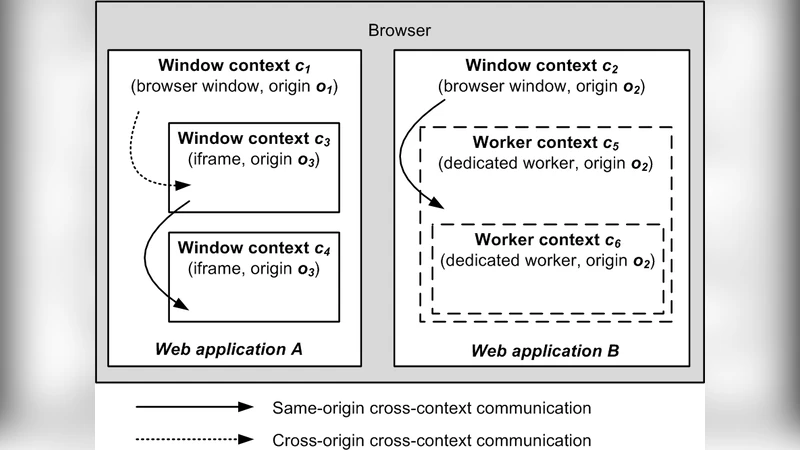
The paper presents a systematic classification of cross‑context communication mechanisms in modern web browsers, motivated by the increasing complexity of Rich Internet Applications (RIAs), mash‑ups, widget‑based portals, and the recent introduction of Web Workers. These applications consist of multiple semi‑isolated execution contexts—window contexts (including top‑level windows, iframes, and frames) and worker contexts (dedicated or shared). Communication between these contexts is essential for functionality such as data sharing between widgets or off‑loading computation to background workers.
Historically, the Same‑Origin Policy (SOP) has severely limited cross‑origin communication, forcing developers to misuse insecure primitives like cookies, URL fragments, or frame redirection. With the advent of HTML5, browsers introduced native, secure primitives: postMessage, MessageChannel, Web Storage, IndexedDB, and Web SQL. Simultaneously, a variety of client‑side libraries (e.g., easyXDM, postRobot, CrossDomainMessaging) were built on top of both standardized and legacy APIs to provide broader compatibility and higher‑level abstractions.
Existing research has largely focused on the security aspects of these primitives, leaving other important dimensions—reliability, discovery, high‑level communication models, performance, and cross‑browser support—under‑explored. To fill this gap, the authors propose a multi‑dimensional classification framework consisting of eight criteria:
- Security – origin verification, access‑control policies, and confidentiality guarantees.
- Reliability – message ordering, loss detection, retransmission, and delivery acknowledgments.
- Discovery – mechanisms for dynamically locating and establishing connections between contexts.
- High‑Level Model – support for publish/subscribe, RPC, streaming, or other abstract communication patterns beyond raw string/JSON exchange.
- Performance – latency, throughput, and resource consumption.
- Supported Platforms – browser coverage, version requirements, and fallback strategies for legacy environments.
- API Complexity – ease of use, required boilerplate, and learning curve for developers.
- Extensibility – ability to integrate new transports, protocols, or security extensions.
Applying this framework to a representative set of existing systems, the authors find that most solutions excel only in the security dimension and basic payload transmission. Reliability features such as guaranteed ordering or automatic retries are rarely provided, and discovery mechanisms are almost nonexistent. High‑level abstractions (publish/subscribe, RPC) are offered by only a few libraries, while native worker‑to‑worker communication remains limited by the current standard APIs. Moreover, cross‑browser compatibility often relies on polyfills or legacy fallbacks, increasing development overhead.
The paper concludes with a roadmap for future research and engineering efforts:
- Secure, developer‑friendly APIs that embed origin checks and permission handling within the browser, reducing the burden on application code.
- Dynamic discovery protocols enabling contexts to locate each other automatically, especially in environments with many nested iframes or workers.
- Standardized reliability layer (ACK/NACK, sequencing, retransmission) that can be optionally layered on top of existing primitives.
- Unified communication model that treats window, iframe, and worker contexts uniformly, supporting both synchronous RPC‑style calls and asynchronous publish/subscribe streams.
- Comprehensive cross‑browser test suites and compatibility specifications to ensure consistent behavior across browsers and versions.
By addressing these gaps, the web engineering community can build robust, secure, and high‑performance multi‑context applications that fully exploit the capabilities of modern browsers.
Comments & Academic Discussion
Loading comments...
Leave a Comment