Spectral properties of correlation functions of fields with arbitrary position dependence in restricted geometries from the ballistic to the diffusive regimes
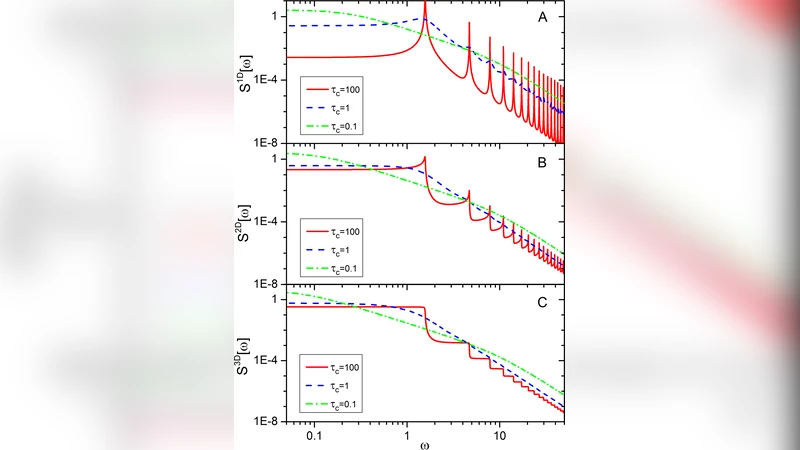
The transition between ballistic and diffusive motion poses difficult problems in several fields of physics. In this work we show how to calculate the spectra of the correlation functions between fields of arbitrary spatial dependence as seen by particles moving through the fields in regions bounded by specularly reflecting walls valid for diffusive and ballistic motion as well as the transition region in between for motion in 2 and 3 dimensions. Applications to relaxation in nmr are discussed.
💡 Research Summary
The paper addresses the long‑standing problem of determining the spectral properties of correlation functions for fields with arbitrary spatial dependence when particles move inside a confined geometry bounded by perfectly reflecting walls. The authors consider particles that travel at a fixed speed v and undergo isotropic scattering events separated by exponentially distributed free‑flight times with mean τc, i.e., a persistent continuous‑time random walk (CTRW). This model interpolates smoothly between the ballistic regime (τc → ∞) and the diffusive regime (τc → 0), thereby covering the full crossover region.
In one dimension the conditional probability p(x,t|x0,0) satisfies the telegrapher’s equation. Using the solution obtained by Goldstein and later refined by Masoliver, Porrà and Weiss, the authors write p as a sum over normal modes n with wave numbers kn = nπ/L, where L is the box length. The time dependence involves hyperbolic functions of sn = √(1−4ωn²τc²) with ωn = kn v. This exact solution captures the initial delta‑function peak of unscattered particles, the subsequent wake of scattered particles, and the effect of multiple wall reflections.
The field‑field correlation function R12(τ)=⟨B1(t)B2(t+τ)⟩ is expressed as an integral over the product of the two spatial field profiles and the conditional probability. Fourier transforming yields a discrete sum over modes: S12(ω)=∑n F1(kn)F2(kn)·
Comments & Academic Discussion
Loading comments...
Leave a Comment