Twin Towers of Hanoi
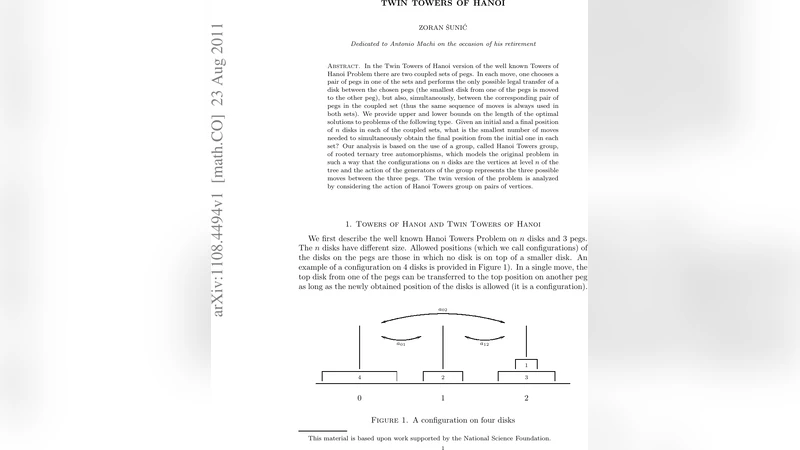
In the Twin Towers of Hanoi version of the well known Towers of Hanoi Problem there are two coupled sets of pegs. In each move, one chooses a pair of pegs in one of the sets and performs the only possible legal transfer of a disk between the chosen pegs (the smallest disk from one of the pegs is moved to the other peg), but also, simultaneously, between the corresponding pair of pegs in the coupled set (thus the same sequence of moves is always used in both sets). We provide upper and lower bounds on the length of the optimal solutions to problems of the following type. Given an initial and a final position of N disks in each of the coupled sets, what is the smallest number of moves needed to simultaneously obtain the final position from the initial one in each set? Our analysis is based on the use of a group, called Hanoi Towers group, of rooted ternary tree automorphisms, which models the original problem in such a way that the configurations on N disks are the vertices at level N of the tree and the action of the generators of the group represents the three possible moves between the three pegs. The twin version of the problem is analyzed by considering the action of Hanoi Towers group on pairs of vertices.
💡 Research Summary
The paper introduces a novel variant of the classic Towers of Hanoi puzzle called the Twin Towers of Hanoi. In this setting two identical three‑peg towers (referred to as the top and bottom sets) are coupled so that a single move consists of selecting a pair of pegs (i, j) and performing the unique legal transfer of the smallest disk between those pegs in both towers simultaneously. The authors formalize the problem using the Hanoi Towers group H, a group of automorphisms of the rooted ternary tree X* = {0,1,2}. A configuration of N disks corresponds to a word of length N over the alphabet {0,1,2}, where the k‑th letter indicates the peg of the k‑th (size‑k) disk. The three generators a₀₁, a₀₂, a₁₂ (renamed a, b, c) act on X by swapping the first occurrence of the two involved symbols; this exactly reproduces the legal move in the classical puzzle. The Schreier graph Γₙ of H on the level‑N vertices is the well‑known Hanoi graph, whose diameter is 2ⁿ − 1 and whose unique shortest paths between the three “corner” configurations (all disks on peg 0, 1 or 2) are given by explicit alternating words in a, b, c.
For the twin version the authors consider the product graph CΓₙ whose vertices are ordered pairs (u_T, u_B) of words of length N, representing the top and bottom configurations. An edge labeled by s∈{a,b,c} connects (u_T, u_B) to (s·u_T, s·u_B). Three concrete decision problems are studied:
- Twin Towers Switch (TTS) – move all disks from peg 0 to peg 2 in the top tower while simultaneously moving all disks from peg 2 to peg 0 in the bottom tower.
- Small Disk Shift (SDS) – starting from a specific coupled configuration (Figure 2 in the paper), shift only the smallest disk in each tower one peg to the right (0→1 in the top, 1→2 in the bottom).
- General Problem (GP) – given any initial and final coupled configurations, determine the minimal number of simultaneous moves.
The main results are:
- Theorem TTS provides an explicit upper bound a(n) for the Switch problem: \
Comments & Academic Discussion
Loading comments...
Leave a Comment