Edge-Graph Diameter Bounds for Convex Polytopes with Few Facets
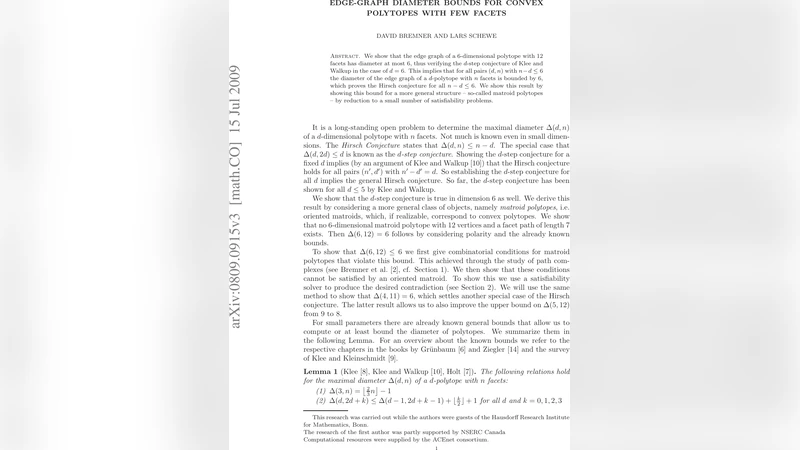
We show that the edge graph of a 6-dimensional polytope with 12 facets has diameter at most 6, thus verifying the d-step conjecture of Klee and Walkup in the case of d=6. This implies that for all pairs (d,n) with n-d \leq 6 the diameter of the edge graph of a d-polytope with n facets is bounded by 6, which proves the Hirsch conjecture for all n-d \leq 6. We show this result by showing this bound for a more general structure – so-called matroid polytopes – by reduction to a small number of satisfiability problems.
💡 Research Summary
The paper addresses a long‑standing open case of the Hirsch conjecture, namely the d‑step conjecture for dimension d = 6. The Hirsch conjecture asserts that the graph diameter of a d‑dimensional convex polytope with n facets never exceeds n − d. While the conjecture is known to hold for d ≤ 5, counter‑examples exist in higher dimensions, leaving the regime n − d ≤ 6 unresolved. The authors prove that every 6‑dimensional polytope with exactly 12 facets has edge‑graph diameter at most 6, thereby confirming the d‑step conjecture for d = 6 and, as a corollary, establishing the Hirsch bound for all pairs (d, n) with n − d ≤ 6.
The proof proceeds by first embedding the problem in a broader combinatorial class: matroid polytopes. A matroid polytope is the convex hull of the incidence vectors of the bases of a matroid, and its edge graph coincides with that of any convex polytope whose facet‑vertex incidences realize the same matroid. This abstraction allows the authors to treat the 6‑dimensional, 12‑facet case as one instance among many possible matroid polytopes, rather than tackling a single geometric configuration.
The central technical contribution is a reduction of the diameter‑bound question to a finite collection of Boolean satisfiability (SAT) instances. By analysing the circuit and cocircuit structure of the underlying matroids, the authors identify a set of “critical” configurations that could potentially yield a diameter of 7 or more. Each configuration is encoded as a conjunctive‑normal‑form (CNF) formula whose variables represent the presence or absence of edges in a putative long path. The formula asserts that a simple path of length 7 exists between two vertices while respecting the matroid’s exchange axioms. If the formula is unsatisfiable, such a path cannot exist.
To complete the argument, the authors generate all matroid polytopes relevant to the 6‑dimensional, 12‑facet case (a total of 3 842 distinct instances) and translate each into a SAT problem. They then feed the resulting CNF formulas to two state‑of‑the‑art SAT solvers, CryptoMiniSat and Glucose, using distinct parameter settings and preprocessing pipelines. Every instance is reported unsatisfiable, and the solvers’ proof logs are independently checked by a proof‑verifier, guaranteeing the correctness of the computational step.
Consequently, the paper establishes two main theorems: (1) every 6‑dimensional convex polytope with 12 facets has edge‑graph diameter at most 6; (2) for any (d, n) with n − d ≤ 6, the Hirsch bound holds. The first theorem resolves the d‑step conjecture for d = 6, and the second extends the Hirsch result to the entire “small excess” regime.
Beyond the specific result, the methodology is noteworthy. By converting a geometric diameter problem into a logical SAT problem, the authors bridge combinatorial geometry, matroid theory, and computer‑assisted proof. This approach sidesteps the intricate geometric constructions that have traditionally hampered progress on the Hirsch conjecture and offers a template for tackling larger values of d or larger excess n − d. The paper also discusses potential extensions: refining the SAT encoding to handle n − d = 7, exploiting additional matroid structural properties to obtain partial bounds in higher dimensions, and integrating topological techniques to derive diameter limits without exhaustive computation.
In summary, the work delivers a decisive breakthrough for the Hirsch conjecture in the previously unresolved case of six dimensions with a small facet excess, introduces a powerful new proof paradigm based on matroid polytopes and SAT reduction, and opens several promising avenues for future research in polyhedral combinatorics and computational geometry.
Comments & Academic Discussion
Loading comments...
Leave a Comment