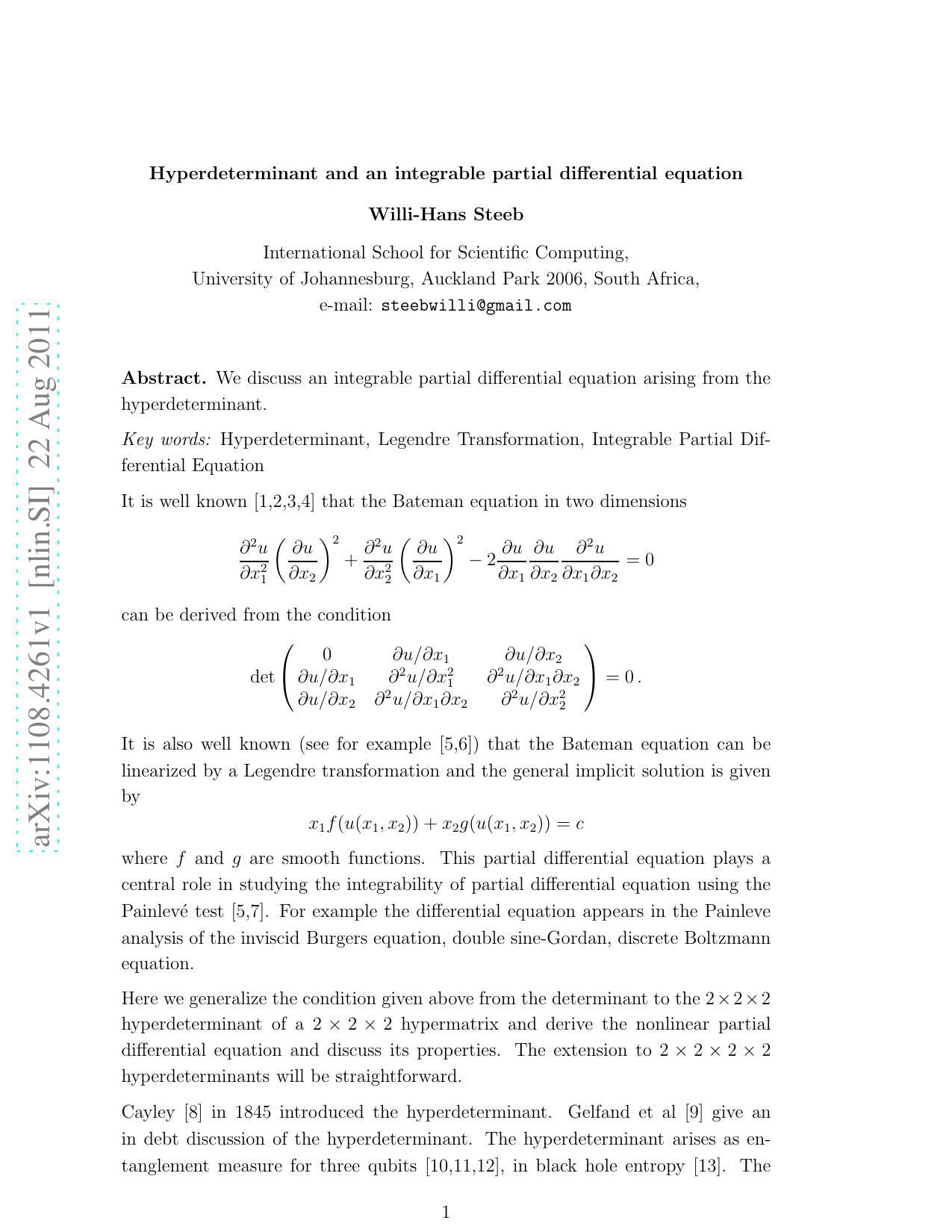
We discuss an integrable partial differential equation arising from the hyperdeterminant.
Deep Dive into Hyperdeterminant and an integrable partial differential equation.
We discuss an integrable partial differential equation arising from the hyperdeterminant.
It is also well known (see for example [5,6]) that the Bateman equation can be linearized by a Legendre transformation and the general implicit solution is given by
where f and g are smooth functions. This partial differential equation plays a central role in studying the integrability of partial differential equation using the Painlevé test [5,7]. For example the differential equation appears in the Painleve analysis of the inviscid Burgers equation, double sine-Gordan, discrete Boltzmann equation.
Here we generalize the condition given above from the determinant to the 2 × 2 × 2 hyperdeterminant of a 2 × 2 × 2 hypermatrix and derive the nonlinear partial differential equation and discuss its properties. The extension to 2 × 2 × 2 × 2 hyperdeterminants will be straightforward.
Cayley [8] in 1845 introduced the hyperdeterminant. Gelfand et al [9] give an in debt discussion of the hyperdeterminant. The hyperdeterminant arises as entanglement measure for three qubits [10,11,12], in black hole entropy [13]. The Nambu-Goto action in string theory can be expressed in terms of the hyperdeterminant [14]. A computer algebra program for the hyperdeterminant is given by Steeb and Hardy [11] Let ǫ 00 = ǫ 11 = 0, ǫ 01 = 1, ǫ 10 = -1, i.e. we consider the 2 × 2 matrix
Then the determinant of a 2 × 2 matrix A 2 = (a ij ) with i, j = 0, 1 can be defined as
Thus det A 2 = a 00 a 11 -a 01 a 10 . In analogy the hyperdeterminant of the 2 × 2 × 2 array A 3 = (a ijk ) with i, j, k = 0, 1 is defined as
There are 2 If only one of the coefficients a ijk is nonzero we find that the hyperdeterminant of A 3 is 0.
Given a 2 × 2 × 2 hypermatrix A 3 = (a jkℓ ), j, k, ℓ = 0, 1 and the 2 × 2 matrix S = s 00 s 01 s 10 s 11 .
The multiplication A 3 S which is again a 2 × 2 hypermatrix is defined by
a jkr s rℓ .
If det(S) = 1, i.e. S ∈ SL(2, C), then Det(A 3 S) = Det(A 3 ).
In analogy with the Bateman equation we set
and obtain the nonlinear partial differential equation
The partial differential equation is invariant under the permutations of x 1 , x 2 , x 3 . The group of symmetries is SL(3, R). The equation can also be linearized by a Legendre transformation.
[1] Fairlie D. B., Govaerts J. and Morzov A., Universal field equations and covariant solutions, Nuclear Phys. B 373 (1992) 214-232.
[2] Fairlie D. B., Integrable systems in higher dimensions, Prog. Theor. Phys. Supp. 1995, N 118, 309-327.
[3] Derjagin V. and Leznov A., Geometrical symmetries of the universal equation, Nonlinear Mathematical Physics, 2 (1995), 46-50.
This content is AI-processed based on ArXiv data.