Algorithm for determining U(1) charges in free fermionic heterotic string models
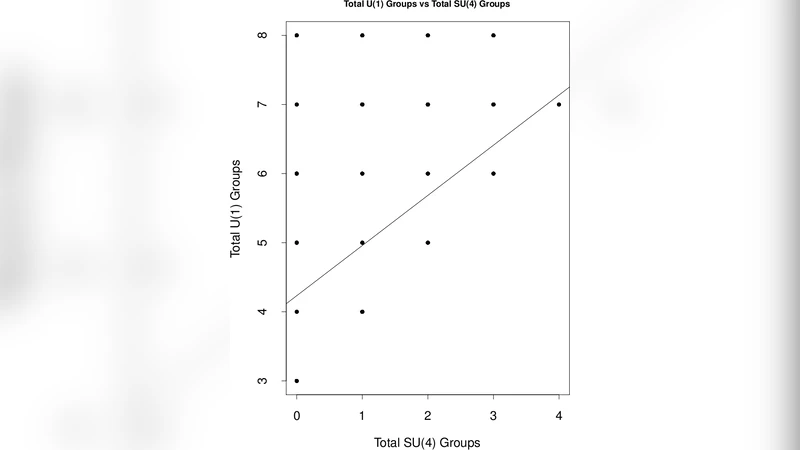
To assist in the search for phenomenologically realistic models in the string landscape, we must develop tools for investigating all gauge charges, including U(1) charges, in string models. We introduce the process for constructing fermionic string models and present an algorithm for determining the U(1) gauge states and U(1) charges in weakly-coupled free fermionic heterotic string (WCFFHS) models given their matter and non-Abelian gauge content. We determine the computational complexity of this algorithm and discuss a particular implementation that can be used in conjunction with a framework developed at Baylor University for building WCFFHS models. We also present preliminary results regarding matter state uniqueness for a run of 1.4 million gauge models and find that U(1) charges affect the number of unique matter states in a significant minority of models constructed. We conclude by considering future avenues of investigation to which this algorithm may be applied.
💡 Research Summary
The paper addresses a practical bottleneck in the systematic exploration of heterotic string vacua: the determination of all Abelian U(1) charges for the massless spectrum of weakly‑coupled free‑fermionic heterotic string (WCFFHS) models. After a concise review of the free‑fermionic construction, the authors describe how a model is specified by a set of 64‑component basis vectors (20 left‑moving, 44 right‑moving) together with a GSO projection matrix. The basis vectors must satisfy modular invariance constraints (mod 2, 8, 16) and are usually expressed in a complex basis to halve the number of components. Linear combinations of these vectors generate sectors; each sector yields a candidate state Q = ½ α + F, where F is a fermion‑number vector with entries in {‑1, 0, +1}. Physical states are selected by imposing masslessness, GSO projection, and the appropriate left‑moving fermion structure (±½ for gauge fermions, ±1 for gauge bosons).
The core contribution is an algorithm that constructs all U(1) gauge states and extracts the corresponding charges for the matter states. The right‑moving parts of the non‑Abelian simple roots form a linearly independent set V_SR of dimension N_SR in a D_RM‑dimensional space (D_RM = 26 − D, with D = 4 for four‑dimensional models). Any U(1) gauge state must be orthogonal to every vector in V_SR and to all other U(1) states. Consequently, the full set of right‑moving U(1) vectors V_U(1) is the orthogonal complement of V_SR, with cardinality N_U = D_RM − N_SR.
The algorithm proceeds in two stages. First, it builds “external” U(1) vectors that have a single component equal to 1 and all others zero. This is achieved by forming the matrix whose rows are the vectors of V_SR, performing Gaussian‑Jordan elimination, and identifying columns without pivots; each such column yields an external vector. Second, for the remaining dimensions, the algorithm iteratively constructs additional U(1) vectors. At each iteration, with n_U already‑generated vectors, it assembles a matrix whose rows consist of V_SR together with those n_U vectors, again performs Gaussian‑Jordan elimination, and selects free columns (f = D_RM − N_SR − n_U). Arbitrary integer values (conventionally 1) are assigned to these free components, and the remaining components are solved from the linear equations ensuring orthogonality. This process guarantees linear independence and terminates after N_U vectors have been generated.
Having obtained the full right‑moving basis for the U(1) gauge states, the left‑moving part is trivially appended (±½ for gauge fermions, ±1 for gauge bosons), completing each U(1) gauge state. The U(1) charge of any massless matter state is then simply the dot product of its right‑moving part with each U(1) basis vector. The authors implement the entire pipeline in C++, using only integer arithmetic to avoid floating‑point round‑off. Partial pivoting is employed during Gaussian elimination to improve numerical stability and prevent overflow of the 64‑bit long integer type; empirical tests show that component magnitudes up to 2^50 remain safe.
Complexity analysis reveals that the dominant cost is O(D_RM³) Gaussian elimination, which is negligible for D_RM ≤ 26. The code was applied to a large dataset of 1.4 million randomly generated gauge models (i.e., models defined only by their non‑Abelian gauge content). In roughly 20 % of the cases, inclusion of U(1) charges altered the count of unique matter states, demonstrating that U(1) information can be decisive for model discrimination. Moreover, a small fraction of models exhibited fractional (anomalous) U(1) charges, suggesting avenues for further phenomenological filtering (e.g., Green‑Schwarz anomaly cancellation, mass generation for exotic states).
The paper concludes by outlining future extensions: handling mixed non‑Abelian–U(1) kinetic mixing, automated detection of anomalous U(1) factors, integration with statistical analysis frameworks, and generalization to other string construction methods. Overall, the work provides a robust, scalable tool for incorporating Abelian charge data into the systematic search of the heterotic string landscape, thereby sharpening the criteria for phenomenologically viable vacua.
Comments & Academic Discussion
Loading comments...
Leave a Comment