Structural and Dynamical Patterns on Online Social Networks: the Spanish May 15th Movement as a case study
The number of people using online social networks in their everyday life is continuously growing at a pace never saw before. This new kind of communication has an enormous impact on opinions, cultural trends, information spreading and even in the commercial success of new products. More importantly, social online networks have revealed as a fundamental organizing mechanism in recent country-wide social movements. In this paper, we provide a quantitative analysis of the structural and dynamical patterns emerging from the activity of an online social network around the ongoing May 15th (15M) movement in Spain. Our network is made up by users that exchanged tweets in a time period of one month, which includes the birth and stabilization of the 15M movement. We characterize in depth the growth of such dynamical network and find that it is scale-free with communities at the mesoscale. We also find that its dynamics exhibits typical features of critical systems such as robustness and power-law distributions for several quantities. Remarkably, we report that the patterns characterizing the spreading dynamics are asymmetric, giving rise to a clear distinction between information sources and sinks. Our study represent a first step towards the use of data from online social media to comprehend modern societal dynamics.
💡 Research Summary
The paper presents a quantitative study of the structural and dynamical properties of the Twitter network that formed around Spain’s “May 15th” (15M) movement in 2011. The authors obtained a month‑long dataset (April 25 – May 26) from a local start‑up that harvested public tweets in Spanish, focusing on 70 hashtags associated with the protests. After filtering, the final corpus comprised 581,749 tweets generated by 85,851 distinct users; 151,222 tweets contained at least one “@username” mention, yielding 206,592 directed, weighted edges (the weight being the number of messages sent from one user to another). The network is cumulative: once a directed edge appears it persists for the remainder of the observation period.
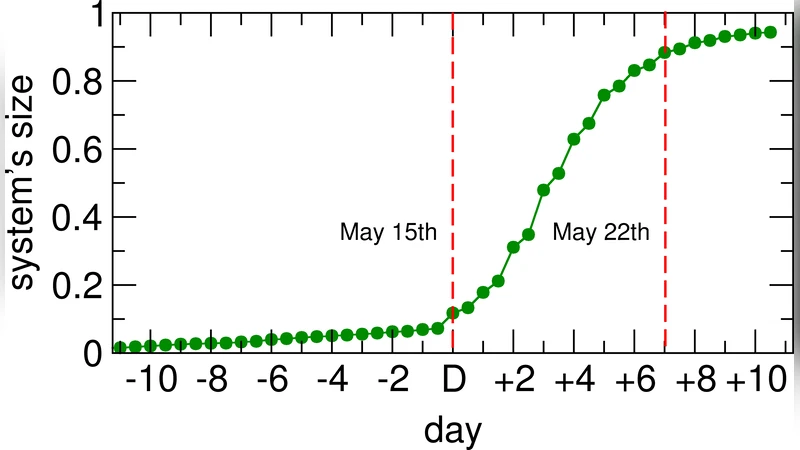
The authors first examine the temporal evolution of the giant component. Rather than a smooth linear increase, the network grows in bursts tightly linked to real‑world events. By the day of the first camp (May 15, denoted D) and the following week, more than 80 % of the eventual users are already active, and the component size stabilizes after D + 7. This bursty growth mirrors the rapid diffusion of the protests across Spain.
Structural analysis reveals classic scale‑free characteristics. Both in‑strength (total incoming tweets) and out‑strength (total outgoing tweets) follow power‑law distributions, but with distinct exponents: γ_in ≈ 1.1 and γ_out ≈ 2.3 (measured at D + 10). Degree distributions also exhibit exponents in the range 2–3, consistent with many real‑world networks. The out‑strength distribution shows an exponential cutoff beyond exponent > 3, reflecting human constraints on message production (time, attention, bandwidth).
Community detection at the mesoscopic level uncovers multiple well‑defined modules that correspond to geographic or topical sub‑groups (e.g., Madrid demonstrators, regional activists, mass‑media accounts, governmental institutions). This modular organization contributes to the network’s robustness: random removal of nodes leaves the giant component largely intact, a hallmark of scale‑free systems.
Dynamics of information flow are highly asymmetric. The authors find that a small fraction of users generate a disproportionate share of traffic: roughly 10 % of active users produce about 52 % of all sent tweets, while less than 1 % of users receive more than half of the incoming messages. The high‑in‑strength nodes act as “information sinks” – they absorb many messages but rarely retransmit them, effectively halting further diffusion. This asymmetry contrasts with the more balanced spreading observed in epidemic or rumor models on homogeneous networks.
The relationship between the number of active users and total tweet volume collapses onto a single curve across different days, indicating that traffic scales linearly with user base size. However, because the sinks concentrate reception, the overall efficiency of propagation is limited despite the presence of many active spreaders.
In discussion, the authors argue that the observed bursty growth, scale‑free topology, modular mesostructure, and sink‑driven asymmetry together shape the 15M movement’s online dynamics. The network’s robustness to random failures coexists with vulnerability to targeted attacks on the few high‑traffic hubs. Moreover, the concentration of inbound traffic on authorities and mass‑media accounts suggests that while these entities are central receivers, they do not act as amplifiers, potentially dampening the spread of protest‑related information.
The study concludes that online social media provide a rich, time‑resolved laboratory for studying collective mobilization. The identified structural signatures and dynamical asymmetries offer practical insights for monitoring real‑time social movements, designing interventions (e.g., counter‑disinformation strategies), and improving predictive models of information diffusion in large‑scale human communication systems. Future work is suggested to integrate real‑time analytics and to explore how these patterns evolve in different cultural or political contexts.
Comments & Academic Discussion
Loading comments...
Leave a Comment