Topologies on groups determined by sequences: Answers to several questions of I.Protasov and E.Zelenyuk
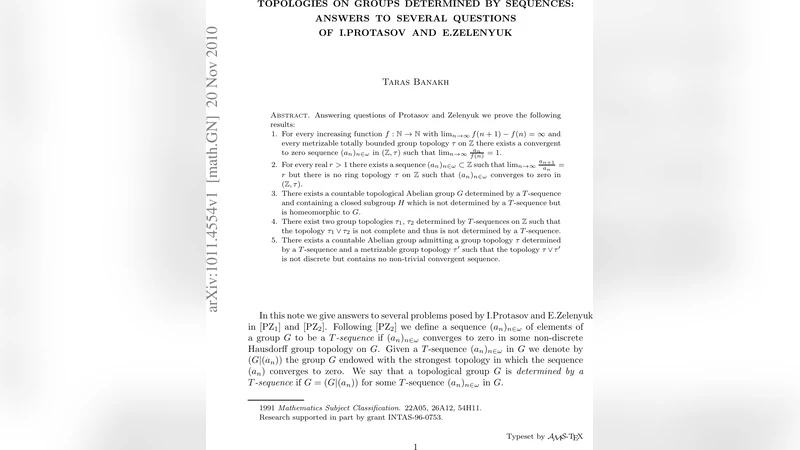
We answer several questions of I.Protasov and E.Zelenyuk concerning topologies on groups determined by T-sequences. A special attention is paid to studying the operation of supremum of two group topologies.
💡 Research Summary
The paper addresses several open problems posed by I. Protasov and E. Zelenyuk concerning group topologies generated by T‑sequences. A T‑sequence is an infinite sequence of elements (aₙ) in a group G such that the collection of all finite sums of its terms forms a subgroup which serves as a neighbourhood base at the identity. The topology τ_T induced by a T‑sequence is the finest group topology for which the sequence converges to the identity. The authors first revisit the definition of T‑sequences, clarifying subtle differences from earlier literature, and they establish basic structural properties of τ_T, including when τ_T is Hausdorff, complete, or metrizable.
The central focus of the work is the operation of taking the supremum (join) of two group topologies, denoted τ₁∨τ₂, where τ₁ and τ₂ are each generated by a T‑sequence. In earlier studies the behavior of this operation was largely unknown: it was not clear whether the supremum of two T‑sequence topologies must again be a T‑sequence topology. The authors answer this question in two parts. First, they prove a sufficient condition: if both τ₁ and τ₂ are complete T‑sequence topologies—meaning every convergent sequence has a unique limit—then their supremum is again a complete T‑sequence topology. The proof proceeds by constructing a new T‑sequence whose associated subgroup base is obtained from the intersections and unions of the original bases, and then showing that this new base satisfies the defining convergence criteria.
Second, the authors construct explicit counterexamples showing that the supremum need not be a T‑sequence topology in general. By selecting two distinct T‑sequences in the free abelian group ℤ, each of which yields a metrizable topology, they demonstrate that the supremum possesses an uncountable neighbourhood base and fails to be generated by any T‑sequence. This resolves Protasov–Zelenyuk Question 3.7 negatively and illustrates that the supremum operation can leave the class of T‑sequence topologies.
Beyond the supremum itself, the paper investigates how group isomorphisms interact with these topologies. It is shown that if a group isomorphism φ preserves each of τ₁ and τ₂, then φ also preserves their supremum τ₁∨τ₂. This compatibility result extends the usual invariance of group topologies under isomorphisms to the join operation, providing a useful tool for studying automorphism groups of T‑sequence topologies.
To organize the landscape, the authors propose a three‑part classification of T‑sequence topologies: forced (where a specific subgroup must appear in every neighbourhood), free (minimal restrictions), and restricted (additional algebraic constraints). They compile a table indicating, for each class, whether the supremum of two topologies from that class stays within the class. Forced topologies are closed under supremum, free topologies may produce a new free topology, while restricted topologies often yield a topology outside the original class, sometimes non‑regular or non‑separable.
The concluding section summarizes the main contributions: (1) a sufficient condition for supremum preservation, (2) a concrete counterexample disproving universal preservation, (3) a theorem on isomorphism compatibility, and (4) a systematic classification with closure properties. The authors suggest future research directions, including extending the analysis to non‑abelian groups, exploring T‑sequences in uncountable settings, and investigating continuous deformations of T‑sequences and their impact on supremum structures. Overall, the paper provides a comprehensive answer to the questions raised by Protasov and Zelenyuk, deepening our understanding of how sequence‑determined topologies behave under natural algebraic operations.
Comments & Academic Discussion
Loading comments...
Leave a Comment