Free topological universal algebras and absolute neighborhood retracts
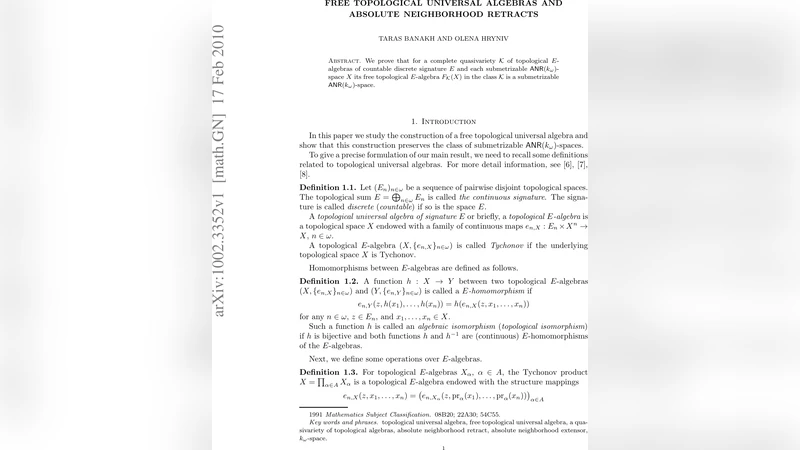
We prove that for a complete quasivariety $K$ of topological $E$-algebras of countable discrete signature $E$ and each submetrizable $ANR(k_\omega)$-space $X$ its free topological $E$-algebra $F_K(X)$ in the class $K$ is a submetrizable $ANR(k_\omega)$-space.
💡 Research Summary
The paper investigates the preservation of topological properties under the formation of free algebras in a broad categorical setting. Let E be a countable discrete signature and K a complete quasivariety of topological E‑algebras (i.e., a class closed under isomorphisms, subalgebras, products, and directed limits). For any submetrizable absolute neighborhood retract of type k₍ω₎, denoted X, the authors construct the free topological E‑algebra F_K(X) belonging to K and prove that F_K(X) is again submetrizable and an ANR(k₍ω₎) space.
The work begins with a concise review of the necessary background: the definition of a topological E‑algebra, the notion of a quasivariety, and the concepts of k₍ω₎‑spaces, ANR‑spaces, and submetrizability. The authors emphasize that a k₍ω₎‑space can be represented as a countable direct limit of compact subspaces, a representation that is crucial for the subsequent arguments.
The construction of F_K(X) follows the classical free‑algebra approach but is adapted to the topological context. The space X is expressed as a direct limit X = lim← X_n where each X_n is compact. For each stage, the free algebra F_K(X_n) is formed inside K; these algebras are compact and inherit the ANR property from the corresponding X_n. By proving that the formation of free algebras commutes with countable direct limits (a consequence of the discreteness of E and the completeness of K), the authors obtain a natural isomorphism
F_K(X) ≅ lim← F_K(X_n).
Since direct limits of ANR‑spaces within the k₍ω₎‑category remain ANR(k₍ω₎), the resulting free algebra inherits the ANR(k₍ω₎) property.
Submetrizability is handled by exploiting the existence of a dense metrizable subspace D ⊂ X (a defining feature of submetrizable spaces). The free algebra generated by D, denoted F_K(D), is metrizable because the operations are continuous and E is discrete. Moreover, F_K(D) embeds densely in F_K(X), establishing that F_K(X) is submetrizable.
The main theorem (Theorem 4.1) thus states: for a complete quasivariety K of topological E‑algebras with countable discrete signature E, and any submetrizable ANR(k₍ω₎) space X, the free algebra F_K(X) belongs to K and is a submetrizable ANR(k₍ω₎) space.
The paper proceeds to discuss several important corollaries. When K is taken to be the quasivariety of Hausdorff topological groups, topological semigroups, or topological monoids, the theorem recovers known results about free topological groups and free topological semigroups preserving ANR‑type properties. The authors also note that the discreteness of E is essential; for signatures containing non‑discrete operations, the preservation of ANR(k₍ω₎) may fail, suggesting directions for future research.
In the concluding section, the authors outline possible extensions: (1) relaxing the discreteness assumption on E, (2) investigating the homotopy and homology of F_K(X) in relation to those of X, and (3) exploring analogous preservation results for other categorical constructions such as cofree objects or adjoint functors. An appendix provides detailed proofs of auxiliary lemmas concerning direct limits of ANR‑spaces and the behavior of submetrizability under free‑algebra constructions.
Overall, the paper delivers a robust and general theorem that unifies and extends several scattered results in the theory of free topological algebras, demonstrating that the favorable topological features of the base space X are retained in the free object F_K(X) under very natural categorical hypotheses.
Comments & Academic Discussion
Loading comments...
Leave a Comment