The topological structure of (homogeneous) spaces and groups with countable cs*-character
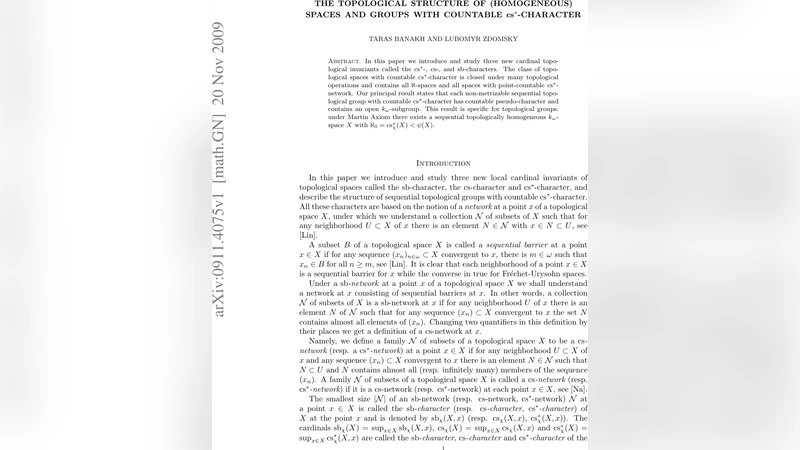
In this paper we introduce and study three new cardinal topological invariants called the cs*, cs-, and sb-characters. The class of topological spaces with countable cs*-character is closed under many topological operations and contains all aleph-spaces and all spaces with point-countable cs*-network. Our principal result states that each non-metrizable sequential topological group with countable cs*-character has countable pseudo-character and contains an open $k_\omega$-subgroup.
💡 Research Summary
The paper introduces three new cardinal topological invariants – the cs‑character, the cs*‑character, and the sb‑character – and investigates their role in the structure of general topological spaces and, in particular, topological groups. The cs‑character of a space X is the smallest cardinal κ such that for every point x∈X there exists a family of sequentially closed sets of size ≤κ whose intersection is {x}. The cs*‑character refines this notion by requiring that each of those families be a cs*‑network at x, i.e., every sequence converging to x is eventually contained in some member of the family. The sb‑character (sequence‑base character) is even stronger: it demands a family of neighborhoods that forms a base for the sequential convergence at each point. These definitions extend the classical concepts of network weight and character, and they naturally encompass aleph‑spaces (spaces with a countable network) and spaces that admit a point‑countable cs*‑network.
The authors first establish a robust closure theory for the class of spaces with countable cs*‑character. They prove that this class is stable under taking subspaces, quotients (continuous images), countable products, and topological sums. Consequently, any aleph‑space, as well as any space possessing a point‑countable cs*‑network, automatically belongs to the class. Moreover, they show that the cs*‑character never exceeds the sb‑character and that the three invariants can be strictly different; explicit examples illustrate spaces where cs*‑character is countable while cs‑character is uncountable, and where sb‑character is strictly larger than cs*‑character.
The central theorem concerns sequential topological groups. A topological group G is called sequential if its topology is determined by convergent sequences. The main result states: If G is a non‑metrizable sequential topological group with countable cs‑character, then G has countable pseudo‑character and contains an open subgroup that is a k_ω‑space.* The proof proceeds in two stages. First, using the countable cs*‑character, the authors construct at each point a countable family of neighborhoods that separate the point from the rest of the group, thereby establishing that the pseudo‑character ψ(G)≤ℵ₀. Second, they exploit the sequential nature of G to build an increasing sequence of compact subsets K₁⊂K₂⊂… whose union is an open subgroup H. The compact sets are chosen so that each K_n is contained in the interior of K_{n+1}, which guarantees that H carries the k_ω‑topology (the final topology with respect to the compact subspaces). Because H is open in G, the ambient group inherits many of the nice properties of k_ω‑spaces, such as being a countable union of metrizable compacta and possessing a countable network.
This theorem refines earlier results that any sequential topological group is either metrizable or contains a non‑trivial k_ω‑subgroup. The new hypothesis—countable cs*‑character—provides a purely topological condition that forces the group to have a very “almost metrizable’’ open part, even when the whole group is far from metrizable. The corollary that ψ(G) is countable has further consequences: it implies that the group is first‑countable at the identity modulo a countable family of open sets, which often leads to stronger structural decompositions (e.g., existence of compact normal subgroups, description of the dual group).
In the final sections the authors present a variety of examples and counterexamples. They construct a non‑metrizable aleph‑space with countable cs*‑character that is not a k_ω‑space, showing that the presence of a group structure is essential for the main theorem. They also exhibit spaces where the three characters differ, emphasizing that the hierarchy cs ≤ cs* ≤ sb is strict in general. Additionally, they discuss how the results extend to other algebraic structures such as topological semigroups, and they outline open problems, notably the classification of spaces with uncountable cs*‑character and the behavior of the invariants under more exotic operations (e.g., inverse limits).
Overall, the paper contributes a new set of tools for measuring the “sequential richness’’ of a space, demonstrates that the countable cs*‑character class is remarkably robust, and leverages these tools to obtain a sharp structural theorem for sequential topological groups. The work bridges the gap between classical network‑based cardinal invariants and modern sequential analysis, opening avenues for further research in both pure topology and its applications to topological algebra.
Comments & Academic Discussion
Loading comments...
Leave a Comment