We present a number of bounds on convergence time for two elitist population-based Evolutionary Algorithms using a recombination operator k-Bit-Swap and a mainstream Randomized Local Search algorithm. We study the effect of distribution of elite species and population size.
Deep Dive into Convergence Properties of Two ({mu} + {lambda}) Evolutionary Algorithms On OneMax and Royal Roads Test Functions.
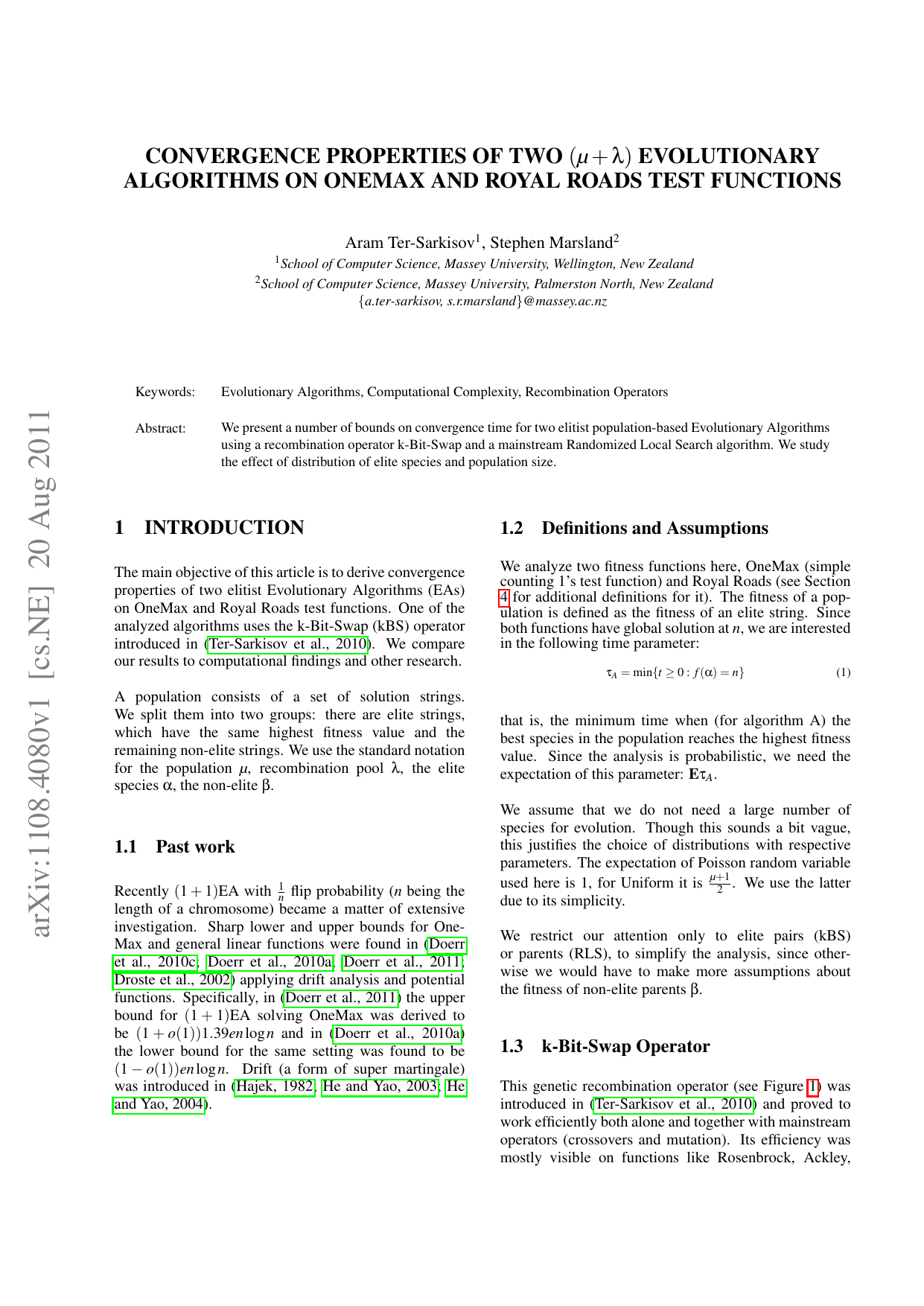
We present a number of bounds on convergence time for two elitist population-based Evolutionary Algorithms using a recombination operator k-Bit-Swap and a mainstream Randomized Local Search algorithm. We study the effect of distribution of elite species and population size.
The main objective of this article is to derive convergence properties of two elitist Evolutionary Algorithms (EAs) on OneMax and Royal Roads test functions. One of the analyzed algorithms uses the k-Bit-Swap (kBS) operator introduced in (Ter-Sarkisov et al., 2010). We compare our results to computational findings and other research.
A population consists of a set of solution strings. We split them into two groups: there are elite strings, which have the same highest fitness value and the remaining non-elite strings. We use the standard notation for the population µ, recombination pool λ, the elite species α, the non-elite β.
Recently (1 + 1)EA with 1 n flip probability (n being the length of a chromosome) became a matter of extensive investigation. Sharp lower and upper bounds for One-Max and general linear functions were found in (Doerr et al., 2010c;Doerr et al., 2010a;Doerr et al., 2011;Droste et al., 2002) applying drift analysis and potential functions. Specifically, in (Doerr et al., 2011) the upper bound for (1 + 1)EA solving OneMax was derived to be (1 + o(1))1.39en log n and in (Doerr et al., 2010a) the lower bound for the same setting was found to be (1o(1))en log n. Drift (a form of super martingale) was introduced in (Hajek, 1982;He and Yao, 2003;He and Yao, 2004).
We analyze two fitness functions here, OneMax (simple counting 1’s test function) and Royal Roads (see Section 4 for additional definitions for it). The fitness of a population is defined as the fitness of an elite string. Since both functions have global solution at n, we are interested in the following time parameter:
that is, the minimum time when (for algorithm A) the best species in the population reaches the highest fitness value. Since the analysis is probabilistic, we need the expectation of this parameter: Eτ A .
We assume that we do not need a large number of species for evolution. Though this sounds a bit vague, this justifies the choice of distributions with respective parameters. The expectation of Poisson random variable used here is 1, for Uniform it is µ+1 2 . We use the latter due to its simplicity.
We restrict our attention only to elite pairs (kBS) or parents (RLS), to simplify the analysis, since otherwise we would have to make more assumptions about the fitness of non-elite parents β.
This genetic recombination operator (see Figure 1) was introduced in (Ter-Sarkisov et al., 2010) and proved to work efficiently both alone and together with mainstream operators (crossovers and mutation). Its efficiency was mostly visible on functions like Rosenbrock, Ackley, Rastrigin and Royal Roads. We also tested its performance on OneMax specifically for this article.
The models we derive are complete, i.e. they are functions of just population size µ, recombination pool λ and length of the chromosome n, i.e. the actual parameters of EAs, though we make some weak assumptions about the pairing of parents.
We derive the expectation of convergence time for the population-based elitist EA with a recombination operator (1-Bit-Swap Operator) and mutation-based RLS. Our theoretical and computational findings confirm that for OneMax the benefit of population is unclear, i.e. its effect is not always positive. For Royal Roads it is always positive. This problem-specific issue was noticed before (see e.g. Figures 4 and5 in (He and Yao, 2002)).
We use two distributions of elite species in the population: Uniform( 1 µ ) and Poisson(1). Since the expressions for the expected first hitting time of algorithms Eτ we have found are quite complicated, we do the computational estimation and find some asymptotic results as well.
Tournament Selection Procedure We use this selection because it is fairly straightforward in implementation and analysis. • Select two species x i , x j uniformly at random
, either x i or x j enters the pool at random
• else the species with better fitness enters the pool
We start with Uniform distribution of elite species with parameter 1 µ , which gives the lower bound on convergence time, which is due to the assumption on the number of elite species needed for the evolution.
The probability of selecting an elite pair is
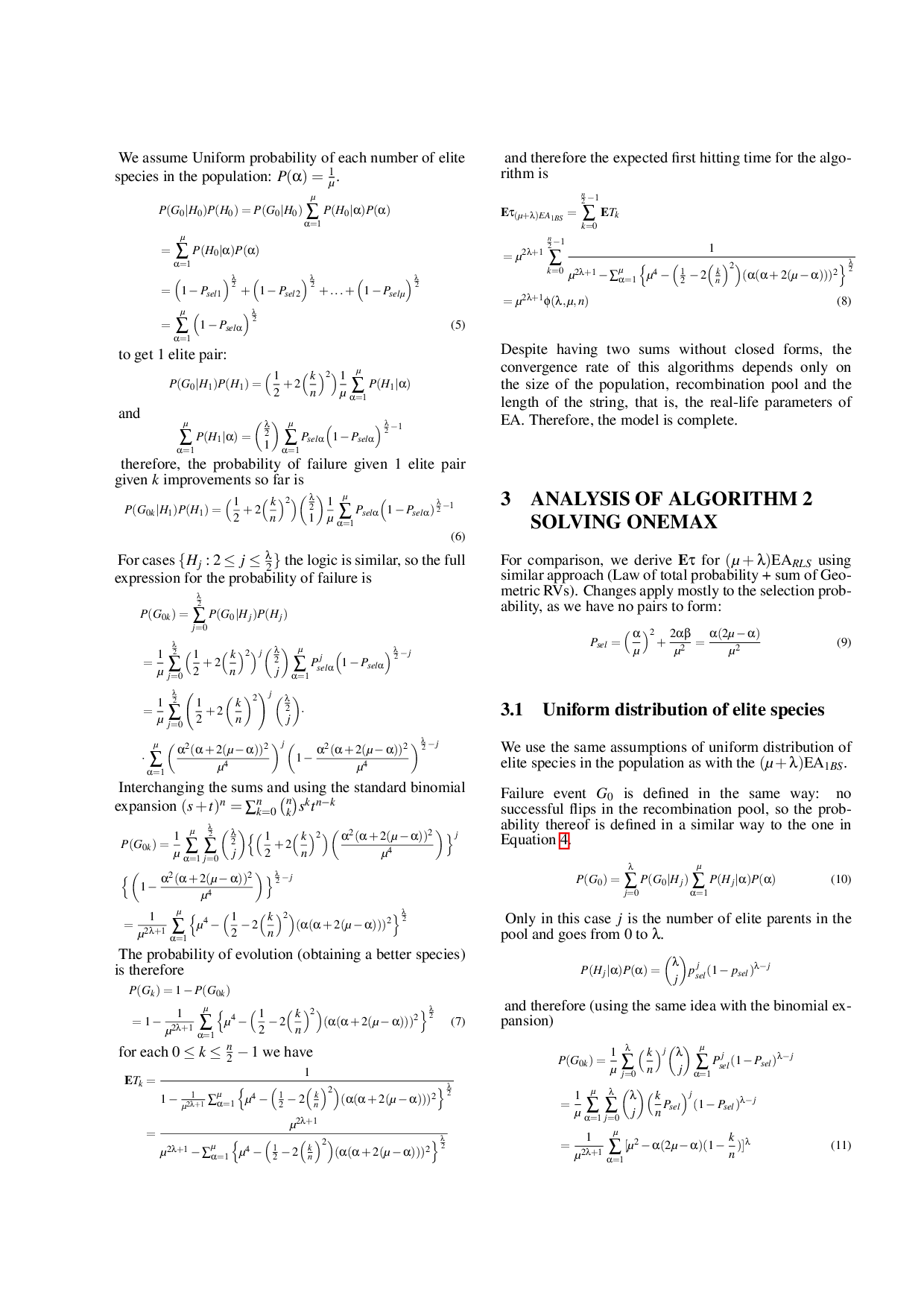
Since we restrict the analysis only to elite pairs, the probability of evolution (generation of a better offspring as a result of 1-Bit-Swap) is
where k = 0 : n 2 -1, which is due to the assumption that at the start of the algorithm f (α) = n 2 .
We are deriving an upper bound on the probability (and, therefore, lower bound on the expectation of the first hitting time). We are interested in the probability of evolving at least 1 new elite species next generation, i.e. of at least 1 successful swap.
P( at least 1 new elite species in the population at t + 1) = 1 -P(no new elite species in the population at t + 1)
We define G 0 to be the event that no new species evolves over 1 particular generation. The number of elite pairs H j in the population varies from 0 to λ 2 , and elite spec
…(Full text truncated)…
This content is AI-processed based on ArXiv data.