Unambiguous 1-Uniform Morphisms
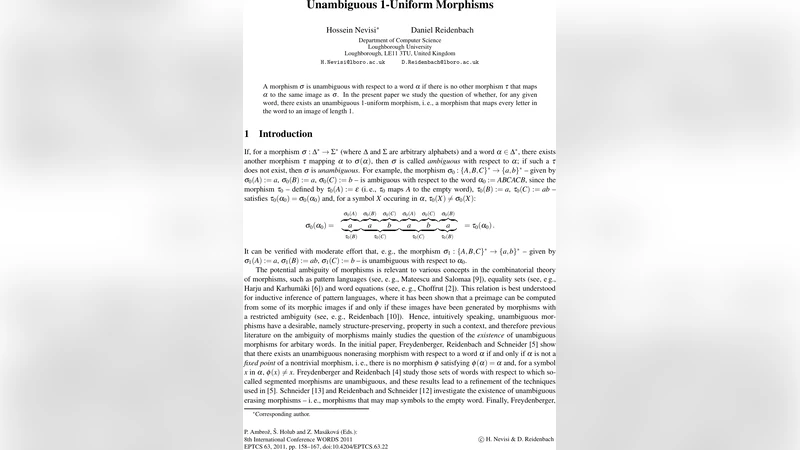
A morphism h is unambiguous with respect to a word w if there is no other morphism g that maps w to the same image as h. In the present paper we study the question of whether, for any given word, there exists an unambiguous 1-uniform morphism, i.e., a morphism that maps every letter in the word to an image of length 1.
💡 Research Summary
The paper investigates the existence of unambiguous 1‑uniform morphisms for arbitrary patterns. A morphism σ : Δ* → Σ* is called 1‑uniform if it maps every symbol of the source alphabet Δ to a word of length 1 in the target alphabet Σ. σ is unambiguous with respect to a pattern α ∈ Δ* if there is no other morphism τ : Δ* → Σ* such that τ(α)=σ(α) while τ differs from σ on at least one variable occurring in α. The central question (Problem 1) asks whether, for any given pattern α, there exists a 1‑uniform morphism σ that is unambiguous with respect to α.
The authors begin by recalling known results on ambiguity for general (non‑erasing) morphisms. In particular, they cite Freydenberger, Reidenbach and Schneider’s theorem that a pattern α is a fixed point of a non‑trivial morphism if and only if every non‑erasing morphism is ambiguous with respect to α. Consequently, the study can be restricted to patterns that are not fixed points.
Section 3 – Fixed target alphabets
The authors first fix the size of the target alphabet Σ and ask for sufficient conditions guaranteeing an unambiguous 1‑uniform morphism.
Binary alphabets (|Σ| = 2). They consider the family αₘ = 1·1·2·2·…·m·m for m ≥ 4. Using the fact that squares cannot be avoided over a binary alphabet, they prove that no unambiguous 1‑uniform morphism exists for any αₘ when Σ is binary.
Three‑letter alphabets (|Σ| ≥ 3). By invoking Thue’s classic construction of an infinite square‑free word over three letters, they build a word w′ by duplicating each letter of w. The prefix of w′ can serve as the image of αₘ under a 1‑uniform morphism σ, and because w′ contains only the trivial squares aa, bb, cc, σ is shown to be unambiguous. This yields a complete dichotomy: binary alphabets are insufficient for the αₘ family, while ternary alphabets always suffice.
The authors then present two more general sufficient criteria that work even with a binary target alphabet.
Theorem 3 states that if a certain auxiliary pattern β (constructed from a sequence of integers r₁,…,r_{⌈n/2⌉}) is square‑free, then a patterned word α built from repetitions of the variables according to the rᵢ’s admits an unambiguous 1‑uniform morphism into {a,b}.
Theorem 4 identifies, for each n ≥ 2, the shortest non‑fixed‑point pattern α having exactly n distinct variables and provides an explicit 1‑uniform morphism (mapping roughly half of the variables to a and the rest to b) that is unambiguous. Concrete examples for n = 5 and n = 6 illustrate the construction. This shows that for any number of variables a binary alphabet can support an unambiguous 1‑uniform morphism, provided the pattern has the specific structure described.
Section 4 – Variable‑size target alphabets
The authors relax the restriction that |Σ| be independent of the number of variables. They conjecture that whenever a pattern α has at least four distinct variables and is not a fixed point, there exists an alphabet Σ with |Σ| < |var(α)| and a corresponding unambiguous 1‑uniform morphism.
Two refined conjectures are formulated.
Conjecture 1 posits the existence of such a morphism for every non‑fixed‑point pattern with ≥ 4 variables.
Conjecture 2 narrows the search to morphisms σ_{i,j} that identify exactly two variables i and j (mapping them to the same letter) while keeping all other variables distinct. The conjecture claims that for any non‑fixed‑point pattern there is a pair (i,j) making σ_{i,j} unambiguous.
The paper connects Conjecture 2 to an existing open conjecture (Conjecture 3) concerning the behavior of the deletion morphisms δ_i (which erase a single variable). Conjecture 3 asserts that if every δ_i(α) is a fixed point of a non‑trivial morphism, then α itself must be a fixed point. While this conjecture remains unresolved, its truth would immediately imply the “only‑if” direction of Conjectures 1 and 2.
Proposition 1 provides a useful negative test: if σ_{i,j}(α) happens to be a fixed point of a non‑trivial morphism, then σ_{i,j} cannot be unambiguous for α. An explicit example with α₁ = 1·2·3·4·1·4·3·2 demonstrates the situation.
Conclusions and outlook
The paper establishes several concrete families of patterns for which unambiguous 1‑uniform morphisms exist, both with fixed binary/ternary target alphabets and with alphabets whose size may depend on the number of variables. It shows that the obstacle to unambiguity is closely tied to the presence of squares and fixed‑point structures. The authors leave the general conjectures open, highlighting the need for a deeper combinatorial understanding of how variable identification (σ_{i,j}) interacts with fixed‑point phenomena. Their results suggest that, except for the trivial fixed‑point cases, unambiguous 1‑uniform morphisms are far more common than previously thought, opening new avenues for efficient pattern‑language inference and for the analysis of word equations where morphic images of minimal length are desirable.
Comments & Academic Discussion
Loading comments...
Leave a Comment