Homotopies in Classical and Paraconsistent Modal Logics
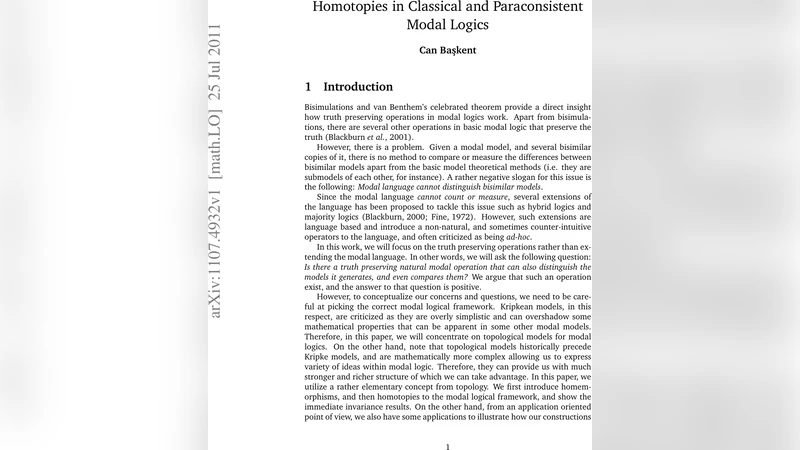
Topological semantics for modal logics has recently gained new momentum in many different branches of logic. In this paper, we will consider the topological semantics of both classical and paraconsistent modal logics. This work is a new step in the research program that focuses on paraconsistent systems from geometric and topological point of view. Here, we discuss the functional transformations in paraconsistent and classical modal cases: how to transform one classical or paraconsistent topological model to another, how to transform one transformation to another in a validity preserving way. Furthermore, we also suggest a measure to keep track of such change.
💡 Research Summary
The paper investigates truth‑preserving transformations between topological models of modal logic, focusing both on classical modal logics and on paraconsistent (and dually, paracomplete) modal logics. The authors argue that Kripke semantics, while historically important, is too coarse to capture the richer geometric structure needed for measuring differences between bisimilar models. They therefore adopt topological semantics, which dates back to the 1920s and was revitalized by McKinsey and Tarski, because it provides a more expressive framework for modal operators: the necessity operator □ corresponds to the interior operator Int, and the possibility operator ◇ corresponds to the closure operator Clo.
Two equivalent ways of presenting a topological space are given: one based on a family τ of open sets, the other on a family σ of closed sets. Continuity, openness, homeomorphisms, and homotopies are defined in the usual topological sense. For paraconsistent logics the authors stipulate that the extension of every propositional variable is a closed set; for paracomplete logics it is an open set. This choice avoids the problem that the complement of an open set need not be open, which would otherwise make negation difficult to interpret. Consequently they introduce two negation symbols: “∼” for the closed complement (closure of the complement) and “˙∼” for the open complement (interior of the complement). Under these conventions, the topologies that arise in paraconsistent and paracomplete settings are discrete, and a simple homeomorphism exists between any two models of the same cardinality (Proposition 1.3).
The core technical contribution begins with Theorem 2.1: if two paraconsistent topological models M = ⟨S,σ,V⟩ and M′ = ⟨S,σ′,V′⟩ are linked by a homeomorphism f : (S,σ) → (S,σ′) and the valuation is transferred via V′(p) = f(V(p)), then for every formula ϕ we have M ⊨ ϕ iff M′ ⊨ ϕ. The authors decompose the homeomorphism requirement into two weaker conditions: continuity yields preservation in one direction (Corollary 2.2), openness yields preservation in the opposite direction (Corollary 2.3). The same pattern applies to paracomplete models, where the interior operator replaces closure.
Next, the paper introduces homotopies between continuous maps f and f′. A homotopy H : S ×
Comments & Academic Discussion
Loading comments...
Leave a Comment