On locally constructible spheres and balls
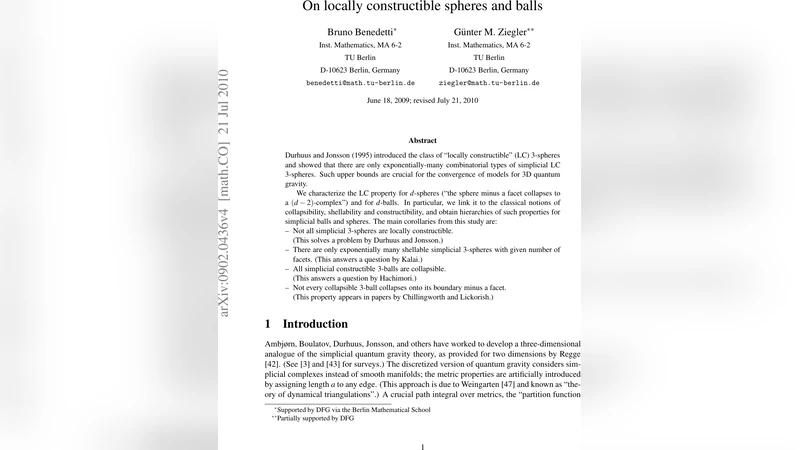
Durhuus and Jonsson (1995) introduced the class of “locally constructible” (LC) 3-spheres and showed that there are only exponentially-many combinatorial types of simplicial LC 3-spheres. Such upper bounds are crucial for the convergence of models for 3D quantum gravity. We characterize the LC property for d-spheres (“the sphere minus a facet collapses to a (d-2)-complex”) and for d-balls. In particular, we link it to the classical notions of collapsibility, shellability and constructibility, and obtain hierarchies of such properties for simplicial balls and spheres. The main corollaries from this study are: 1.) Not all simplicial 3-spheres are locally constructible. (This solves a problem by Durhuus and Jonsson.) 2.) There are only exponentially many shellable simplicial 3-spheres with given number of facets. (This answers a question by Kalai.) 3.) All simplicial constructible 3-balls are collapsible. (This answers a question by Hachimori.) 4.) Not every collapsible 3-ball collapses onto its boundary minus a facet. (This property appears in papers by Chillingworth and Lickorish.)
💡 Research Summary
The paper “On locally constructible spheres and balls” revisits the notion of locally constructible (LC) complexes introduced by Durhuus and Jonsson in 1995, extending it from 3‑dimensional spheres to arbitrary dimension d and to d‑balls, and places it within the classical hierarchy of collapsibility, shellability, and constructibility. An LC d‑sphere is defined as a simplicial d‑sphere from which the removal of a single facet leaves a complex that can be collapsed down to a (d‑2)‑dimensional subcomplex using only elementary collapses that never increase dimension beyond (d‑2). For d‑balls the analogous condition requires that after deleting one boundary facet the remaining boundary collapses to a (d‑2)‑complex.
The authors first establish a precise inclusion chain: every LC sphere is collapsible, every shellable sphere is LC, and every constructible sphere is collapsible, yielding the strict hierarchy
shellable ⊂ LC ⊂ constructible ⊂ collapsible.
They prove that the LC condition is strictly weaker than shellability but stronger than mere constructibility. The paper provides an algorithmic criterion for testing LC: one checks whether the deletion of a facet yields a complex whose Hasse diagram admits a sequence of elementary collapses that never involves cells of dimension higher than (d‑2).
A major breakthrough is the construction of explicit 3‑spheres that are not LC, thereby solving the open problem posed by Durhuus and Jonsson. The authors adapt the classic “Bing’s house” example, triangulating it with eight tetrahedra and showing that no choice of facet removal yields a 1‑dimensional collapse. Consequently, not all simplicial 3‑spheres belong to the LC class.
Using the LC characterization, the paper derives an exponential upper bound on the number of shellable 3‑spheres with a given number of facets. By encoding a shelling order together with the collapse sequence required by LC, they show that the number of such spheres grows at most like αⁿ for some constant α, answering a question of Kalai concerning the combinatorial growth of shellable 3‑spheres.
For 3‑balls, the authors prove that every constructible 3‑ball is collapsible, settling a question of Hachimori. The proof proceeds by induction on the constructible decomposition: a constructible ball is obtained by gluing two smaller constructible balls along a common facet, and the collapsibility of the pieces extends to the whole. Conversely, they exhibit a collapsible 3‑ball that does not collapse onto its boundary minus a facet, refuting a conjecture implicit in work by Chillingworth and Lickorish. This example again relies on a modified Bing’s ball, where any attempted collapse that avoids a specific boundary facet inevitably gets stuck at a 2‑cell.
The results have direct implications for 3‑dimensional quantum gravity models based on dynamical triangulations. The exponential bound on LC (hence shellable) spheres guarantees that the state sum over triangulations remains convergent, a prerequisite for a well‑defined path integral. Moreover, the clarified hierarchy informs which combinatorial moves (e.g., Pachner moves) preserve the LC property, thereby guiding the design of Monte‑Carlo algorithms that sample only physically relevant configurations.
In the concluding section the authors outline several open directions: determining exact exponential constants for higher dimensions, extending the LC framework to non‑simplicial triangulations, and investigating the statistical properties of LC triangulations in quantum gravity simulations (e.g., average curvature, Hausdorff dimension). The paper thus not only resolves several longstanding combinatorial questions but also strengthens the bridge between discrete geometry and quantum field theory.
Comments & Academic Discussion
Loading comments...
Leave a Comment