New separation between $s(f)$ and $bs(f)$
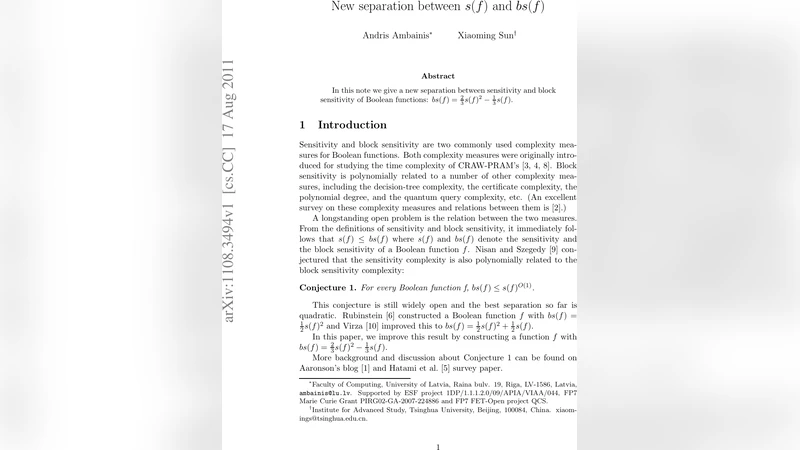
In this note we give a new separation between sensitivity and block sensitivity of Boolean functions: $bs(f)=(2/3)s(f)^2-(1/3)s(f)$.
💡 Research Summary
The paper addresses the long‑standing open problem of relating two fundamental complexity measures of Boolean functions: sensitivity s(f) and block sensitivity bs(f). While it is trivial that s(f) ≤ bs(f), Nisan and Szegedy conjectured that bs(f) is polynomially bounded by s(f). The best known separations prior to this work were due to Rubinstein (bs = ½ s²) and Virza (bs = ½ s² + ½ s). This note improves the separation to a quadratic bound with a larger constant:
bs(f) = (2⁄3) s(f)² − (1⁄3) s(f).
The authors adopt a systematic “OR‑composition” framework. For a base function g : {0,1}^m → {0,1}, they define a composed function
f(x₁,…,x_{n,m}) = ∨{i=1}^n g(x{i,1},…,x_{i,m}).
Lemma 1 shows that this construction scales the measures as follows:
s₀(f) = n·s₀(g), s₁(f) = s₁(g), bs₀(f) = n·bs₀(g).
Thus the OR layer multiplies the 0‑sensitivity and 0‑block‑sensitivity by n while leaving the 1‑sensitivity unchanged.
To achieve the new separation, the authors design a specific family of base functions g indexed by an integer k≥0. Let n = 2(2k+1). The function g outputs 1 exactly when the input contains a “pattern P_j”: two consecutive bits (2j−1, 2j) are 1, and all 2k bits immediately to the left and right of this pair are 0 (indices are taken modulo n). This pattern ensures:
s₁(g) = 3k + 2, s₀(g) = 1, bs₀(g) = 2k + 1.
Applying Lemma 1 with n = 3k + 2 (the number of OR copies) yields a final function f on (4k + 2)(3k + 2) variables satisfying
s(f) = 3k + 2, bs(f) = (3k + 2)(2k + 1).
Eliminating k gives the exact relation bs(f) = (2⁄3) s(f)² − (1⁄3) s(f), establishing the claimed separation.
The paper then proves that, within the OR‑composition paradigm, this separation is optimal as long as the base function satisfies s₀(g)=1. Theorem 2 shows that any such g with bs₀(g)=k must have s₁(g) ≥ 3k − ½. Combining this lower bound with Lemma 1 yields the universal inequality
bs(f) ≤ (2⁄3) s(f)² + O(s(f))
for any function obtained by OR‑composing a g with s₀(g)=1. Consequently, achieving a constant larger than 2/3 would require a base function with s₀(g) > 1, i.e., a more intricate structure.
The authors conclude by highlighting open directions: constructing base functions with higher 0‑sensitivity, exploring alternative composition operators (e.g., XOR, majority), and investigating how these constructions interact with other complexity measures such as decision‑tree depth, polynomial degree, or quantum query complexity. The work thus not only improves the quantitative gap between sensitivity and block sensitivity but also clarifies the limitations of the current compositional technique, guiding future research toward potentially stronger separations.
Comments & Academic Discussion
Loading comments...
Leave a Comment