On the Unification of Process Semantics: Logical Semantics
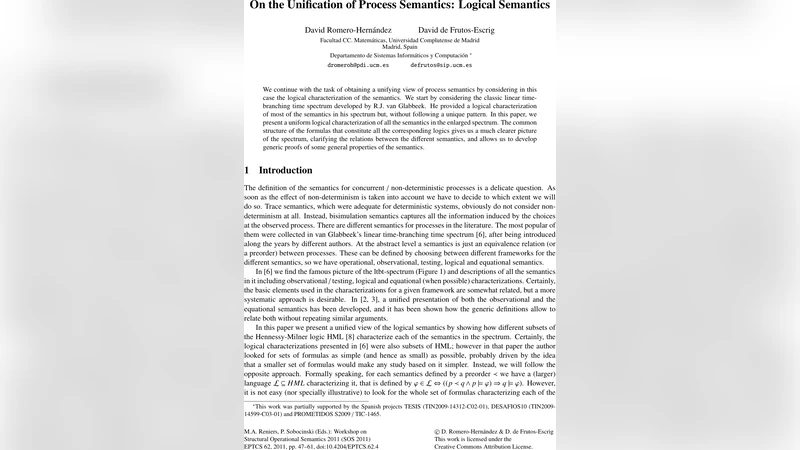
We continue with the task of obtaining a unifying view of process semantics by considering in this case the logical characterization of the semantics. We start by considering the classic linear time-branching time spectrum developed by R.J. van Glabbeek. He provided a logical characterization of most of the semantics in his spectrum but, without following a unique pattern. In this paper, we present a uniform logical characterization of all the semantics in the enlarged spectrum. The common structure of the formulas that constitute all the corresponding logics gives us a much clearer picture of the spectrum, clarifying the relations between the different semantics, and allows us to develop generic proofs of some general properties of the semantics.
💡 Research Summary
The paper tackles the long‑standing problem of giving a unified logical account of the many process semantics that populate Van Glabbeek’s linear‑time/branching‑time (ltbt) spectrum. While Van Glabbeek’s original work supplied logical characterisations for most of the semantics, each was presented as an ad‑hoc subset of Hennessy‑Milner Logic (HML) without a common structural pattern. The authors propose a systematic approach that treats every semantics as a preorder induced by a specific sub‑language L ⊆ HML, defined by a uniform set of syntactic rules.
The core technical device is the notion of N‑constrained simulation. For any binary relation N on processes, an N‑constrained simulation S_N is a relation contained in N that respects the usual simulation condition (whenever p S_N q and p —a→ p′, there exists q′ with q —a→ q′ and p′ S_N q′). Classical simulations, ready simulations, complete simulations, etc., are recovered by choosing N as the universal relation, the ready‑set equality relation I, or the existence‑of‑action relation C, respectively. This abstraction yields a “spine” of the spectrum: the vertical chain of N‑constrained simulations on which all other semantics hang.
Using this spine, the authors define for each semantics Z a logical language L_Z by a small collection of inference rules. The basic operators are the HML prefix a φ, conjunction (finite ∧), and negation ¬. Additional operators (e.g., universal quantification over actions, or the “must” operator) appear only where needed (e.g., in ready‑trace or possible‑worlds semantics). The preorder induced by L_Z is p ⊑_Z q iff every formula of L_Z satisfied by p is also satisfied by q. Crucially, the authors prove that for any semantics Z, adding disjunction (∨) to L_Z does not change the induced preorder (Proposition 1), because ∨ can be eliminated by distributing over ∧ and the prefix operator, and because negation is never applied to arbitrary formulas in these logics.
The paper then bridges the logical view with the observational view. It introduces branching general observations (BGO_N) and linear general observations (LGO_N), which are finite trees labelled by local observations drawn from a set L_N (e.g., the set of enabled actions for ready simulations). The authors define several observation‑based preorders (≤_b^N, ≤_l^N, ≤_l^⊇N, ≤_lf^N, ≤_lf^⊇N) that compare sets of observations via inclusion or matching of traces. Theorem 1 shows that for each N, the simulation preorder induced by N‑constrained simulations coincides with the branching observation preorder ≤_b^N. Theorem 2 establishes analogous correspondences for the linear semantics (trace, ready‑trace, failures, ready‑failures) with the appropriate observation preorders.
With this machinery in place, the authors systematically reconstruct the logical characterisations of all classic semantics (trace, completed trace, failures, ready, ready‑trace, possible worlds, etc.) and, more importantly, introduce new semantics that were absent from the original spectrum. Notably, they identify “minimal readies”, a semantics that naturally emerges from the logical framework by restricting to the basic ready‑set formulas a >. They also discover a subtle mistake in the classic logical characterisation of the possible‑worlds semantics: the original definition omitted the requirement that the formula a φ must hold for every action a in a given set X. By adding the missing universal condition, the corrected logic aligns with the intended observational behaviour.
Figure 2 (the enlarged spectrum) visualises the resulting hierarchy, showing how the newly defined semantics (e.g., trace simulation, impossible future, 2‑nested simulation) fit between the established nodes. The diagram makes explicit the inclusion relationships: a finer semantics corresponds to a larger logical language, and vice‑versa.
In summary, the paper delivers a unified logical semantics for the entire ltbt spectrum by (1) abstracting all simulation‑based semantics via N‑constrained simulations, (2) defining a family of HML‑based sub‑languages L_Z that uniformly characterise each preorder, (3) proving that logical inclusion mirrors semantic refinement, (4) linking these logics to finite observational structures, and (5) uncovering and correcting gaps in the classic literature while adding new, naturally motivated semantics. This unified approach simplifies proofs of general properties, provides a clear roadmap for extending the spectrum, and offers a solid foundation for future work on process equivalences and their logical specifications.
Comments & Academic Discussion
Loading comments...
Leave a Comment