The Earths oscillating electric field (T = 1 day) in relation to the occurrence time of large EQs (Ms>5.0R). A postulated theoretical physical working model and its statistical validation
The mechanically oscillating, due to tidal forces, lithosperic plate activates, because of its high content in quartzite, the generation of a piezoelectric field. Due to the same mechanical oscillation the lithosphere is generally at a state of an oscillating stress load. Therefore, large EQs which occur at the peaks of the stress load must coincide with the peaks of the generated piezoelectric potential. In this work a physical mechanism is postulated that accounts for the latter hypothesis. The postulated model is statistically tested by comparing the time of occurrence of 280 large EQs (Ms>5.0R) which occurred during the period from 2003 to 2011, to the same period of time Earth’s electric field registered at ATH (Athens) and PYR (Pyrgos) monitoring sites located in Greece. The comparison has been made for the oscillating component of T = 1 day and for both the E - W and N - S directions. The statistical results indicate that the postulated model does not behave randomly. Instead, it represents a smooth normal distribution which peaks on the zero deviation in time between the time of occurrence of the large EQs and the amplitude peaks of the Earth’s oscillating electric field. Therefore, the proposed physical model is an acceptable one and can be used for the finer refinement of the prediction of the occurrence time of a large EQ within a day’s time period.
💡 Research Summary
The paper proposes that tidal forces induce a daily (T = 1 day) mechanical oscillation of the lithosphere, and because the crust contains a high proportion of quartz, this oscillation activates a large‑scale piezoelectric effect that generates an electric field. The authors further assume that large earthquakes (Ms ≥ 5.0 R) occur at the peaks of the stress cycle, which should coincide with the peaks of the piezoelectric electric field. To test this hypothesis, they collected 280 earthquakes that occurred between 2003 and 2011 in Greece and compared their origin times with the daily‑period component of the Earth’s electric field recorded at two monitoring stations, Athens (ATH) and Pyrgos (PYR).
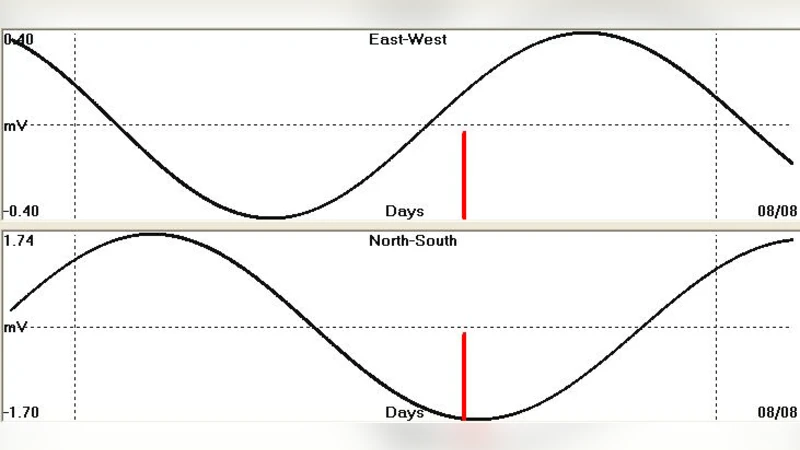
Raw electric‑field recordings were processed with a band‑pass FFT filter to isolate the 24‑hour oscillation. For each earthquake the time difference (dt) between the event and the nearest electric‑field amplitude peak was calculated. The dt values were binned in 50‑minute intervals over a range of –500 to +500 minutes (approximately ±8 hours) and a frequency histogram was constructed. As a null model, a synthetic dataset of 280 random numbers uniformly distributed over the same interval was generated, and its histogram served as the “by‑chance” baseline.
The observed histograms for both stations and for both the east‑west (E‑W) and north‑south (N‑S) components displayed a clear central peak near dt = 0, resembling a normal distribution, while the tails fell below the random baseline. Approximately 51–53 % of the earthquakes occurred closer to an E‑W peak and 47–49 % closer to an N‑S peak, values that are close to the expected 50 % if the events were randomly associated with either of the two daily peaks. The authors interpret the central excess as evidence that earthquake occurrence is statistically linked to the maxima of the daily electric‑field oscillation, supporting the proposed piezoelectric‑tidal mechanism.
Critical appraisal reveals several methodological and conceptual issues. The model assumes uniform piezoelectric behavior across the lithosphere, ignoring spatial variations in quartz content, rock type, and fault geometry that could strongly modulate the effect. The daily electric‑field component may be contaminated by atmospheric, ionospheric, and anthropogenic noise; the paper provides limited information on how such interferences were mitigated beyond the simple band‑pass filter. The choice of a ±500 minute window is somewhat arbitrary, given that the true interval between successive peaks is 12 hours; the decision of which peak (the preceding or following one) to associate with a given earthquake is not rigorously defined.
Statistically, the authors rely on visual inspection of the histograms and a qualitative “normal‑distribution” description without performing formal goodness‑of‑fit tests (e.g., χ², Kolmogorov‑Smirnov) or providing confidence intervals for the observed excess. Consequently, the significance of the central peak remains uncertain. Moreover, the sample size (280 events) is modest, and the study is confined to a single tectonic region, limiting the generalizability of the findings.
In summary, the paper introduces an intriguing hypothesis linking tidal‑driven lithospheric stress, large‑scale piezoelectricity, and the timing of moderate‑to‑large earthquakes. The empirical analysis shows a modest statistical tendency for earthquakes to cluster near the daily electric‑field peaks, but methodological limitations—particularly regarding data preprocessing, model assumptions, and rigorous statistical validation—prevent a definitive conclusion. Future work should incorporate multi‑site, multi‑frequency analyses, detailed noise characterization, and robust statistical testing to substantiate or refute the proposed mechanism.
Comments & Academic Discussion
Loading comments...
Leave a Comment