Computing the obstacle number of a plane graph
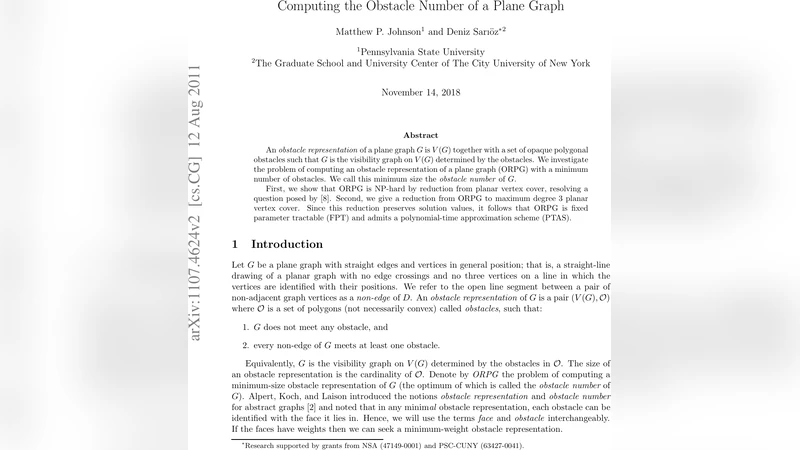
An obstacle representation of a plane graph G is V(G) together with a set of opaque polygonal obstacles such that G is the visibility graph on V(G) determined by the obstacles. We investigate the problem of computing an obstacle representation of a plane graph (ORPG) with a minimum number of obstacles. We call this minimum size the obstacle number of G. First, we show that ORPG is NP-hard by reduction from planar vertex cover, resolving a question posed by [8]. Second, we give a reduction from ORPG to maximum degree 3 planar vertex cover. Since this reduction preserves solution values, it follows that ORPG is fixed parameter tractable (FPT) and admits a polynomial-time approximation scheme (PTAS).
💡 Research Summary
The paper investigates the computational problem of determining the minimum number of opaque polygonal obstacles required to realize a given plane graph G as a visibility graph on its vertex set V(G). This minimum, called the obstacle number of G, is the objective of the Obstacle Representation of a Plane Graph (ORPG) problem. The authors make two principal contributions.
First, they prove that ORPG is NP‑hard. The reduction starts from the planar vertex cover problem. Given a planar graph G, they construct in polynomial time a new planar graph G₃ of maximum degree three. Each original vertex vᵢ is replaced by a cycle Cᵢ of length 2bᵢ (alternating blue/red vertices) together with a leaf zᵢ attached to a red vertex. Each original edge (vᵢ, vⱼ) becomes a three‑edge path Pᵢⱼ whose endpoints are distinct blue vertices of Cᵢ and Cⱼ. Additionally, f copies of a three‑vertex path P₃ are added, where f is the number of faces in a planar embedding of G. The construction guarantees that G has a vertex cover of size k if and only if G₃ has a vertex cover of size k′ = k + f + m + Σbᵢ (m = |E(G)|). The proof shows how a cover of G can be transformed into a cover of G₃ and vice‑versa, preserving the exact size relationship.
Second, they reduce ORPG to the maximum‑degree‑3 planar vertex cover problem in a value‑preserving way. They embed G₃ into a plane graph ˜G whose faces consist of two elementary structures: empty triangles (bounded faces with three vertices and no interior vertices) and diamonds (pairs of empty triangles sharing an edge). In a diamond, the shared edge corresponds to a non‑edge of the original graph; consequently, any obstacle representation must select at least one of the two triangles as an obstacle. By arranging the gadgets so that each vertex of G₃ corresponds to a set of empty triangles and each edge corresponds to a diamond, they obtain a bijection between obstacle sets of ˜G and vertex covers of G₃. Moreover, all non‑triangular faces of ˜G are forced to be obstacles, matching the f copies of P₃ in G₃. Hence the size of a minimum obstacle set in ˜G equals the size of a minimum vertex cover in G₃.
Because the reduction is value‑preserving, any algorithmic result for maximum‑degree‑3 planar vertex cover transfers directly to ORPG. Planar vertex cover is known to admit both a polynomial‑time approximation scheme (PTAS) and fixed‑parameter tractable (FPT) algorithms. The authors cite Xiao’s FPT algorithm running in O(1.1616^k·n) time and the Albér et al. algorithm running in O(2^{4√3·k}·n) time for a vertex‑cover size k. Consequently, ORPG also admits a PTAS (Corollary 3.3) and is FPT (Corollary 3.4).
The paper also discusses implementation details. Vertices are placed on an O(n)×O(n) integer lattice and perturbed to achieve general position. Around each vertex a small disk of radius r = ½·min{inter‑vertex and vertex‑edge distances} is drawn; edges become rectangles of uniform width. Each disk is partitioned into a blue arc of angle α (≤45°) centered on each incident edge (representing a non‑edge) and the remaining red arcs. The red arcs correspond to forced obstacle faces. When a red arc is large (≥180°−α), it is subdivided into three or five sub‑arcs, and dummy vertices are added to preserve the “striped” pattern and the diamond structure. This geometric construction guarantees that the combinatorial gadgets (empty triangles, diamonds, and forced faces) are faithfully realized in the plane drawing.
Finally, the authors address modeling assumptions. The reduction formally requires a RAM model with unit‑time real arithmetic, but they note that coordinates can be encoded with O(log n) bits, and an alternative construction using touching polygons of bounded complexity is possible.
In summary, the paper establishes that computing the obstacle number of a plane graph is computationally intractable in the worst case (NP‑hard), yet it is algorithmically tractable from the perspective of parameterized complexity and approximation: the problem admits both an FPT algorithm and a PTAS, inherited from the well‑studied planar vertex‑cover problem. This bridges geometric visibility representations with classic graph‑theoretic covering problems and clarifies the complexity landscape of obstacle representations for planar graphs.
Comments & Academic Discussion
Loading comments...
Leave a Comment