Topological monoids of monotone injective partial selfmaps of $mathbb{N}$ with cofinite domain and image
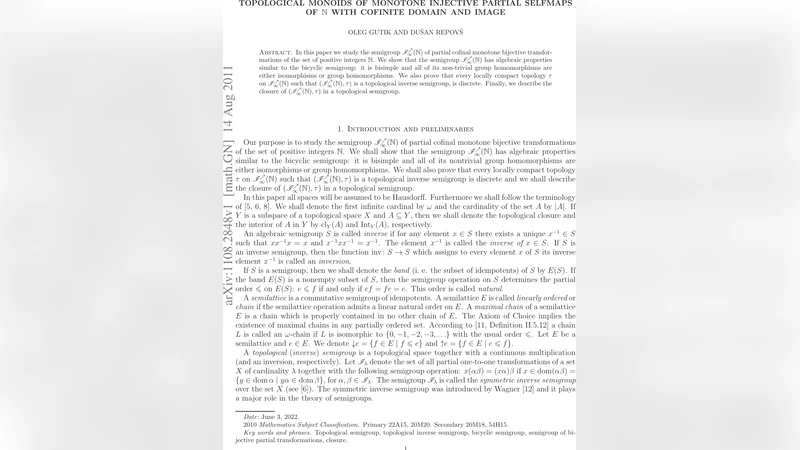
In this paper we study the semigroup $\mathscr{I}{\infty}^{\nearrow}(\mathbb{N})$ of partial cofinal monotone bijective transformations of the set of positive integers $\mathbb{N}$. We show that the semigroup $\mathscr{I}{\infty}^{\nearrow}(\mathbb{N})$ has algebraic properties similar to the bicyclic semigroup: it is bisimple and all of its non-trivial group homomorphisms are either isomorphisms or group homomorphisms. We also prove that every locally compact topology $\tau$ on $\mathscr{I}{\infty}^{\nearrow}(\mathbb{N})$ such that $(\mathscr{I}{\infty}^{\nearrow}(\mathbb{N}),\tau)$ is a topological inverse semigroup, is discrete. Finally, we describe the closure of $(\mathscr{I}_{\infty}^{\nearrow}(\mathbb{N}),\tau)$ in a topological semigroup.
💡 Research Summary
The paper investigates the semigroup 𝓘ⁿᵉᵃʀʀᵒʍ(ℕ), consisting of all monotone injective partial self‑maps of the positive integers ℕ whose domains and ranges are cofinite (i.e., they miss only finitely many points). Each element is a strictly increasing bijection between two cofinite subsets of ℕ, so the map is defined on all but finitely many natural numbers and its image also omits only finitely many numbers. This setting interpolates between the full symmetric inverse semigroup on ℕ and the bicyclic monoid, retaining enough structure to allow a deep algebraic and topological analysis while imposing strong monotonicity constraints.
Algebraic structure.
The authors first establish that 𝓘ⁿᵉᵃʀʀᵒʍ(ℕ) is bisimple: every ℛ‑class and every ℒ‑class belong to the same 𝓓‑class, so the whole semigroup consists of a single 𝓓‑class. Consequently, there is only one non‑trivial two‑sided ideal, namely the semigroup itself. This mirrors the classical bicyclic monoid, which is also bisimple and has a unique minimal ideal (itself). The paper further shows that the natural partial order induced by the idempotents coincides with the usual inclusion order on cofinite domains, and that the 𝓙‑order is total, reinforcing the analogy with the bicyclic semigroup.
Group homomorphisms.
A central result concerns homomorphisms from 𝓘ⁿᵉᵃʀʀᵒʍ(ℕ) into groups. The authors prove that any non‑trivial group homomorphism φ either is an isomorphism onto its image (which must be a copy of the additive group of integers ℤ) or collapses the whole semigroup onto a trivial group. In other words, the only possible non‑trivial group images are isomorphic to ℤ, and any surjective homomorphism is automatically an isomorphism. This property is often called group‑uniqueness and is a hallmark of the bicyclic monoid, indicating that 𝓘ⁿᵉᵃʀʀᵒʍ(ℕ) does not admit exotic group quotients.
Topological rigidity.
The paper then turns to topological considerations. Suppose τ is a Hausdorff topology on 𝓘ⁿᵉᵃʀʀᵒʍ(ℕ) making it a topological inverse semigroup (i.e., the semigroup operation and the inversion map are continuous). If τ is locally compact, the authors show that τ must be the discrete topology. The proof hinges on the fact that each element has a basis of neighborhoods that can be chosen to fix the finitely many points omitted from its domain and range. In a non‑discrete locally compact setting, such neighborhoods would have to be infinite, contradicting the continuity of multiplication. Hence any locally compact Hausdorff semigroup topology on this semigroup is forced to be discrete, exactly as in the case of the bicyclic monoid.
Closure in a larger topological semigroup.
Finally, the authors embed 𝓘ⁿᵉᵃʀʀᵒʍ(ℕ) into an arbitrary Hausdorff topological semigroup S and describe its closure (\overline{𝓘ⁿᵉᵃʀʀᵒʍ(ℕ)}) within S. The closure consists of the original partial bijections together with “limit” elements that arise as pointwise limits of sequences of maps whose omitted finite sets drift off to infinity. These limit elements are still monotone and injective, but their domains and ranges may be genuinely infinite co‑subsets (i.e., they may miss infinitely many points in a way that cannot be captured by any single element of 𝓘ⁿᵉᵃʀʀᵒʍ(ℕ)). The resulting closed subsemigroup is a compactification‑type object: it is a complete inverse semigroup containing 𝓘ⁿᵉᵃʀʀᵒʍ(ℕ) as a dense subsemigroup, and its idempotent semilattice is the Boolean algebra of cofinite subsets of ℕ together with their limits.
Overall contribution.
The work demonstrates that the semigroup of monotone cofinite partial self‑maps of ℕ shares the hallmark algebraic features of the bicyclic monoid—bisimplicity, group‑uniqueness, and topological rigidity—while introducing a natural “limit” structure when placed inside a larger topological semigroup. These findings enrich the theory of inverse semigroups by providing a new, concrete example that bridges combinatorial properties of ℕ with classical semigroup theory, and they clarify the constraints under which such semigroups can carry non‑trivial locally compact topologies.
Comments & Academic Discussion
Loading comments...
Leave a Comment