Grothendieck-type inequalities in combinatorial optimization
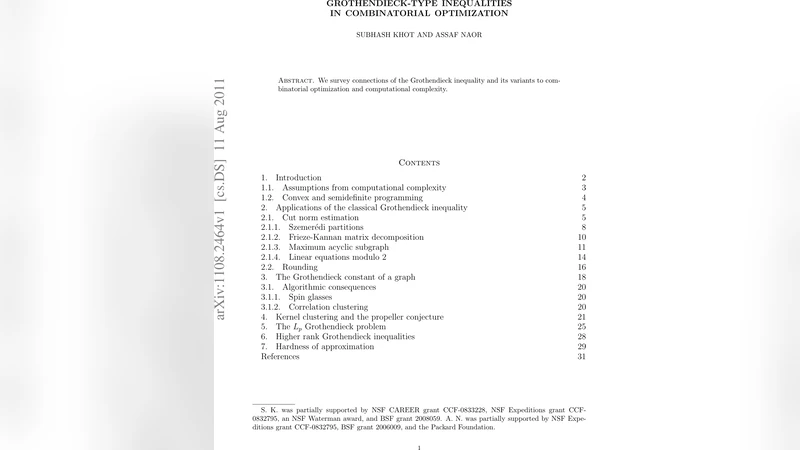
We survey connections of the Grothendieck inequality and its variants to combinatorial optimization and computational complexity.
💡 Research Summary
This survey paper provides a comprehensive overview of how the Grothendieck inequality and its many variants have become central tools in combinatorial optimization and computational complexity theory. The authors begin by recalling the classical Grothendieck inequality, which states that for any real matrix (A) there exists a universal constant (K_G) such that the supremum of the bilinear form over unit vectors on the Euclidean sphere is at most (K_G) times the supremum over ({-1,+1}) signs. The exact value of (K_G) remains unknown; the best known bounds are (1.676\ldots < K_G < 1.782\ldots).
The first part of the paper sets the stage by reviewing the two main hardness assumptions used throughout: the P ≠ NP conjecture (often instantiated via 3‑colorability) and the Unique Games Conjecture (UGC). The authors explain how a polynomial‑time algorithm for a target task (T) can be leveraged to solve a hard problem, thereby establishing hardness of approximation results.
Section 2 focuses on direct algorithmic applications of the classical inequality. The central problem is the cut‑norm estimation of a matrix (A), defined as (|A|{\text{cut}} = \max{S,T} \sum_{i\in S,,j\in T} a_{ij}). By augmenting (A) to a matrix (B) of size ((m+1)\times(n+1)) and observing that (|A|{\text{cut}} = \frac14|B|{\infty\to1}), the authors reduce cut‑norm approximation to the problem of maximizing (\sum_{i,j} b_{ij}\varepsilon_i\delta_j) over sign vectors. This latter problem can be approximated via a semidefinite programming (SDP) relaxation; the Grothendieck inequality guarantees that the SDP value is within a factor (K_G) of the true optimum, and a simple rounding scheme (random hyperplane cut) yields a solution whose expected value is at least (\frac{1}{K_G}) times the SDP optimum. Consequently, a polynomial‑time algorithm achieves a constant‑factor approximation for the cut‑norm.
Four concrete sub‑applications are discussed: (i) Szemerédi regularity partitions, (ii) the Frieze–Kannan matrix decomposition, (iii) the maximum acyclic subgraph problem, and (iv) solving linear equations modulo 2 with approximation guarantees. Each case illustrates how cut‑norm approximation serves as a versatile primitive.
Section 2.2 delves into the rounding step in detail, showing how the Goemans–Williamson hyperplane technique can be viewed as a probabilistic implementation of the Grothendieck inequality, and how the same analysis yields the best known upper bound on (K_G).
Section 3 introduces the graph‑specific Grothendieck constant (K_G(G)), defined by restricting the inequality to matrices that are adjacency or weight matrices of a given graph (G). The authors explain algorithmic consequences: for spin‑glass models the constant determines the quality of SDP‑based approximations, while for correlation clustering it dictates the achievable approximation ratio.
Section 4 treats kernel clustering and the “Propeller conjecture,” which posits an optimal rounding scheme for a class of kernel matrices. By applying a Grothendieck‑type inequality tailored to the kernel setting, the authors obtain improved approximation guarantees for multi‑class clustering problems.
Section 5 studies the (\ell_p) Grothendieck problem, where the bilinear form is evaluated on vectors from (\ell_p) and (\ell_q) spaces. The associated constant (K_{p,q}) generalizes (K_G). The paper concentrates on the cases ((p,q)=(1,\infty)) and ((2,2)), showing how SDP relaxations combined with appropriate rounding achieve constant‑factor approximations whose factors are precisely (K_{p,q}).
Section 6 explores higher‑rank (tensor) Grothendieck inequalities, extending the bilinear setting to multilinear forms. Although still largely theoretical, these extensions hint at potential applications in high‑dimensional data analysis and multilinear algebra.
Section 7 is devoted to hardness of approximation. Under P ≠ NP, the authors review classic reductions showing that improving upon the Grothendieck‑based approximation ratios for problems such as MAX‑CUT, MAX‑2‑SAT, and kernel clustering would imply polynomial‑time algorithms for NP‑hard tasks. Under the UGC, they present stronger results: for many of the same problems, the Grothendieck constant (or its graph‑specific analogue) is provably the optimal approximation threshold, assuming the conjecture holds. These results position the Grothendieck inequality as a bridge between algorithm design and complexity lower bounds.
The survey concludes by emphasizing the dual role of the Grothendieck inequality: it provides both a powerful analytic tool for designing SDP‑based approximation algorithms and a natural barrier that matches known hardness results. Open directions include narrowing the gap between the known upper and lower bounds on (K_G), extending non‑commutative and multilinear versions to concrete optimization problems, and exploring connections to quantum information theory, where analogous inequalities already play a role. Overall, the paper paints a vivid picture of how a deep functional‑analytic theorem has become indispensable in modern combinatorial optimization.
Comments & Academic Discussion
Loading comments...
Leave a Comment