Digital Forensics Analysis of Spectral Estimation Methods
Steganography is the art and science of writing hidden messages in such a way that no one apart from the intended recipient knows of the existence of the message. In today’s world, it is widely used in order to secure the information. In this paper, the traditional spectral estimation methods are introduced. The performance analysis of each method is examined by comparing all of the spectral estimation methods. Finally, from utilizing those performance analyses, a brief pros and cons of the spectral estimation methods are given. Also we give a steganography demo by hiding information into a sound signal and manage to pull out the information (i.e, the true frequency of the information signal) from the sound by means of the spectral estimation methods.
💡 Research Summary
The paper investigates the use of traditional spectral‑estimation techniques for digital‑forensic steganalysis, focusing on how well these methods can reveal hidden sinusoidal components embedded in audio signals. Five estimators are examined: the non‑parametric Periodogram, the windowed Blackman‑Tukey method, and three parametric approaches—Capon’s minimum‑variance method, the Yule‑Walker linear‑prediction technique, and the Modified Covariance method. The authors first present compact mathematical formulations for each estimator, highlighting the role of sample size (N), window length (M), and model order (p) in shaping bias, variance, and resolution.
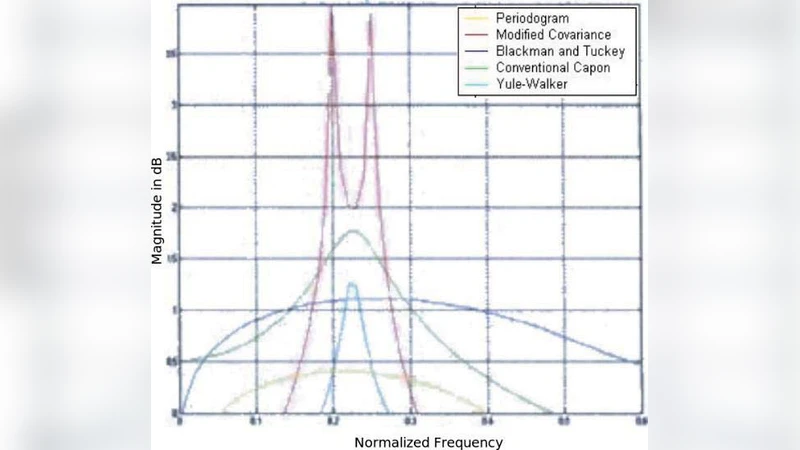
A series of MATLAB simulations is then carried out in three experimental groups. In the first group, synthetic signals consisting of two sinusoids corrupted by additive white Gaussian noise (AWGN) are generated. By varying the frequency separation (e.g., 5 Hz vs. 25 Hz, then 10 Hz vs. 22 Hz) and the model order, the authors show that the Modified Covariance estimator consistently pinpoints both frequencies without shift, even when the sinusoids are closely spaced. Capon’s method follows, while the Periodogram, Blackman‑Tukey, and Yule‑Walker fail to separate the peaks under the same conditions. Increasing the order reduces variance for all methods, but only the Modified Covariance maintains perfect resolution.
The second group assumes that the exact autocorrelation function R is available, eliminating the need for its estimation. Here, the Blackman‑Tukey estimator performs worst, whereas Yule‑Walker and Capon achieve the highest resolution. The Yule‑Walker estimator yields slightly larger peak magnitudes than Capon, indicating better amplitude fidelity. Doubling the order again introduces extra ripples in Blackman‑Tukey but does not substantially improve the parametric methods.
The third group uses a real audio file (sample.wav) as the noise background, thereby introducing non‑Gaussian, correlated noise. A weak sinusoid is added to the audio, and the estimators are tasked with extracting its frequency. All methods experience performance degradation due to the correlated, non‑white nature of the sound, yet the Modified Covariance method still identifies the hidden frequency, albeit with increased variance. Raising the model order allows Yule‑Walker to begin recovering the frequency, but a considerably higher order is required compared to the AWGN case.
From these experiments the authors draw several practical conclusions. Non‑parametric estimators (Periodogram, Blackman‑Tukey) are advantageous when the signal is deterministic and the data record is long; they are simple to implement but suffer from poor resolution in noisy or short‑record scenarios. Parametric estimators (Capon, Yule‑Walker, Modified Covariance) excel when the underlying process is stochastic or when an accurate autocorrelation matrix is available. Among them, the Modified Covariance method stands out: it needs only modest model order, can separate very close frequencies, is relatively robust to the type of noise (AWGN or correlated), and its performance degrades mainly in terms of variance rather than bias. However, for purely deterministic signals it may be less appropriate because its model‑based assumptions are unnecessary.
The paper also notes that window selection (e.g., Bartlett versus Parzen) critically influences the Blackman‑Tukey estimator, and that overly large model orders can introduce spurious peaks across all methods. Overall, the study provides a clear guideline for forensic analysts: choose non‑parametric methods for long, clean recordings; employ parametric techniques—especially Modified Covariance—when dealing with short, noisy, or steganographically altered audio. The work demonstrates that spectral estimation is a viable tool for steganalysis, and that careful method selection can substantially improve the detection of hidden information in digital evidence.
Comments & Academic Discussion
Loading comments...
Leave a Comment