No extension of quantum theory can have improved predictive power
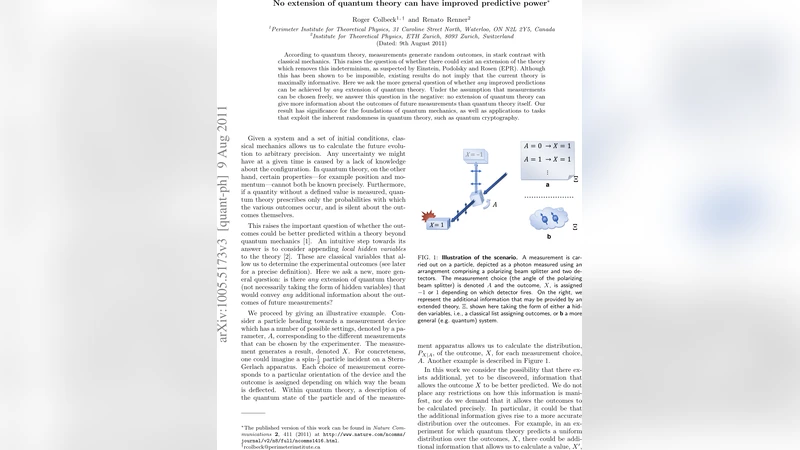
According to quantum theory, measurements generate random outcomes, in stark contrast with classical mechanics. This raises the question of whether there could exist an extension of the theory which removes this indeterminism, as suspected by Einstein, Podolsky and Rosen (EPR). Although this has been shown to be impossible, existing results do not imply that the current theory is maximally informative. Here we ask the more general question of whether any improved predictions can be achieved by any extension of quantum theory. Under the assumption that measurements can be chosen freely, we answer this question in the negative: no extension of quantum theory can give more information about the outcomes of future measurements than quantum theory itself. Our result has significance for the foundations of quantum mechanics, as well as applications to tasks that exploit the inherent randomness in quantum theory, such as quantum cryptography.
💡 Research Summary
The paper addresses a foundational question: can any theoretical extension of quantum mechanics improve the predictive power of the theory regarding the outcomes of future measurements? Building on the long‑standing Einstein‑Podolsky‑Rosen (EPR) debate, the authors formulate the problem in a fully general operational framework. They consider an “extension” to be any model that supplements the standard quantum description—state ψ and measurement setting x—with additional variables λ (often called hidden variables) and a joint probability distribution ρ(λ|ψ). The central claim is that, under two widely accepted assumptions, no such extension can yield more accurate predictions than quantum theory itself.
The first assumption is free choice (sometimes called measurement independence): experimenters can select measurement settings independently of any pre‑existing variables, implying statistical independence between x and λ. The second is no‑signalling: any hidden variable must respect relativistic causality and cannot be used to transmit information instantaneously between spacelike separated regions. These premises are standard in modern Bell‑type analyses and are considered essential for any physically realistic theory.
Using these assumptions, the authors derive the following key relation. For a given outcome a, the conditional probability in the extended model is P(a|x,ψ,λ). Because of no‑signalling, this probability depends only on the local setting x and λ, not on distant choices. Free choice guarantees that the distribution ρ(λ|ψ) is independent of x. By applying Bayes’ theorem and the law of total probability, they show that the averaged probability over λ reproduces the quantum prediction:
∑_λ ρ(λ|ψ) P(a|x,ψ,λ) = P_Q(a|x,ψ).
Crucially, the authors go further and prove that the equality holds for each individual λ as well, i.e., P(a|x,ψ,λ) = P_Q(a|x,ψ). Consequently, λ carries no extra information about the outcome; the extended model is “trivial.” This result is formalized as Theorem 1 in the paper and constitutes a stronger statement than traditional Bell‑type impossibility theorems, which only rule out certain statistical correlations. Here, even a single measurement outcome cannot be predicted more accurately by any extension that respects the two assumptions.
The paper discusses the implications for deterministic hidden‑variable theories. To evade the theorem, such theories must either abandon free choice (as in super‑deterministic proposals where the measurement setting is pre‑determined and correlated with λ) or violate no‑signalling (allowing faster‑than‑light influences). Both routes are considered highly implausible or experimentally inaccessible, reinforcing the view that quantum mechanics is already maximally informative.
From an applied perspective, the theorem underpins the security of quantum cryptographic protocols and the reliability of quantum random‑number generators. Since no external information can improve the prediction of a quantum outcome, the randomness generated by a quantum device is provably irreducible, providing a solid foundation for device‑independent cryptography and randomness‑expansion schemes.
Finally, the authors contrast their result with Bell inequalities. While Bell tests rule out local hidden‑variable models by exposing statistical violations, the present work eliminates any hidden‑variable model that could improve predictive power on a per‑trial basis, assuming free choice and no‑signalling. This establishes quantum theory not only as non‑local in the Bell sense but also as maximally predictive within the allowed physical constraints. The paper thus closes a long‑standing loophole in the EPR argument and clarifies that any future theory seeking to surpass quantum mechanics must fundamentally revise one of the two core assumptions.
Comments & Academic Discussion
Loading comments...
Leave a Comment