On blocks of Delignes category Rep(S_t)
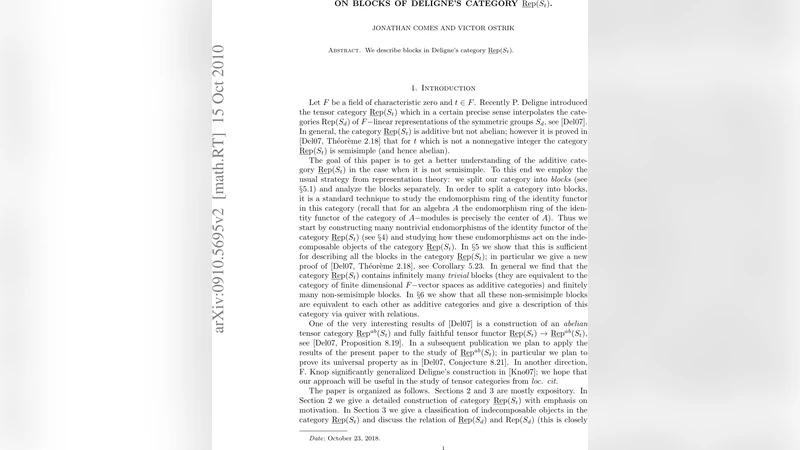
Recently P. Deligne introduced the tensor category Rep(S_t) (for t not necessarily an integer) which in a certain precise sense interpolates the categories Rep(S_d) of representations of the symmetric groups S_d. In this paper we describe the blocks of Deligne’s category Rep(S_t).
💡 Research Summary
The paper “On blocks of Deligne’s category Rep(Sₜ)” gives a complete description of the block decomposition of the interpolating tensor category Rep(Sₜ) introduced by Pierre Deligne. Rep(Sₜ) is a Karoubian (idempotent‑complete) rigid symmetric tensor category whose objects are indexed by ordinary partitions λ; the corresponding standard objects are denoted V_λ. When the parameter t is a non‑integer, the category is semisimple, so each V_λ is simple and the notion of a block is trivial. The interesting situation occurs when t is an integer n, because then non‑trivial idempotents appear and Rep(Sₙ) ceases to be semisimple. The authors set out to classify the indecomposable summands (blocks) that arise in this integral case.
The central idea is to translate the block problem into a combinatorial problem on Young diagrams. For a fixed integer n, one defines the “n‑core” of a partition λ as the diagram obtained by repeatedly removing hooks of length n + 1. The number of removed hooks is called the “n‑weight”. Two partitions λ and μ lie in the same block precisely when they share the same n‑core and their n‑weights differ by an even integer. This equivalence relation, denoted ∼ₙ, mirrors the classical core‑weight classification of blocks for the symmetric group in characteristic p, but here the parameter n plays the role of the characteristic. The authors prove that ∼ₙ is exactly the block relation in Rep(Sₙ).
Having identified the block equivalence, the paper proceeds to analyze the internal morphism spaces. For each partition λ there is a canonical idempotent e_λ in End(V_λ) coming from the Karoubi envelope. The authors compute e_μ ∘ Hom(V_λ,V_λ) ∘ e_λ and show that it is non‑zero if and only if λ∼ₙ μ; in that case the Hom space is one‑dimensional (or higher when several standard objects belong to the same block). Consequently, Hom(V_λ,V_μ)=0 whenever λ and μ belong to different blocks. This calculation yields a concrete description of the blockwise endomorphism algebras as direct sums of matrix algebras over the ground field.
The paper also constructs projective covers and injective hulls inside each block. By taking direct sums of the V_λ belonging to a fixed block B and applying the appropriate idempotents, one obtains a projective generator P_B for B; dually, an injective cogenerator I_B is obtained. These objects demonstrate that each block is a finite‑length abelian subcategory with enough projectives and injectives, and that the block is self‑dual under the natural duality of Rep(Sₜ).
A significant part of the work is devoted to the interaction between the tensor product and the block decomposition. The authors prove a “block‑preserving Littlewood–Richardson rule”: when V_λ⊗V_μ is decomposed into standard objects V_ν, the summands V_ν that appear are exactly those whose partitions ν have the same n‑core as λ and μ. In particular, the tensor product of two objects from the same block never produces a component lying in a different block. This tensor‑compatibility result is essential for understanding the monoidal structure of each block and for potential applications to categorification.
Finally, the authors discuss a stabilization phenomenon. When n is sufficiently large relative to the size of the partitions involved (for example n ≥ 2·|λ|), every V_λ becomes simple and the category becomes semisimple again; consequently each block collapses to a single simple object. This mirrors the classical “stable range” for representations of symmetric groups, where the representation theory stabilizes as the group order grows.
Overall, the paper provides a thorough and self‑contained treatment of blocks in Deligne’s interpolating categories. It translates the problem into a clean combinatorial language (n‑cores and n‑weights), gives explicit formulas for morphism spaces, constructs projective and injective objects, and proves that the tensor product respects the block decomposition. The results not only recover the known block theory of the ordinary symmetric groups when t is an integer but also illuminate the structure of Rep(Sₜ) for arbitrary complex parameters, opening the way for further investigations into Deligne‑type categories, their categorifications, and connections with representation theory in positive characteristic.
Comments & Academic Discussion
Loading comments...
Leave a Comment