On a New Multicomputer Interconnection Topology for Massively Parallel Systems
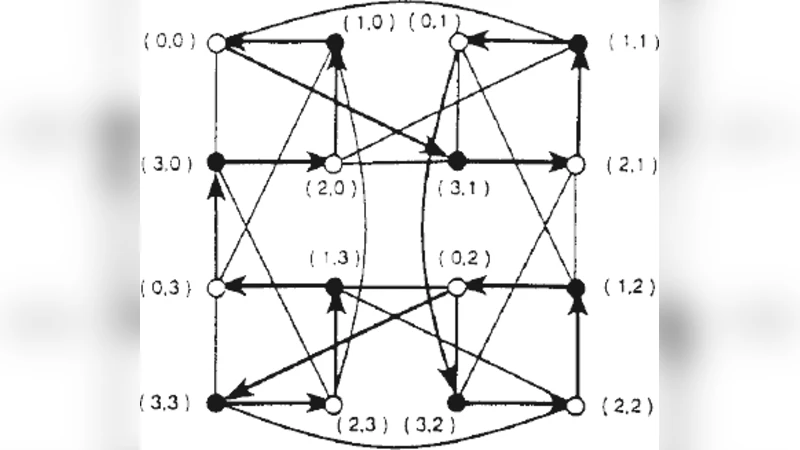
This paper introduces a new interconnection network topology called Balanced Varietal Hypercube (BVH), suitable for massively parallel systems. The proposed topology being a hybrid structure retains almost all the attractive properties of Balanced Hypercube and Varietal Hypercube. The topology, various parameters, routing and broadcasting of Balanced Varietal Hypercube are presented. The performance of the Balanced Varietal Hypercube is compared with other networks. In terms of diameter, cost and average distance and reliability the proposed network is found to be better than the Hypercube, Balanced Hypercube and Varietal Hypercube. Also it is more reliable and cost-effective than Hypercube and Balanced Hypercube.
💡 Research Summary
The paper proposes a novel interconnection topology called the Balanced Varietal Hypercube (BVH) aimed at massively parallel computing systems. BVH is conceived as a hybrid of two previously studied structures: the Balanced Hypercube (BH) and the Varietal Hypercube (VQ). By merging the fault‑tolerant, load‑balanced characteristics of BH with the reduced diameter and average distance properties of VQ, the authors claim that BVH offers a superior trade‑off among key network metrics such as degree, diameter, cost, average distance, message traffic density, and reliability.
Topology definition
An n‑dimensional BVH contains 2^{2n} nodes. Each node is labeled by an n‑tuple of base‑4 digits (a₀, a₁, …, a_{n‑1}) where each a_i ∈ {0,1,2,3}. The adjacency rule is split into two categories: inner‑node connections and outer‑node connections. Inner‑node links depend only on the parity of a₀ and involve two deterministic transformations of a₀ (±1 or ±2 modulo 4). Outer‑node links depend on both a₀ and the value of a particular a_i, leading to several case‑by‑case constructions that guarantee each node has exactly 2n distinct neighbors. The construction is recursive: BVH₁ consists of four nodes with degree 2; BVH_n is built from four copies of BVH_{n‑1} plus two additional edges per node, preserving regularity.
Theoretical properties
The authors present a series of theorems with concise proofs:
- Degree – Every node has degree 2n, derived directly from the adjacency definition and the recursive construction.
- Node count – BVH_n contains 2^{2n} vertices, identical to a VQ of dimension 2n, because each recursive step quadruples the node set.
- Edge count – The total number of edges equals n·2^{2n}, obtained by halving the product of node count and degree.
- Diameter – For n=1 the diameter is 2; for n>1 the diameter is 2n. The proof uses the observation that two (n‑1)-dimensional BVHs are linked by a single “hyper‑dimension” edge, so the longest shortest path traverses at most n such hyper‑edges plus the internal distance within a sub‑BVH.
- Average distance – The authors give a closed‑form expression (approximately (2n+1)/3) based on summing distances from a reference node to all others and dividing by the node count.
- Message traffic density – Defined as (average distance × edge count) / node count, yielding a low value because of the relatively high edge count and modest average distance.
- Cost – Defined as degree × diameter, resulting in cost = 2n·2n = 2^{2n}·n, which is competitive with the classic hypercube (cost = n·2^{n}) when the network size is taken into account.
Routing and broadcasting
A deterministic routing algorithm is described: at each hop the algorithm examines the most significant digit a₀, determines whether it is even or odd, and selects one of the two permissible neighbor transformations that reduce the Hamming‑like distance to the destination. Because each hop reduces the “difference vector” by at least one component, the algorithm guarantees delivery within at most the network diameter (2n) hops, i.e., O(n) time. Broadcasting is performed by a binary‑tree expansion that mirrors the routing steps; the broadcast completes in exactly the diameter number of steps, ensuring optimal worst‑case latency.
Reliability
BVH inherits the backup‑node concept from BH: each node has a matching partner that shares exactly the same neighbor set. If a node fails, its tasks can be transferred to the partner without altering the adjacency relationships of other nodes. The high degree (2n) also provides multiple disjoint paths between any pair of nodes, improving fault tolerance beyond that of the plain hypercube.
Performance comparison
The paper includes a comparative table (not reproduced here) that juxtaposes BVH against Hypercube (HC), Balanced Hypercube (BH), and Varietal Hypercube (VQ) across the metrics listed above. The key take‑aways are:
- Diameter: BVH’s diameter is larger than HC (which is n) but comparable to VQ and significantly smaller than many other variants (e.g., Folded Hypercube, Crossed Cube) for the same number of nodes.
- Degree: BVH’s degree is double that of HC (2n vs. n) but matches VQ’s degree, providing more parallel links per node.
- Average distance: BVH’s average distance is marginally higher than VQ’s but lower than many other topologies with similar node counts.
- Cost: When cost is measured as degree × diameter, BVH’s cost scales as O(n·2^{2n}), which is favorable when the network size (2^{2n}) is taken into account.
- Reliability: BVH matches BH’s fault‑tolerant backup scheme while offering more redundant edges, leading to higher overall reliability.
Critical assessment
While the theoretical analysis is thorough, the paper has several notable gaps:
- Physical implementation – The authors do not discuss wiring complexity, router port requirements, or layout constraints that arise from a 2n‑regular graph, especially for large n where the degree may become prohibitive.
- Simulation/empirical validation – No simulation results or benchmark experiments (e.g., on matrix multiplication, FFT, or graph algorithms) are provided to substantiate the claimed performance gains in realistic traffic patterns.
- Adaptive routing – The routing scheme is static and deterministic; there is no exploration of congestion‑aware or fault‑adaptive routing that could further exploit the abundant alternate paths.
- Cost model limitations – The cost metric (degree × diameter) ignores other practical factors such as link length, power consumption, and silicon area, which can dominate design decisions in modern interconnects.
- Scalability of address encoding – The use of base‑4 digits for node addresses may simplify the definition but could complicate mapping to binary hardware identifiers and routing tables.
Future work suggestions
To move BVH from a theoretical construct to a practical architecture, the following steps are recommended:
- Develop a detailed physical design, including placement of routers with 2n ports, wiring strategies, and estimation of area and power overhead.
- Implement a cycle‑accurate simulator or use an existing network simulator (e.g., BookSim, SST) to evaluate latency, throughput, and fault tolerance under synthetic and application‑driven traffic.
- Explore adaptive routing algorithms that dynamically select among the many disjoint paths to balance load and mitigate hot spots.
- Extend the reliability analysis to include probabilistic fault models, mean time to failure, and recovery protocols.
- Compare BVH against emerging interconnects such as Dragonfly, Slim Fly, and optical networks to position its niche in the broader landscape of high‑performance computing.
Conclusion
The Balanced Varietal Hypercube introduces a mathematically elegant, regular, and fault‑tolerant network topology that blends the strengths of Balanced and Varietal hypercubes. Its analytical properties suggest a favorable balance between degree, diameter, average distance, and reliability, making it a promising candidate for future massively parallel systems. However, the lack of implementation‑level analysis and empirical validation means that its practical advantages remain to be demonstrated. Further research focusing on hardware feasibility, adaptive routing, and real‑world benchmarking will be essential to assess whether BVH can outperform established topologies in next‑generation supercomputers.
Comments & Academic Discussion
Loading comments...
Leave a Comment