Weak Dominance Drawings and Linear Extension Diameter
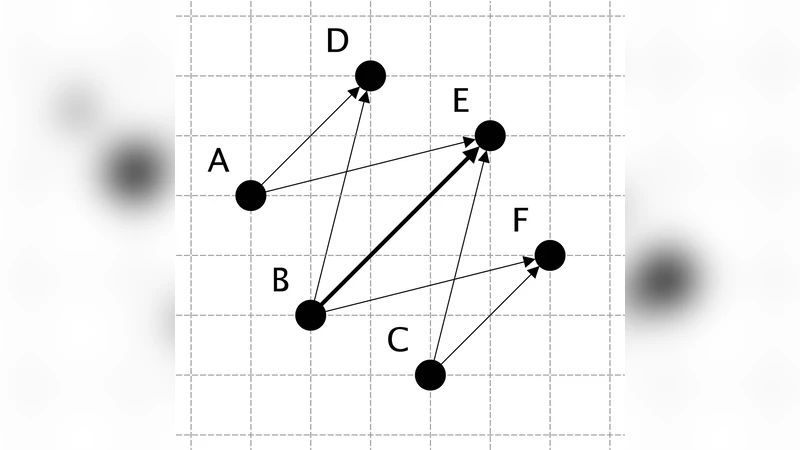
We introduce the problem of Weak Dominance Drawing for general directed acyclic graphs and we show the connection with the linear extension diameter of a partial order P. We present complexity results and bounds.
💡 Research Summary
The paper introduces a new graph‑drawing problem called Weak Dominance Drawing (WDD) that extends the classic dominance drawing concept from planar st‑graphs to arbitrary directed acyclic graphs (DAGs). In a traditional dominance drawing, a pair of vertices (u, v) satisfies X(u) ≤ X(v) and Y(u) ≤ Y(v) if and only if there exists a directed path from u to v. This equivalence holds only when the graph’s dominance dimension dim(G) equals 2, which is the case for planar st‑graphs. For DAGs with dim(G) > 2, the coordinate dominance may imply a path that does not actually exist; the authors call each such spurious implication a “falsely implied path” (fip).
A weak dominance drawing relaxes the “if‑and‑only‑if” condition: whenever a directed path exists, the corresponding coordinate dominance must hold, but the converse is not required. The objective of WDD is to assign two topological orderings t_X and t_Y to the vertices (equivalently, to place vertices in the plane) so that the number of fips, denoted fip(Γ), is minimized. The decision version asks, given a DAG G and an integer C, whether there exist two topological orderings whose intersection (the set of vertex pairs ordered consistently in both) has size at most C.
The authors relate the number of incomparable vertex pairs, inc(G) = |V|·(|V|−1)/2 − |E*| (where E* is the edge set of the transitive closure), to the possible number of fips: trivially fip(Γ) ≤ inc(G). They derive two upper bounds on the optimal fip count. Lemma 1 shows that if dim(G)=d, then the minimum possible fip is at most inc(G) − (d − 2). Lemma 2 uses a probabilistic argument to obtain a tighter bound: min_Γ fip(Γ) ≤ inc(G) − (d²·inc(G))/dim(G). Both bounds illustrate that larger dimension offers more flexibility to reduce spurious implications.
The core theoretical contribution is the equivalence between WDD and the Linear Extension Diameter (LED) problem for partially ordered sets. A poset P can be viewed as a transitive DAG G. A linear extension of P corresponds to a topological ordering of G. The distance between two linear extensions L_i and L_j, defined as the number of element pairs ordered oppositely, equals the number of fips when those extensions are used as t_X and t_Y. Consequently, finding a pair of linear extensions with maximal distance (the LED problem) is exactly the same as minimizing the intersection size (or equivalently the fip count) in WDD. Since LED has been proved NP‑complete (Brightwell & Massow, 2008), the reduction immediately yields NP‑completeness of WDD (Corollary 1).
The paper concludes by highlighting open research directions. One is to better understand the structure of the two topological orderings that achieve the minimal fip count, potentially leading to approximation or heuristic algorithms. Another is the generalization to more than two topological orderings, where the objective would be to minimize fips across all pairwise intersections—a problem that remains unexplored. The authors suggest that the derived bounds based on dim(G) and inc(G) could guide algorithm design, but exact optimization remains computationally intractable. Overall, the work bridges graph drawing, order theory, and computational complexity, opening a new avenue for visualizing DAGs beyond the restrictive planar case.
Comments & Academic Discussion
Loading comments...
Leave a Comment