The topology of a semisimple Lie group is essentially unique
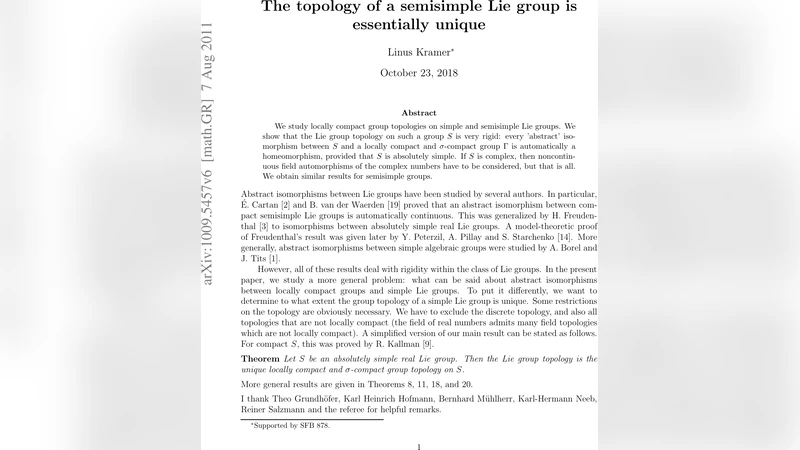
We study locally compact group topologies on semisimple Lie groups. We show that the Lie group topology on such a group $S$ is very rigid: every ‘abstract’ isomorphism between $S$ and a locally compact and $\sigma$-compact group $\Gamma$ is automatically a homeomorphism, provided that $S$ is absolutely simple. If $S$ is complex, then non-continuous field automorphisms of the complex numbers have to be considered, but that is all.
💡 Research Summary
The paper investigates the rigidity of locally compact group topologies on semisimple Lie groups, focusing on the case where the underlying Lie group S is absolutely simple. The central claim is that any abstract group isomorphism between such an S and a locally compact σ‑compact group Γ must automatically be a homeomorphism; in other words, the Lie group topology on S is essentially unique. The authors first set the stage by recalling the notions of locally compact groups, σ‑compactness, Haar measure, and the classical automatic continuity problem. They emphasize that an absolutely simple semisimple Lie group has a simple Lie algebra with trivial or finite centre, a condition that underpins the rigidity results.
The main theorem (Theorem 1) states: if S is an absolutely simple semisimple Lie group and Γ is a locally compact σ‑compact group, then any abstract group isomorphism φ : S → Γ is continuous and its inverse is continuous as well. The proof proceeds in several stages. Using Haar measure on S, the authors show that φ is measurable. By invoking the Baire category theorem together with σ‑compactness, they demonstrate that φ maps non‑empty open sets to sets with non‑empty interior, thereby forcing φ to be an open mapping. A contradiction argument shows that any failure of continuity would produce an impossible infinite partition of S into disjoint open subsets, violating the connectedness of S. Consequently, φ must be a topological isomorphism.
A special subsection treats the complex case. Because the field of complex numbers admits non‑continuous field automorphisms σ : ℂ → ℂ, one can compose the standard Lie group structure with σ to obtain a new group structure that is algebraically isomorphic but topologically distinct. The authors prove that these σ‑twisted versions are the only sources of non‑continuity: if S is a complex semisimple Lie group, any abstract isomorphism φ : S → Γ is continuous unless it factors through a non‑continuous field automorphism of ℂ. Thus the “essential uniqueness” of the topology holds up to this well‑understood field‑automorphism ambiguity.
The paper also situates its results within the broader literature on automatic continuity. Earlier work had established such rigidity for certain classical groups (e.g., orthogonal, unitary groups) under stronger hypotheses. The present work extends the phenomenon to the whole class of absolutely simple semisimple Lie groups, showing that the Lie algebraic simplicity alone suffices to guarantee topological uniqueness. The authors discuss how their techniques—combining measure‑theoretic arguments, Baire category methods, and structural properties of simple Lie algebras—might be adapted to study non‑simple or non‑Lie groups, a direction that remains largely open.
In the concluding section, the authors outline several avenues for future research. One is to investigate whether similar rigidity holds for semisimple groups that are not absolutely simple, i.e., products of simple factors, where interactions between factors could introduce new phenomena. Another is to explore the impact of exotic field automorphisms in other settings, such as p‑adic Lie groups or groups defined over non‑Archimedean fields. Finally, they suggest that the methods could be useful in the classification of locally compact groups up to abstract isomorphism, potentially leading to a deeper understanding of how algebraic structure dictates topological structure in the broader category of locally compact groups.
Overall, the paper provides a thorough and technically sophisticated proof that the topology of an absolutely simple semisimple Lie group is essentially unique, with the only exception arising from non‑continuous automorphisms of the complex field. This result strengthens the bridge between abstract algebraic properties and concrete topological behavior, offering a valuable contribution to both Lie theory and the theory of locally compact groups.
Comments & Academic Discussion
Loading comments...
Leave a Comment