Wave instabilities of a collisionless plasma in fluid approximation
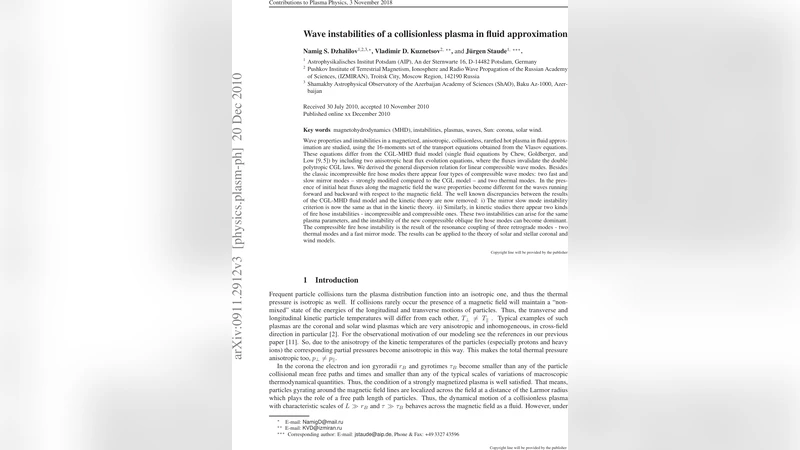
Wave properties and instabilities in a magnetized, anisotropic, collisionless, rarefied hot plasma in fluid approximation are studied, using the 16-moments set of the transport equations obtained from the Vlasov equations. These equations differ from the CGL-MHD fluid model (single fluid equations by Chew, Goldberger, and Low, 1956) by including two anisotropic heat flux evolution equations, where the fluxes invalidate the double polytropic CGL laws. We derived the general dispersion relation for linear compressible wave modes. Besides the classic incompressible fire hose modes there appear four types of compressible wave modes: two fast and slow mirror modes - strongly modified compared to the CGL model - and two thermal modes. In the presence of initial heat fluxes along the magnetic field the wave properties become different for the waves running forward and backward with respect to the magnetic field. The well known discrepancies between the results of the CGL-MHD fluid model and the kinetic theory are now removed: i) The mirror slow mode instability criterion is now the same as that in the kinetic theory. ii) Similarly, in kinetic studies there appear two kinds of fire hose instabilities - incompressible and compressible ones. These two instabilities can arise for the same plasma parameters, and the instability of the new compressible oblique fire hose modes can become dominant. The compressible fire hose instability is the result of the resonance coupling of three retrograde modes - two thermal modes and a fast mirror mode. The results can be applied to the theory of solar and stellar coronal and wind models.
💡 Research Summary
The paper presents a comprehensive fluid‑theory study of wave propagation and instabilities in a magnetized, anisotropic, collisionless, and rarefied hot plasma. Starting from the Vlasov equation, the authors derive a 16‑moment set of transport equations that extend the classic Chew‑Goldberger‑Low (CGL) magnetohydrodynamic model by incorporating two evolution equations for the anisotropic heat fluxes parallel to the magnetic field. This addition removes the double‑polytropic closure of the CGL model and allows the heat fluxes to evolve dynamically, thereby breaking the symmetry between forward‑ and backward‑propagating waves.
Linearizing the 16‑moment equations, the authors obtain a general dispersion relation for compressible modes. In addition to the well‑known incompressible fire‑hose instability, four distinct compressible wave families emerge: (i) a fast mirror mode, (ii) a slow mirror mode, and (iii) two thermal (or “heat‑flux”) modes. The slow mirror mode’s instability criterion now coincides exactly with that derived from kinetic theory, a major improvement over the CGL prediction, which overestimates the stability threshold. The presence of an initial heat flux along the magnetic field introduces a pronounced asymmetry: waves traveling parallel to the field experience different phase speeds and growth rates compared to those traveling antiparallel.
A particularly novel result is the identification of a compressible fire‑hose instability. This mode does not exist in the CGL framework; it arises from a resonant coupling of three retrograde branches – the two thermal modes and the fast mirror mode. The coupling produces an oblique, compressible fire‑hose branch whose growth rate can exceed that of the classical incompressible fire‑hose, especially at moderate to high plasma beta and for significant temperature anisotropy. Consequently, both incompressible and compressible fire‑hose instabilities may be present for the same plasma parameters, and the compressible branch can dominate the dynamics.
The authors discuss the physical implications of these findings for space and astrophysical plasmas. The revised instability thresholds and the new compressible fire‑hose mode provide a more accurate description of the conditions observed in the solar corona, solar wind, and stellar winds, where temperature anisotropies and heat fluxes are substantial. By reconciling fluid‑model predictions with kinetic theory, the 16‑moment approach offers a practical yet rigorous tool for modeling wave–particle interactions, energy transport, and plasma heating in collisionless environments. The paper thus bridges a long‑standing gap between fluid and kinetic descriptions and opens avenues for improved coronal and heliospheric modeling.
Comments & Academic Discussion
Loading comments...
Leave a Comment