Pseudogroups and their etale groupoids
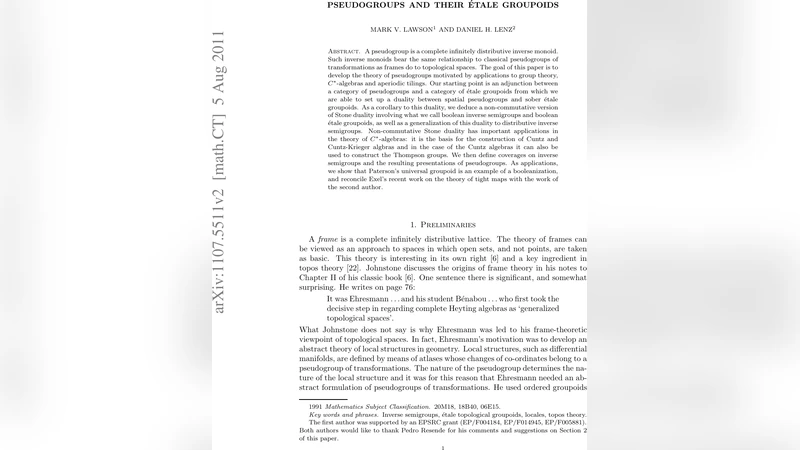
A pseudogroup is a complete infinitely distributive inverse monoid. Such inverse monoids bear the same relationship to classical pseudogroups of transformations as frames do to topological spaces. The goal of this paper is to develop the theory of pseudogroups motivated by applications to group theory, C*-algebras and aperiodic tilings. Our starting point is an adjunction between a category of pseudogroups and a category of etale groupoids from which we are able to set up a duality between spatial pseudogroups and sober etale groupoids. As a corollary to this duality, we deduce a non-commutative version of Stone duality involving what we call boolean inverse semigroups and boolean etale groupoids, as well as a generalization of this duality to distributive inverse semigroups. Non-commutative Stone duality has important applications in the theory of C*-algebras: it is the basis for the construction of Cuntz and Cuntz-Krieger algbras and in the case of the Cuntz algebras it can also be used to construct the Thompson groups. We then define coverages on inverse semigroups and the resulting presentations of pseudogroups. As applications, we show that Paterson’s universal groupoid is an example of a booleanization, and reconcile Exel’s recent work on the theory of tight maps with the work of the second author.
💡 Research Summary
The paper introduces the notion of a pseudogroup as a complete, infinitely distributive inverse monoid, positioning these algebraic objects as the non‑commutative analogue of frames in point‑free topology. By observing that the idempotent semilattice of a pseudogroup is precisely a frame, the authors set up a categorical bridge between pseudogroups and étale groupoids. The central construction is an adjunction between the category of pseudogroups and the category of étale groupoids; this adjunction yields a duality between spatial pseudogroups (those whose idempotents correspond to genuine open subsets) and sober étale groupoids.
From this duality two major non‑commutative Stone‑type correspondences are derived. First, a Boolean inverse semigroup—an inverse semigroup whose idempotents form a Boolean algebra—corresponds dually to a Boolean étale groupoid, i.e., an étale groupoid whose space of identities is a Boolean space. This gives a non‑commutative version of classical Stone duality. Second, the authors extend the correspondence to distributive inverse semigroups, relaxing the requirement of infinite distributivity while preserving the duality with a suitable class of étale groupoids.
A key technical tool introduced is the notion of a coverage on an inverse semigroup. A coverage specifies which families of elements “cover” a given element, allowing one to present a pseudogroup as the completion of a free inverse semigroup modulo covering relations. Using this framework the paper shows that Paterson’s universal groupoid of an inverse semigroup is precisely the Booleanization (i.e., the Boolean étale groupoid obtained by Booleanizing the idempotent semilattice) of the associated pseudogroup.
The authors also reconcile Exel’s theory of tight maps with their coverage approach. Tight filters—central to Exel’s construction of C*-algebras from inverse semigroups—are shown to be exactly the proper filters that satisfy the covering axioms. Consequently, the tight representation of an inverse semigroup into a C*-algebra coincides with the representation obtained from the Boolean étale groupoid arising via coverage. This connection underlies the construction of Cuntz–Krieger algebras and, in the case of Cuntz algebras, provides a pathway to the Thompson groups.
Several concrete applications are discussed. For inverse semigroups arising from locally finite tilings, the groupoid of ultrafilters coincides with the tiling groupoid. For inverse semigroups built from locally finite directed graphs, the ultrafilter groupoid matches the graph groupoid introduced by Kumjian, Pask, Raeburn, and Renault. The paper also demonstrates that the Booleanization process yields Paterson’s universal groupoid, thereby unifying several previously disparate constructions.
Overall, the work unifies frame theory, inverse semigroup theory, and étale groupoid theory within a single categorical framework, providing powerful tools for the analysis of C*-algebras, aperiodic tilings, and related algebraic structures. By establishing robust dualities and presenting a systematic method for constructing pseudogroups via coverages, the authors open new avenues for both theoretical exploration and concrete applications in non‑commutative topology and operator algebras.
Comments & Academic Discussion
Loading comments...
Leave a Comment