Relativity, Doppler shifts, and retarded times in deriving the correction for the finite speed of light: a comment on Second-order Doppler-shift corrections in free-fall absolute gravimeters
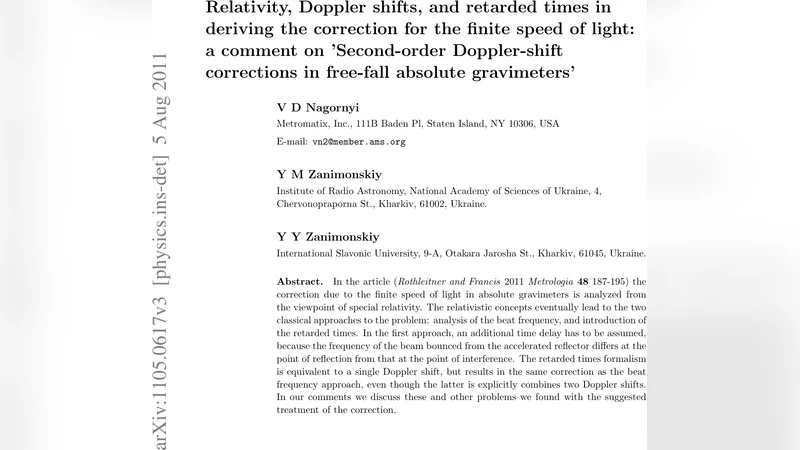
In the article (Rothleitner and Francis 2011 Metrologia 48 187-195) the correction due to the finite speed of light in absolute gravimeters is analyzed from the viewpoint of special relativity. The relativistic concepts eventually lead to the two classical approaches to the problem: analysis of the beat frequency, and introduction of the retarded times. In the first approach, an additional time delay has to be assumed, because the frequency of the beam bounced from the accelerated reflector differs at the point of reflection from that at the point of interference. The retarded times formalism is equivalent to a single Doppler shift, but results in the same correction as the beat frequency approach, even though the latter is explicitly combines two Doppler shifts. In our comments we discuss these and other problems we found with the suggested treatment of the correction.
💡 Research Summary
The paper presents a critical examination of the relativistic treatment of the finite‑speed‑of‑light correction in absolute gravimeters as proposed by Rothleitner and Francis (Metrologia 48, 2011). The authors, Nagornyi, Zanimonskiy, and Zanimonskiy, argue that special‑relativistic effects are utterly negligible for the velocities involved in modern absolute gravimeters (maximum test‑mass speed ≈ 2 m/s). The second‑order term of the Lorentz factor, V²/2c², is on the order of 10⁻¹⁷, far below the instrument’s attainable accuracy (10⁻¹⁰) and even below the quantum‑mechanical uncertainty limits for ballistic gravimetry. Consequently, any “relativistic” terminology is misleading; the correction is fundamentally a classical problem involving Doppler shifts and signal‑propagation delays.
The authors then dissect two classical approaches that lead to the same correction: (1) analysis of the beat frequency generated by the interference of the reference and reflected laser beams, and (2) the retarded‑time formalism, which treats the finite light‑travel time as a delay applied to the reflector’s position. For the beat‑frequency method, they emphasize that a simple double‑Doppler shift formula, f₀₀₀ = f₀(1 + 2V/c + 2V²/c² + …), is valid only at the instant of reflection τ. In an accelerated free‑fall, the reflected frequency changes between τ (reflection) and t (interference). Ignoring this leads to an implicit assumption of infinite light speed. By relating τ and t through τ = t − (b + V₀t + ½g₀t²)/c, they derive the observed reflected frequency f₀₀₀(t) and obtain a disturbed acceleration g(t) = g₀ + 3g₀c(V₀ + g₀t). This differs from the naïve substitution V → V₀ + g₀t in the double‑Doppler formula, which would give g(t) = g₀ + 2g₀c(V₀ + g₀τ). The extra factor of 3 arises from the proper accounting of the time delay between reflection and interference.
A crucial point raised is that the correction cannot be derived in isolation from the gravimeter’s data model. The measured acceleration is a weighted average of the true acceleration plus any disturbance Δg(t) over the measurement interval T, with the weighting function w(t) determined by the measurement scheme (e.g., equally spaced in time, equally spaced in distance, multi‑level schemas). The correction is Δg = −∫Δg(t)w(t)dt. Different weighting functions lead to different numerical corrections; mixing models, as illustrated by Murata (1978), can introduce biases of several µGal. Therefore, any comparison of correction formulas must specify the underlying data model and weighting function.
The retarded‑time approach treats the finite speed of light as a single delay applied to the reflector’s coordinate: the observed velocity V₀ = V/(1 + V/c) mimics a Doppler shift but originates from signal travel time. By differentiating the delayed position twice, the authors obtain the same disturbed acceleration g(t) = g₀ + 3g₀c(V₀ + g₀t) as in the beat‑frequency analysis, demonstrating the equivalence of the two methods despite their different physical interpretations.
The paper also points out several inconsistencies in the literature: misuse of the term “second‑order Doppler shift” (which in this context refers to the second‑order term of the classical Doppler expansion, not the relativistic shift), confusion between disturbance magnitudes and integrated trajectory biases, and misinterpretation of earlier works (e.g., Kuroda & Mio 1991) regarding the number of Doppler factors involved.
In conclusion, the authors make three main statements: (i) relativistic corrections are far below the detection threshold for absolute gravimetry and can be ignored; (ii) for an accelerating reflector, the reflected beam’s frequency varies with time and distance, necessitating an additional time‑delay term when extracting the acceleration from the beat frequency; (iii) the beat‑frequency and retarded‑time formalisms, though based on different aspects of light propagation, are mathematically equivalent in yielding the same acceleration disturbance and thus the same correction. The paper advocates focusing on accurate classical optical modeling and consistent data‑model weighting rather than invoking relativistic terminology.
Comments & Academic Discussion
Loading comments...
Leave a Comment