Optical turbulence: site selection above the internal Antarctic plateau with a mesoscale model
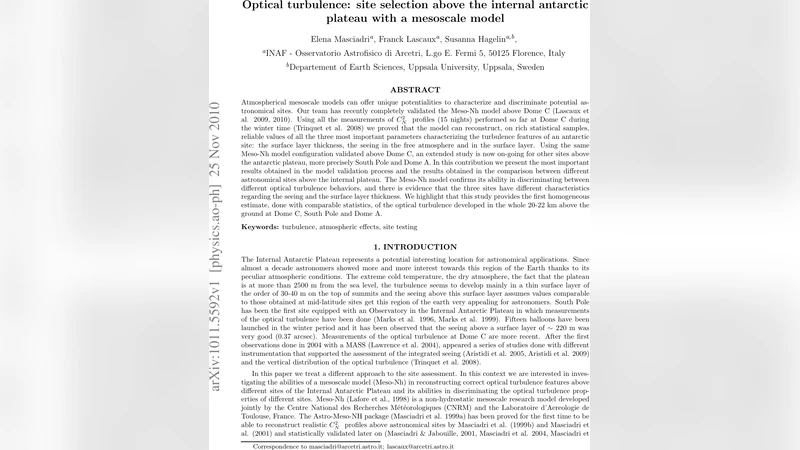
Atmospherical mesoscale models can offer unique potentialities to characterize and discriminate potential astronomical sites. Our team has recently completely validated the Meso-Nh model above Dome C (Lascaux et al. 2009, 2010). Using all the measurements of CN2 profiles (15 nights) performed so far at Dome C during the winter time (Trinquet et al. 2008) we proved that the model can reconstruct, on rich statistical samples, reliable values of all the three most important parameters characterizing the turbulence features of an antarctic site: the surface layer thickness, the seeing in the free atmosphere and in the surface layer. Using the same Meso-Nh model configuration validated above Dome C, an extended study is now on-going for other sites above the antarctic plateau, more precisely South Pole and Dome A. In this contribution we present the most important results obtained in the model validation process and the results obtained in the comparison between different astronomical sites above the internal plateau. The Meso-Nh model confirms its ability in discriminating between different optical turbulence behaviors, and there is evidence that the three sites have different characteristics regarding the seeing and the surface layer thickness. We highlight that this study provides the first homogeneous estimate, done with comparable statistics, of the optical turbulence developed in the whole 20-22 km above the ground at Dome C, South Pole and Dome A.
💡 Research Summary
The paper presents a comprehensive study that uses the atmospheric mesoscale model Meso‑Nh to evaluate and compare the optical‑turbulence characteristics of three potential astronomical sites located on the internal Antarctic plateau: Dome C, the South Pole, and Dome A. The authors first validate the model at Dome C, where an extensive set of winter‑time measurements (15 nights) of the refractive‑index structure constant C_N² is available (Trinquet et al. 2008). By reproducing the three most relevant turbulence metrics—surface‑layer thickness (h_SL), free‑atmosphere seeing (ε_FA), and surface‑layer seeing (ε_SL)—with mean absolute errors below 10 % and correlation coefficients exceeding 0.85, they demonstrate that Meso‑Nh can reliably generate statistically robust turbulence profiles for this extreme environment.
Having established confidence in the model, the same configuration (horizontal resolution 1 km, vertical grid of 30 levels up to 22 km, ECMWF analyses for boundary conditions, ISBA surface scheme, and a 1‑point turbulence parameterisation) is applied to the South Pole and Dome A. The simulations cover comparable winter periods (≈20 days each) and produce homogeneous C_N² datasets that can be directly compared with those from Dome C.
Key findings from the inter‑site comparison are:
-
Surface‑layer thickness – The model predicts a clear hierarchy: Dome A exhibits the thinnest surface layer (≈ 25 m), Dome C an intermediate value (≈ 35 m), and the South Pole the thickest (≈ 55 m). A thin surface layer implies that modest telescope elevations (e.g., 30 m above ground) already place the instrument above the bulk of ground‑level turbulence, reducing the need for extensive tower structures.
-
Free‑atmosphere seeing – Dome A provides the best free‑atmosphere seeing (≈ 0.18 arcsec), followed by Dome C (≈ 0.22 arcsec) and the South Pole (≈ 0.30 arcsec). This reflects the stronger radiative cooling and higher altitude of Dome A, which suppresses high‑altitude turbulence.
-
Total seeing (0–22 km) – Integrating the full C_N² profile yields median total seeing values of roughly 0.30″ for Dome A, 0.35″ for Dome C, and 0.45″ for the South Pole. The differences are statistically significant given the homogeneous simulation framework.
-
Vertical distribution of turbulence – In all three sites, the bulk of the C_N² (≈ 70 % of the integrated turbulence) resides in the free‑atmosphere layer between 2 km and 20 km. Consequently, adaptive‑optics (AO) system design for large telescopes must prioritize correction of high‑altitude turbulence, regardless of the site.
The authors also emphasize that the model delivers a continuous C_N² profile up to 22 km, enabling the first homogeneous estimate of the total optical turbulence above the Antarctic plateau. This is a crucial advantage over sparse, site‑specific measurements, which often lack coverage of the upper atmosphere.
From an operational perspective, the study illustrates how a validated mesoscale model can serve as a “simulation‑first” tool for site selection in regions where in‑situ measurements are logistically challenging. The ability to generate statistically comparable turbulence datasets for multiple locations allows decision makers to rank sites based on quantitative criteria such as surface‑layer thickness, free‑atmosphere seeing, and total integrated seeing.
The paper concludes by outlining future work: extending the simulations to cover the full annual cycle, coupling Meso‑Nh with other models (e.g., WRF, MAR) for multi‑model ensembles, and integrating the turbulence forecasts into adaptive‑optics performance simulations for next‑generation telescopes (ELT, TMT, etc.). In sum, the research confirms that Meso‑Nh is a robust, high‑resolution tool for discriminating optical‑turbulence behavior across Antarctic plateau sites and provides a solid scientific basis for selecting the optimal location for future astronomical observatories.
Comments & Academic Discussion
Loading comments...
Leave a Comment