Structured Operational Semantics for Graph Rewriting
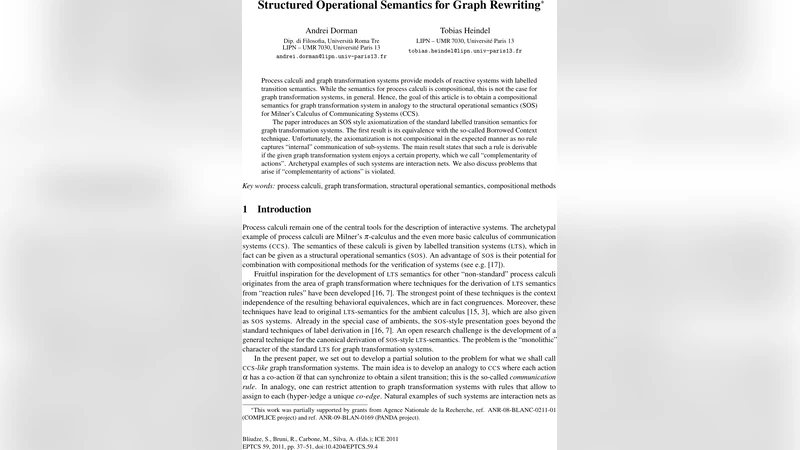
Process calculi and graph transformation systems provide models of reactive systems with labelled transition semantics. While the semantics for process calculi is compositional, this is not the case for graph transformation systems, in general. Hence, the goal of this article is to obtain a compositional semantics for graph transformation system in analogy to the structural operational semantics (SOS) for Milner’s Calculus of Communicating Systems (CCS). The paper introduces an SOS style axiomatization of the standard labelled transition semantics for graph transformation systems. The first result is its equivalence with the so-called Borrowed Context technique. Unfortunately, the axiomatization is not compositional in the expected manner as no rule captures “internal” communication of sub-systems. The main result states that such a rule is derivable if the given graph transformation system enjoys a certain property, which we call “complementarity of actions”. Archetypal examples of such systems are interaction nets. We also discuss problems that arise if “complementarity of actions” is violated.
💡 Research Summary
The paper tackles the long‑standing gap between the compositional structural operational semantics (SOS) that underpins process calculi such as Milner’s CCS and the largely monolithic labelled transition semantics traditionally used for graph transformation systems (GTS). The authors first recall the double‑pushout (DPO) approach to hyper‑graph rewriting and the Borrowed Context (BC) technique introduced in earlier work. In the BC framework a state is an inclusion J → G (J is the interface) and a transition label is a pair of inclusions J → F ← K. A transition exists when a DPO‑BC diagram can be completed, i.e., when the minimal context F that “borrows” the missing part of a rule’s left‑hand side is supplied and the rule can be applied, after which the interface is updated via a pullback. This yields a labelled transition system (LTS) that is sound and, under certain conditions, a congruence.
The core contribution is a reformulation of this BC semantics as an SOS rule system, called SOS_BC. The authors introduce three families of inference rules:
-
Basic Action axioms – For each graph rewriting rule ρ = (L ← I → R) and each subgraph D ⊆ L, an axiom allows the system to “borrow” the complement b_D^L, assemble the full left‑hand side L, and then replace it by R. This mirrors the CCS axiom a·P →_a P.
-
Context rules (application and narrowing) – A context C = J → E ← J₀ can be applied to any transition, provided it is monotone (J → J) and does not interfere with the deletion part of the rule. The “narrowing” rule corresponds to name restriction (ν a) in CCS: a context of the form J → J ← J₀ removes the interface elements J₀ from a label, provided the required push‑out complement exists.
-
Parallel composition rule – A transition can be embedded in a larger, non‑inhibiting context, analogous to parallel composition P | Q in CCS. The authors formalise “non‑inhibiting” via the existence of a diagram where both squares are push‑outs, ensuring that the added context supplies at least the trigger part F without attaching new edges to nodes that will be deleted.
While SOS_BC faithfully reproduces the BC LTS, it initially lacks a rule that captures internal communication (the CCS τ‑rule). In CCS, complementary actions α and α̅ synchronize to a silent τ transition. The paper shows that such a rule is not derivable in general for arbitrary graph rewriting systems because the necessary “matching” of complementary parts may be impossible.
To overcome this, the authors introduce the property complementarity of actions. A GTS enjoys this property if for every label α there exists a pair of complementary edges (or hyper‑edges) such that any occurrence of α in a graph can be paired with an occurrence of its complement α̅, and the two together satisfy the non‑overlap conditions required for a DPO push‑out. When this property holds, the authors prove that a τ‑rule becomes derivable in SOS_BC: two basic actions that are complements can be combined in a single transition whose label is a silent τ, and the resulting state is the parallel composition of the two residual graphs. Interaction nets are presented as a canonical example: each node has a unique dual, and rewriting rules always involve a pair of dual edges, guaranteeing complementarity.
The paper also analyses what goes wrong when complementarity is violated. If a label has multiple potential complements or if complementary parts belong to different rules, the construction of a τ‑transition may be ambiguous or impossible, leading to non‑confluent transition systems and breaking the congruence property of the LTS. In such cases the BC technique and SOS_BC are no longer equivalent, and additional ad‑hoc rules would be required to regain compositionality.
Finally, the authors discuss the implications of their results. By providing an SOS‑style, compositional semantics for a substantial class of graph rewriting systems, they open the door to applying the rich toolbox of process‑algebraic verification (bisimulation, congruence checking, compositional reasoning) to graph‑based models. The work also clarifies the precise structural conditions (complementarity) under which internal communication can be expressed, offering a design guideline for future graph‑based languages and interaction‑net frameworks.
In summary, the paper (1) formalises an SOS axiomatization of the BC labelled transition semantics, (2) proves its equivalence to the original BC approach, (3) identifies the lack of an internal communication rule, (4) introduces and exploits the complementarity of actions property to derive such a rule for systems like interaction nets, and (5) analyses the failure modes when the property does not hold, thereby contributing both a theoretical foundation and practical insights for compositional graph rewriting.
Comments & Academic Discussion
Loading comments...
Leave a Comment