$K$-theory of Leavitt path algebras
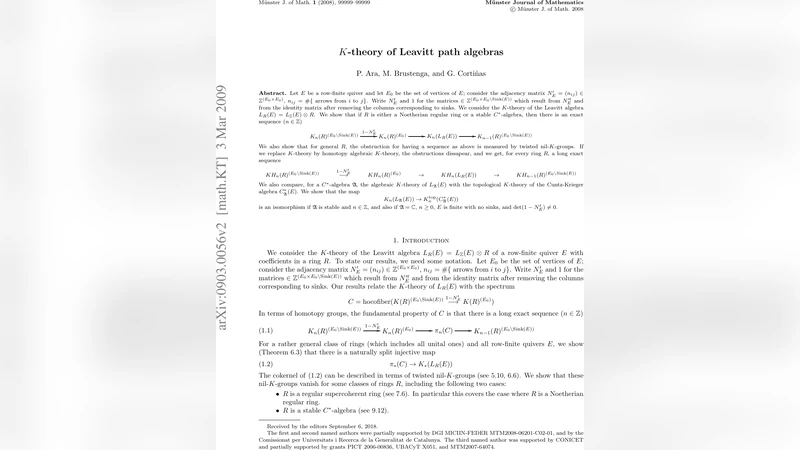
Let $E$ be a row-finite quiver and let $E_0$ be the set of vertices of $E$; consider the adjacency matrix $N’E=(n{ij})\in\Z^{(E_0\times E_0)}$, $n_{ij}=#{$ arrows from $i$ to $j}$. Write $N^t_E$ and 1 for the matrices $\in \Z^{(E_0\times E_0\setminus\Sink(E))}$ which result from $N’^t_E$ and from the identity matrix after removing the columns corresponding to sinks. We consider the $K$-theory of the Leavitt algebra $L_R(E)=L_\Z(E)\otimes R$. We show that if $R$ is either a Noetherian regular ring or a stable $C^$-algebra, then there is an exact sequence ($n\in\Z$) [ K_n(R)^{(E_0\setminus\Sink(E))}\stackrel{1-N_E^t}{\longrightarrow} K_n(R)^{(E_0)}\to K_n(L_R(E))\to K_{n-1}(R)^{(E_0\setminus\Sink(E))} ] We also show that for general $R$, the obstruction for having a sequence as above is measured by twisted nil-$K$-groups. If we replace $K$-theory by homotopy algebraic $K$-theory, the obstructions dissapear, and we get, for every ring $R$, a long exact sequence [ KH_n(R)^{(E_0\setminus\Sink(E))}\stackrel{1-N_E^t}{\longrightarrow}KH_n(R)^{(E_0)}\to KH_n(L_R(E))\to KH_{n-1}(R)^{(E_0\setminus\Sink(E))} ] We also compare, for a $C^$-algebra $\fA$, the algebraic $K$-theory of $L_\fA(E)$ with the topological $K$-theory of the Cuntz-Krieger algebra $C^\fA(E)$. We show that the map [ K_n(L\fA(E))\to K^{\top}_n(C^_\fA(E)) ] is an isomorphism if $\fA$ is stable and $n\in\Z$, and also if $\fA=\C$, $n\ge 0$, $E$ is finite with no sinks, and $\det(1-N_E^t)\ne 0$.
💡 Research Summary
The paper investigates the algebraic K‑theory of Leavitt path algebras associated to a row‑finite quiver E, denoted L_R(E)=L_ℤ(E)⊗R, and establishes precise long exact sequences that relate the K‑groups of the coefficient ring R to those of the Leavitt algebra. The authors begin by fixing the vertex set E₀ of E and defining the adjacency matrix N′_E∈ℤ^{E₀×E₀} where the (i,j)‑entry counts arrows from i to j. By deleting the columns corresponding to sink vertices, they obtain a reduced transpose matrix N_E^t and a similarly reduced identity matrix 1, both living in ℤ^{E₀×(E₀\Sink(E))}. The map 1−N_E^t, acting by matrix multiplication on direct sums of K‑groups indexed by vertices, is the central operator in the exact sequences.
The first main theorem states that if the coefficient ring R is either a Noetherian regular ring or a stable C*‑algebra, then for every integer n there is a short exact sequence
\
Comments & Academic Discussion
Loading comments...
Leave a Comment