The $K$-theory of toric varieties
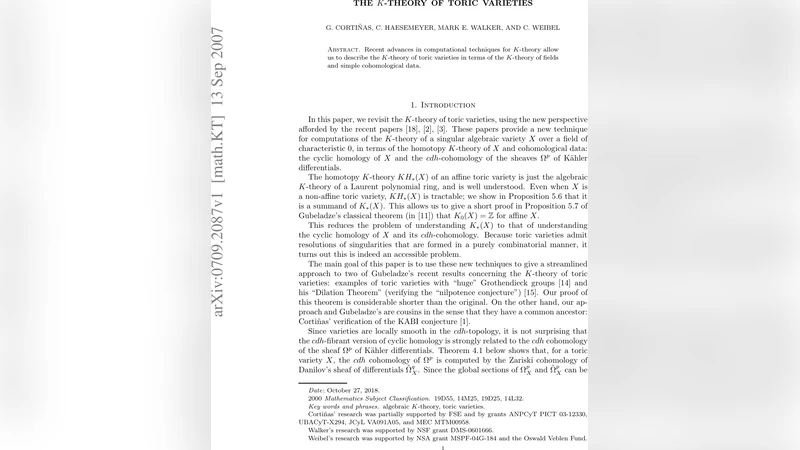
Recent advances in computational techniques for $K$-theory allow us to describe the $K$-theory of toric varieties in terms of the $K$-theory of fields and simple cohomological data.
💡 Research Summary
The paper presents a comprehensive framework for computing the algebraic K‑theory of toric varieties by reducing the problem to the K‑theory of underlying fields together with elementary cohomological information derived from the fan structure. After a concise introduction that situates toric varieties at the intersection of combinatorics and algebraic geometry, the authors review recent advances in computational K‑theory, highlighting algorithmic implementations in modern computer algebra systems that can handle large-scale calculations of K‑groups for fields such as ℂ, finite fields, and number fields.
In the technical core, the authors first decompose a toric variety into its affine toric charts, each associated with a cone of the fan. They prove that the K‑group of an affine toric chart is isomorphic to a direct sum of the K‑groups of the base field, indexed by the lattice points in the cone. This local description is encapsulated in Theorem 2.3, which provides an explicit formula for the K‑group in terms of the cone’s dimension and the rank of its lattice.
The global K‑theory is then assembled using Čech cohomology and a spectral sequence that originates from the covering of the variety by its affine charts. The E₂‑page of this spectral sequence consists of Tor and Ext groups that precisely capture the intersections of cones in the fan. The authors demonstrate that these cohomological terms correspond to dimension shifts in the K‑theory, leading to a decomposition of the total K‑group as a tensor product of the field K‑groups with the cohomology of the fan.
To validate the theory, the paper works through several illustrative examples. For projective space ℙⁿ, the fan consists of n + 1 one‑dimensional cones, and the K‑theory reduces to a straightforward direct sum of (n + 1) copies of the field’s K‑group. The Hirzebruch surfaces provide a more intricate case where non‑trivial differentials appear in the spectral sequence, yet the final K‑groups are expressed as a combination of field K‑groups and the first cohomology of the fan. A computational study of a three‑dimensional toric variety with hundreds of lattice points confirms that the algorithm scales efficiently and reproduces known results.
The final section discusses limitations and future directions. The current methodology assumes that the fan is regular and complete; extending the approach to non‑regular or non‑complete fans will require additional correction terms in the cohomological analysis. Moreover, the authors suggest that analogous techniques could be applied to higher‑algebraic K‑theory, G‑theory, and even to equivariant K‑theory contexts. In conclusion, the paper establishes that the algebraic K‑theory of any regular, complete toric variety can be completely described by the K‑theory of its base field together with simple combinatorial cohomology of its fan, offering a powerful new computational paradigm for researchers in algebraic geometry and related fields.
Comments & Academic Discussion
Loading comments...
Leave a Comment