On the Throughput-Delay Trade-off in Georouting Networks
We study the scaling properties of a georouting scheme in a wireless multi-hop network of $n$ mobile nodes. Our aim is to increase the network capacity quasi linearly with $n$ while keeping the average delay bounded. In our model, mobile nodes move a…
Authors: Philippe Jacquet, Salman Malik, Bernard Mans
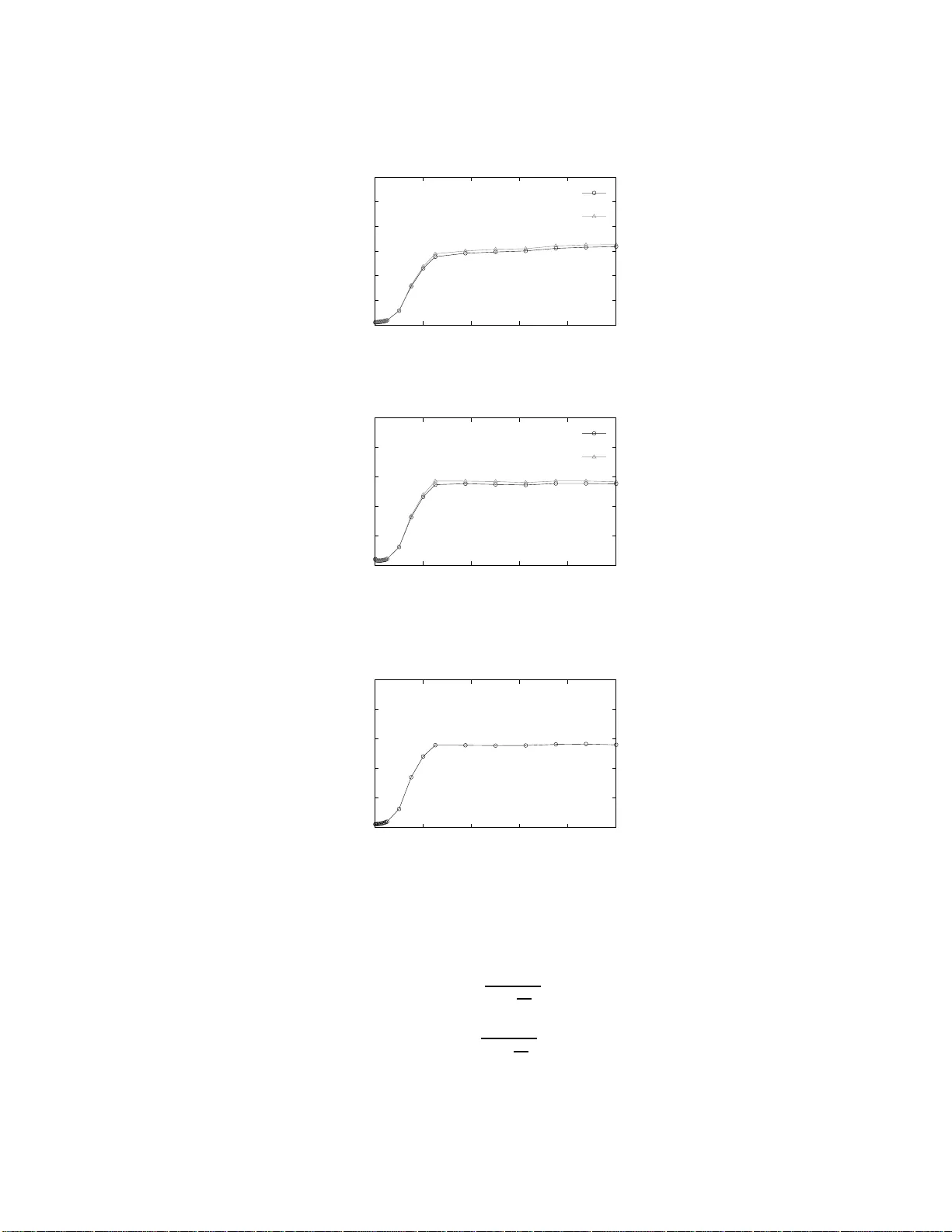
On the Throughput-Del ay T rade-off in Georouting Net w orks Phili pp e Jacquet ∗ , Salm an Malik* , Bernard Mans † , Al onso Silv a*, Abstract W e study the scaling prop erties of a georouting sc h eme in a wireless m ulti-hop net work of n mobile n o des. O ur aim is to increase the net work capacit y quasi linearly with n while k eeping the a v erage delay boun ded. In our model, mobile nod es mo ve according to an i.i.d. random wa lk with velocit y v and transmit pac kets to randomly c hosen d estinations. The av erage pac ket deliv ery d ela y of our s cheme is of ord er 1 /v and it ac hiev es the net work capacit y of ord er n log n log log n . This sho ws a p ractical throughput-delay trade-off, in particular when compared with the s emin al result of Gupta and Kumar w h ic h sho ws net wo r k capacit y of order p n/ log n and n egligible dela y and the groundb r eaking result of Grossglausser and Tse w hic h ac hieves net work capacit y of order n but with an av erage dela y of order √ n/v . W e confirm the generalit y of our analytical resu lts usin g simulat ions under v arious interference mo dels. 1 In tro ductio n Gupta and Kumar [1] studied t he capacit y of wireless netw orks consisting of ra ndo mly lo cated no des whic h a re immobile. They show ed that if eac h source no de has a ra ndomly chose n destination no de, the useful netw ork capacit y is o f order C p n/ log n where n is the num b er of no des and C is the nominal capacit y of eac h no de. Ho w ev er, if the no des are mobile and follow i.i.d. ergo dic mot ions in a square area, Grossglauser and Tse [2] sho w ed that the net w ork capacit y can rise to O ( nC ) 1 b y using the mobilit y of the no des. Note that in this case, a source no de r ela ys its pac k et to a ra ndom mo bile relay no de whic h transmits this pac k et to its destination no de only when they come close tog ether, i.e. , at a distance of order 1 / √ n . Therefore, the time it take s to deliv er a pack et to its destination would b e o f o rder ∗ INRIA, Ro cquencourt, F rance . Email: na me.su rname@ inria.fr † Macquarie Universit y , Sidney , Austra lia. Email: ber nard.m ans@m q.edu.au 1 W e re call the following notation: (i) f ( n ) = O ( g ( n )) means that there exists a constant c and a n integer N such tha t f ( n ) ≤ cg ( n ) for n > N . (ii) f ( n ) = Θ ( g ( n )) mea ns that there exists tw o constants c 1 and c 2 and a n integer N such that c 1 g ( n ) ≤ f ( n ) ≤ c 2 g ( n ) for n > N . 1 Network Ca p acity Delivery De lay Gupta & K umar O q n log n negligible [1] Grossglauser & Tse O ( n ) O √ n v [2] Our w ork O n log n log log n O 1 v T able 1 : Netw o r k Ca pacity v s . Delivery Delay T rade-off. √ nL/v where v is the av erage sp eed of the no des a nd L is the length of the fixed square area where no des are deplo ye d. In con trast, in G upta and Kumar’s result [1], the pac ke t deliv ery dela y tends to b e negligible, although the net w or k capacit y dro ps by a fa cto r of √ n lo g n . In this a r ticle, w e aim to maximize the capacity of mobile net w orks while keep ing the mean pac k et deliv ery dela y b ounded with increasing n um b er of no des. F or rela ying pac kets tow ards their destinations, mobile no des use our prop osed georouting strategy , called the Constr aine d R elative B e aring (CRB) sc heme. W e sho w tha t, in a ra ndom w a lk mobility mo del, this strategy ac hiev es a net work capa city of order n log n log log n C with a time to deliv ery of order L/v . Our main contribution is summarized in T able 1. Note that in ra ndom w alk mobilit y mo dels, no des ha ve f r ee space motion and mo ve in straight lines with constan t sp eed. This mobilit y mo del is a sub class of the free space mo t io n mobilit y mo del. Therefore, we can also extend our result to mobilit y mo dels where t he av erage free space distance ℓ is non zero. Consider an example of a n urban area netw ork in a fixed square a rea of length L with n um b er of no des n = 10 6 , nominal bandwidth C = 100 kbps and dela y p er store-and-forward op eration of 1 ms. The av erage pack et deliv ery dela y for Gupta and Kumar’s case w o uld b e around o ne second but with a net w or k capacit y of 10 Mbps. In the case of Grossglauser and Tse, the net w ork capacity w ould increase to ab out 10 0 Gbps but if the straig h t line crossing time L/v is ab out one hour ( e.g. , with cars as mobile no des), the time to deliv ery w ould b e around one mon th. How ev er, o ur mo del of using mobility of no des along with the prop osed CRB sc heme, to rela y pac k ets to their destinations, w ould lead to a net work capacit y of 10 Gbps with time to deliv ery of ab o ut o ne hour. This article is organized as follows . W e first summarize some imp ortant related w orks and results in Section 2 . W e discuss the mo dels of our net work and CRB sch eme in Sections 3 and 4 resp ectiv ely . The analysis of capacit y and dela y can be found in Section 5 and w e confirm this analysis using simulations in Section 6. W e also discuss a few extensions of o ur 2 w ork in Section 7 and concluding remarks can b e found in Section 8. 2 Related W o r ks The main difference b et w een the prop osed mo dels in the w orks o f Gupta and Kumar [1] and Grossglauser and Tse [2] is that in the former case, no des are stat ic and pack ets are transmitted b et w een no des lik e “hot p otato es”, while in t he latt er case, no des are mobile and relays a re allow ed to car r y buffered pa c k ets while they mov e. Both strategies are based on the follo wing mo del: if p n is t he tra nsmission rate of each no de, i.e. , the prop ortion o f time eac h no de is active and transmitting, the radius of efficien t transmission is giv en b y r n ∼ L q κ np n when n approaches infinit y fo r some constant κ > 0 whic h dep ends on the proto col, in terference mo del, etc. In the context o f [1], the num b er of relays a pack et has to trav erse to reac h its destination is h n = O (1 /r n ). Consequen tly , np n C mus t b e divided b y h n to g et the useful capacit y: np n C / h n = O ( C √ p n n ). In or der to ensure connectivit y in the net w o r k, so that ev ery source is able to comm unicate with its randomly c hosen destination, p n m ust satisfy the limit p n ≤ O (1 / log n ). This leads to Gupta and Kumar’s maximum capacit y of O ( C p n/ log n ) with “ ho t p o tato es” routing. In con trast, in the con text of [2], the net work do es not need to b e connected since the pack ets are mostly carried in the buffer of a mobile relay . Therefore there is no limit on p n other than the requiremen t that it m ust b e smaller than some ε < 1 t ha t dep ends on the proto col and some other phys ical parameters. Th us r n is O (1 / √ n ). In Grossglauser and Tse’s mo del, the source transmits the pac k et to the closest mobile relay or ke eps it until it finds o ne. This mobile relay deliv ers t he pa c k et to the destination when it comes within range of the destination no de. Such a pac ket deliv ery requires a transmission phase whic h also includes retries and ackn o wledgemen ts so t ha t the pac ket deliv ery can b e ev en tually guaranteed. The prop osed mo del of [2] requires a GPS-lik e p ositioning system and the know ledge of the effectiv e range r n . The estimate of r n could b e ach ieved via a p erio dic b eaconing from ev ery no de, where eac h b eacon con t a ins the p osition co o r dinates of the no de, so tha t a no de kno ws the typic a l distance for a successful reception. How ev er, the rela y cannot rely on b eaconing in order to detect when it is in the reception range o f the destination. The reason is that a no de stays in t he reception range of anot her no de for a short t ime p erio d of order r n /v = 1 / √ n and this cannot b e detected via a p erio dic b eaconing with b ounded fr equency since p n = O (1) (the freque ncy of p erio dic b eaconing should b e of O ( √ n )). W e may also assume that t he destination no de is fixed and its car t esian co ordinates are kno wn b y the mobile rela y . Otherwise, if the destination no de is mobile, there w ould b e a requiremen t for this no de to track its new co ordinates and disseminate this information in the wireless net w ork as in [3 , 4]. It is also interesting to note that Diggavi, G rossglauser, and Tse [5] sho we d that a constan t 3 throughput p er source-destination pair is feasible ev en with a more restricted mobilit y mo del. F rancesc hetti et al. [6] pro v ed that there is no gap b et w een the capacit y of randomly lo cated and arbitrar ily lo cated no des. Throughput and dela y t rade-offs hav e app ear ed in [7, 8] where dela y of m ulti-ho p routing is reduced by increasing the cov erage radius o f each tra ns- mission, at the exp ense of reducing the n umber of simultaneous transmissions the netw ork can supp ort. W e will sho w that, in our work, we ha ve a dela y of O (1 /v ) and throughput p er source-destination pair o f O ( 1 log n log log n ). If w e tak e the notatio n of p a ( n ) in [7, 8] to measure the a verage distance tra v eled tow ard the destination b etw een t wo consecutiv e emis- sions of the same pac ke t, then w e will show that our sche me yields p a ( n ) = Θ( 1 / log n ). If w e compare with the result o f [7, 8], w e should hav e a throughput of Θ( 1 log n √ n log n ) but our sc heme deliv ers a higher throughput b y a f a ctor gr eat er than √ n . In fact, if ℓ is the av erage free space distance of the r andom walk, then our sc heme yields p a ( n ) = Θ 1 1 ℓ +log n . The apparen t con tradiction comes from the fact that the authors in [7, 8] consider a mobility mo del based on bro wnian motion. This corresp onds to hav ing ℓ = 0 a nd, in this case, our sc heme would b e equiv alen t to the “hot p o t a to es” routing of [1] with p a ( n ) = Θ( r n ). Let us p oint out t hat the brow nian motion mobility is an imp ortant y et w o r st case mo del and it is not realistic for real w or ld situations such as urban area mobile net w orks. In the section dev oted to g eneralizations, w e extend our result to fit a more general mobility mo del where mobile no des follow fr actal tra jec t o ries with ℓ = ℓ n = Θ(1 / log n ) and the throughput o f our sc heme remains of Θ( 1 log n log log n ). On the practical side, man y proto cols hav e b een pro p osed for wireless m ulti- hop net works . These proto cols ma y b e classified in top ology-based a nd p osition-based proto cols. T op ology- based proto cols [9, 10, 11] need to maintain information on routes p oten tially or curren tly in use, so they do not w o r k effectiv ely in env iro nmen ts with high fr equency of to p ology c hanges. F or this reason, there has b een a n increasing intere st in p o sition- based routing proto cols. In these proto cols, a no de needs to know its ow n p osition, the one-hop neigh b ors’ p ositions, and t he destination no de’s p osition. These proto cols do not need con trol pac ke t s to maintain link states or to up date routing tables. Examples of suc h proto cols can b e found in [12, 13 , 14, 15, 16, 17, 18 , 19]. In con tra st t o our work, they do not analyze the tr a de-off b et we en the capacit y and the dela y of the netw ork under these proto cols a nd their scaling prop erties. 3 Net w ork and Mobilit y Setting s W e consider a netw ork of n mobile no des with their initial p ositions uniformly distributed o ve r the netw ork area. Eac h mobile no de transmits pack ets to a ra ndo mly c hosen fixed no de, called its destination no de, whic h is also randomly lo cated in the netw ork area. W e assume that mobile no des are aw are of their o wn cart esian co ordinates, e.g. , by using G PS o r from the initia l p osition, a mobile no de could use the knowledge of its motion v ector to compute its cart esian co ordinates at an y giv en time. 4 Initially w e consider that only mobile no des participate in the rela y pro cess t o deliv er pac k et to its destination no de. The case where the fixed no des ma y also participate in the relay pro cess is discuss ed in Section 7. A mobile no de should b e aw are of the car t esian co ordinates of the destination no de of a pac ke t it carries. Indeed it can b e assumed that this information is included in all pack ets or is rela y ed with the pac ke ts. Hence our mo del only requires that a source o r relay no de is aw are of the cartesian co ordinates o f the destination node whic h is assumed fixed. Note that if the destination no de is mobile, a mec ha nism to disseminate its up dated cartesian co ordinates in the netw ork can b e used, e.g. , [3 , 4]. How ev er, this is outside the scop e of this pap er as w e particularly fo cus on the throughput-dela y tradeoff. With the av a ila ble info rmation, a mobile relay can determine: - its heading ve ctor, whic h is the motion v ector when its sp eed is non zero, - its b earing ve cto r , whic h is the ve ctor b et wee n its p o sition and the p osition o f a pac ket’s destination; and, - the relative b earing angle, i.e. , the absolute angle b etw een its heading a nd b earing v ectors. In the example of Fig. 1, no de A is carrying a pac k et for no de D . This figure a lso sho ws the heading v ector of mobile no de A and its b earing v ector and relativ e b earing angle for destination no de D . Note t ha t a mobile relay may carry pac kets for mu lt iple destinations but can easily determine the b earing ve cto r and relative b earing angle fo r eac h destination no de. 4 Mo d el of CRB Sc heme In this section, w e will presen t the parameters and sp ecifications of the mo del of our g eorout- ing sc heme. 4.1 P arameters W e define the pa r a meters θ c , called t he carry angle, a nd θ e , called the emission angle. Eac h mobile no de carries a pac ket to its destination no de as long a s its relativ e b earing angle, θ , is smaller than θ c whic h is strictly smaller than π / 2. When this condition is not satisfied, the pa ck et is t r a nsmitted to the next relay . 4.2 Mo d el Sp ecification With Radio Range Aw areness In the following description, w e initially assume that eac h no de is aw are of the effectiv e range of transmission r n . This means tha t there is a p erio dic b eaconing that allo ws this estimate to b e made. In Section 4.3, w e will in v estigate how to sp ecify our mo del without an estimate of the effectiv e range r n . 5 P S f r a g r e p la c e m e n t s θ (relative b earing a ngle) θ e Mobile no de ‘A’ Destination no de ‘D’ Bearing v ector Heading v ector Figure 1: Figurativ e represen tation of our mo del. Unfilled circles represen t the p ot ential mobile relays for pac ket tra nsmitted by no de A for no de D . Assume that no de A is carrying a pac ke t for no de D . The velocity of no de A is denoted b y v ( A ). - If no de A is within range of no de D , it transmits the pac ket to D ; otherwise, - if the r elativ e b earing angle is smaller than θ c , no de A contin ues to carry the pac ke t ; otherwise, - no de A transmits the pac ke t to a random neigh b or mobile no de inside the cone of angle θ e , with b earing ve ctor as the axis, and then forgets the pack et. In order to b etter understand the mo del of our georouting sc heme, consider the example in Fig. 1. Assume that no de A is out of range of no de D and, b ecause of that, it cannot deliv er the pack et directly . Now, if θ < θ c , no de A will con t inue to carry t he pac ket for no de D . Otherwise, it transmits the pac k et to one of the r a ndom mobile relay s, represen ted by unfilled circles in the figure. 4.2.1 T ransmission pro cedure T o transmit the pack et to wards another mobile no de, no de A shall pr o ceed as follows: - it first tra nsmits a Cal l- to-R e c ei ve pac ke t con ta ining the p o sitions of no des A and D ; - a random mobile no de B whic h receiv es this Cal l-to-R e c eive pac ket can compute t he a ngle ( AB , AD ). If this angle is smaller than θ e , it replies with an A c c ep t-to-R e c eiv e pack et con taining an iden t ifier of no de B ; - no de A sends the pack et to the first mobile no de whic h replied with an A c c ept-to-R e c eive pac k et. The first no de whic h sends its A c c ept-to-R e c eive pac k et notifies the other receiv ers of the Cal l-to-R e c eive pac ket, to cancel t heir transmissions of A c c ept-to-R e c eive pa c k ets. There ma y b e more than o ne (but finite) tr a nsmissions of A c c ept-to-R e c eive pack ets in case t w o or more receiv ers are at distance greater than r n from eac h other. 6 Note that this pro cedure do es not need any b eaconing or p erio dic transmission of hello pac k ets. The bac k-off time of no des, transmitting their A c c ept-to-R e c eive pac k et, can a lso b e tuned in o rder to fav or the distance or displacemen t to wards D , dep ending on an y a dditional optional sp ecifications. 4.3 Mo d el Sp ecification Without Radio Range Aw areness The estimation of r n w ould require that the no des emplo y a p erio dic b eaconing mec hanism. If suc h a mec hanism is not a v ailable or desirable, the CRB sc heme relies on the signal to in terference plus noise ratio (SINR) for transmitting pac ke t s to their destinations or random mobile relay s. In other w ords, a mobile no de can relay a pac ket to its destination no de or another mobile no de only if the SINR at the receiv er is ab ov e a giv en threshold. Note that in this case, the sp ecification of the transmission pro cedure is also mo dified so that it terminates when the final destination receiv es the pac k et. T o transmit the pac k et to wards its destination no de or another mobile no de, no de A shall pro ceed as follows : - it first tra nsmits a Cal l- to-R e c ei ve pac ke t con ta ining the p o sitions of no des A and D ; - if no de D receiv es this pac ket, it resp onds immediately with an A c c ept-to-R e c eive pac ket with hig hest priority . No de A , o n receiving this pa ck et, rela ys the pac ket to no de D ; otherwise, - the pro cedure of selecting a random mobile no de, as the next relay , is similar to the pro cedure described in Section 4.2.1. A random mobile no de B , whic h receiv es the Cal l-to- R e c e ive pack et, computes the angle ( AB , AD ). If this a ng le is smaller than θ e , it resp o nds with a n A c c ept-to-R e c eive pac ket; - no de A rela ys the pac ke t to the first mo bile no de whic h sen t its A c c ept-to-R e c eive pack et success fully . The first no de whic h transmits its A c c ept-to-R e c eive pac k et also mak es the other receiv ers to cancel their transmissions of A c c ept-to-R e c eiv e pack ets. 5 P erformance analysi s W e will sho w that our georouting sc heme is stable as long as the av erage transmission rate of eac h mobile no de is p n = O (1 / log log n ). W e will also sho w that the n um b er of transmissions p er pac k et is of O (log n ) and this would lead to a useful netw ork capacit y of O ( C n log n log log n ). W e assume that the net w ork area is a square area and without loss of generality w e assume that it is a square unit area. The mo bile no des mo v e according to i.i.d. random walk: from a uniformly distributed initial p osition, the no des mov e in a straight line with a certain sp eed and randomly c hang e direction. The sp eed is ra ndo mly distributed in an in terv al [ v min , v max ] with v min > 0. T o simplify the a na lysis, we assume that v min = v max = v . W e also assume that each no de c hanges it s direction with a Poiss o n p oint pro cess of r ate τ . When a mobile no de hits the b order of the netw ork, it simply b ounces lik e a billiard ball. This leads to the 7 isotr opic pr op erty (Ja cquet et al. [2 0]): at any giv en time the distribution o f mobile no des is uniform on the square and the sp eed are uniformly distributed in direction indep enden tly of the p osition in the square. W e a ssume tha t the radius r n of efficien t transmission is giv en by r n = r β log log n π n , for some β > 0. Therefore, the av erage num ber o f neigh b ors of an arbitrary no de at an arbi- trary time is β log log n . In order to ke ep the a verage cumulated load finite, the no des hav e an a verage transmission rate of p n = 1 β log log n . Therefore, the actual densit y of sim ulta neous transmitters is n β log log n . 5.1 Metho dology The parameters of inte r est are the fo llo wing: - The delay D n ( r ) of deliv ering a pac ket to the destination when the pack et is generated in a mobile no de at distance r from its destination no de. - The a ve r a ge num ber of times F n ( r ) the pac ke t changes rela y b efore reac hing its destination when it has b een generated in a mo bile no de a t distance r from its destination no de. In order to exhibit the actual p erformance of our pro p osed CRB sc heme, w e aim t o deriv e an upp er-b ound on the parameters D n ( r ) a nd F n ( r ). In the next tw o sub-sections, w e assume w.l.o.g. tha t there is alw ays a rela y no de, to receiv e the pack et, in the emission cone (a s t he no de densit y and angle, θ e , are sufficien tly large) when a relay c hange m ust o ccur. 5.2 Deliv ery Dela y In the quan tity D n ( r ), w e ignore the queueing delay whic h can b ecome apparent when sev eral pac k ets could b e in comp etition in the same relay to b e transmitted at the same time. W e analyze the delay under the h yp othesis that store and forw ard dela ys are negligible (these dela ys w ould b e negligible as long as the queue length is b ounded). Theorem 5.1. We h ave the b ound D n ( r ) ≤ r v cos( θ c ) . (1) Pr o of. During a rela y c hange, the new rela y is closer to the destination than the previous rela y . Ignoring rela y c hanges that take zero time, and neglecting the distance decremen t during rela y change, the pac ket mov es at constan t sp eed v with a relative b ear ing angle alw ay s smaller than θ c . 8 Destination node ‘D’ at position 1 Mobile node ‘A’ Mobile node ‘A’ at position 2 P S f r a g r e p la c e m e n t s θ < θ c θ ′ > θ c r Figure 2: Figurative description of relay change due to turn. A t p osition 1, θ < θ c and no de A carries the pac k et for no de D . A t p osition 2, no de A c hanges its heading v ector and m ust transmit the pack et. 5.3 Num b er of Rela y Changes There are tw o ev en ts that trigger relay changes . 1. Rela y change due to turn, i.e. , the mobile no de, carrying the pac ket, changes its heading v ector suc h that the relative b earing angle b ecomes greater than θ c . 2. Rela y c hange due to pass ov er, i.e. , the mobile no de k eeps its tra jectory and the relative b earing angle b ecomes greater than θ c . Consider a pac ket generated at distance r from its destination. Let F t n ( r ) b e the a verage n um b er of relay c hanges due to turn. Equiv ale ntly , let F p n ( r ) b e the av erage num b er of rela y c hanges due to pass ov er. Therefore, w e ha ve F n ( r ) = F t n ( r ) + F p n ( r ) and we exp ect that the main con tribution of O (log n ) in F n ( r ) will come from F p n ( r ). 5.3.1 Num b er of R elay Changes Due t o T urn W e pr ov e the follo wing theorem: Theorem 5.2. We h ave the b ound F t n ( r ) ≤ π − θ c θ c τ v cos( θ c ) r . Pr o of. W e consider the case in Fig. 2 and assume that a mobile no de is carrying a pa ck et to its destination lo cated at distance r . The node c hanges its direction with P oisson rate τ . When the no de c hanges its direction, it ma y keep a direction that stays within ang le θ c with the b earing v ector and this will not trigg er a rela y c hange. This o ccurs with probability θ c π . Otherwis e, the pa ck et m ust change relay . But t he new relay may ha ve relativ e b earing angle greater than θ c whic h w ould result in an immediate new rela y c hange. Therefore, at eac h direction change, there is an av erage of π − θ c θ c rela ys. Multiplied b y D n ( r ) this giv es our upp er-b ound of F t n ( r ). 9 Destination node ‘D’ Mobile node ‘A’ Mobile node ‘A’ at position 1 at position 2 P S f r a g r e p la c e m e n t s θ < θ c θ ′ = θ c r ρ ( θ , r ) Figure 3: Figurativ e description of rela y c ha nge due to pass ov er. A t p osition 1, θ < θ c and no de A carries the pac k et fo r no de D . At p osition 2, no de A has the same heading v ector but θ ′ = θ c and it mus t transmit the pac k et. Note that w e ha v e not considered the turn due to b o unces on the b orders of square map. But it is easy to see via straightforw ard geometric considerations that they cannot actually generate a relay c ha ng e. 5.3.2 Num b er of R elay Changes Due t o Pass Ov er W e pr ov e the follo wing theorem: Theorem 5.3. We h ave the b ound F p n ( r ) ≤ π tan( θ c ) θ 2 c log r r n . Pr o of. Here we consider the case of Fig. 3. W e assume that a mobile no de at distance r , from its destination, has a relative b earing ang le equal to θ . If it k eeps its tra jectory ( i.e. , do es no t turn), it will need to tr a nsmit to a new relay when it passes ov er the destination, i.e. , when it arriv es at a distance of ρ ( θ , r ) = sin( θ ) sin( θ c ) r from the destination. The function o f θ ρ ( θ , r ) is bijectiv e from [0 , θ c ] to [0 , r ]. F or x ∈ [0 , r ] let ρ − 1 ( x, r ) b e its in verse . Assume that r is the distance to the destination when the rela y receiv es the pac k et or j ust after a turn. Th us the a ngle θ is uniformly distributed on [0 , θ c ], i.e. , with a constant probabilit y densit y 1 θ c . The probability densit y o f the pass o ve r ev en t at x < r ( a ssuming no direction change) is therefore 1 θ c ∂ ∂ x ρ − 1 ( x, r ) = sin( θ c ) θ c cos( ρ − 1 ( x, r )) r = tan( ρ − 1 ( x, r )) θ c 1 x . Since ρ − 1 ( x, r ) ≤ θ c , the p oin t pro cess where the pac ke t w o uld need a rela y c hange due to pass ov er is upp er b ounded b y a Pois son p oin t pro cess o n the interv al [ r n , r ] and of in tensit y equal to tan( θ c ) θ c 1 x for x ∈ [ r n , r ]. Since a rela y c hange due to pass o ve r corresp onds to an av erage of π θ c rela ys, and neglecting the decremen t of distance during eac h transmission phase, w e g et F p n ( r ) = Z r r n π tan( θ c ) θ 2 c dx x = π tan( θ c ) θ 2 c log r r n . 10 W e hav e th us F n ( r ) ≤ π − θ c θ c τ cos( θ c ) v r + π tan( θ c ) θ 2 c log r r n . Therefore we ha ve a main contribution of O (log n ) rela y changes that comes fro m log (1 /r n ). The result holds b ecause w e assume t hat there is alw ays a receiv er in each relay c hange. In the next sub-section we remo ve this condition to establish a result with high probability . 5.4 Num b er of Rela y Changes With High Probabilit y of Success In the previous subsection w e assumed that t here is alw ays a receiving relay in t he emission cone at eac h relay c hange and w e said that the relay c hange is alwa ys successful. The case with f ailed relay change w ould intro duce additional complications. F or example one could use the fixed relays if the pac ke t cannot b e deliv ered to a mobile r ela y . An yhow , to simplify the presen t con tribution, w e will show that with high probability , i.e. , with probabilit y approac hing one when n approac hes infinity , ev ery rela y c ha nge succeeds. Theorem 5.4. With high pr ob ability on arbitr ary p ackets, al l r elay change s suc c e e d for this p acket and ar e in aver age numb er F n ( r ) and the delay is D n ( r ) . Pr o of. W e use a mo dified sto c hastic system to cop e with failed rela y changes. The mo difi- cation is the f o llo wing: when there is no relay in the emission cone during a relay c hange a de c oy mobile rela y is created in the emission cone that will receiv e the pa ck et. Eac h decoy rela y is used only fo r one pac ket and disapp ear a f ter use. Notice that the mo dified system is not a practical sc heme in a practical netw ork. The analysis in the previous section still holds and in par ticular F n ( r ) is no w the av erage unconditional n umber of relay c hanges (including those via decoy relay s) for a ny pac ket starting at distance r from destination. Let P n ( r ) b e the probabilit y that a pac ke t starting a t distance r has a failed relay c hange. The probability that a relay c hange fails is equal to ( 1 − θ e r 2 n ) n − 1 ∼ e − nθ 2 e r 2 n = (log n ) − β θ e π . Therefore the av erage n um b er of f ailed relay c hanges E n ( r ) ≤ F n ( r )(log n ) − β θ e π whic h tends to zero when β θ e π > 1, since F n ( r ) = O (log n ). The final result comes since P n ( r ) ≤ E n ( r ). 6 Sim ulations W e p erformed sim ulations with CRB georouting sc heme under tw o contexts : 1. a simplified con text where the net w ork is mo deled under unit disk mo del; 2. a realistic contex t where the netw ork op erat es under slott ed ALOHA and a realistic SINR in terference mo del is considered. The simulations of CRB sc heme ar e stressed to the p o int that the motion timings are not so large compared to slot t imes. 11 6.1 Under Disk Graph Mo del In this section, w e consider a net work of n mobile no des. W e a ssume that all no des ha ve the same radio r a nge give n b y r n = r β 0 log log n π n . Eac h mobile no de mo ve s according to an i.i.d. rando m w alk mobility mo del, i.e. , it starts from a uniformly distributed initial p osition, mo v es in straigh t line with constant sp eed and uniformly selected direction and reflects on the b orders of the square area (lik e billiard ba lls). In the next section (Section 6 .2 ), we will further explore the effect of interference on the sim ulations, but for the momen t w e only consider a source mobile no de and its ra ndomly lo cated destination no de whic h is fixed. W e adopt the disk graph mo del of interfere nce, i.e. , t w o no des are connected o r they can exc hang e information if the distance b et w een them is smaller than a certain threshold (called radio range), otherwise, they are disconnected. A mobile no de relays the pac k et only if the relativ e bear ing angle, i.e. , the a bsolute a ng le made by the heading vec t or and the b earing v ector, b ecomes greater tha n θ c . Otherwise, it con tinue s to carry the pack et. 6.1.1 Sim ulation parameters and assumptions The purp ose of our sim ulations is to v erify the scaling b eha vior of a verage delay and num b er of hops p er pa ck et with increasing n umber of no des in the net w o rk. Therefore, the n umber of mobile no des, n , in the netw ork is v aried from 10 000 to tw o million no des. The v alues of other parameters, whic h remain constant, and do not impact the scaling b eha vior are listed as follo ws. (i) P arameters of CRB sc heme, θ c and θ e , are take n to b e π / 6. (ii) The sp eed of all mobile no des is constant, i.e. , 0 . 005 unit distance p er slot. (iii) All mobile no des c hange their direction according to a P oisson p oin t pro cess with mean equal to 10 slots. (iv) The v alue of constant factor β 0 is a ssumed to b e equal to 40. 6.1.2 Results W e hav e ev aluated the following parameters. (i) Av erage dela y p er pac ket. (ii) Av erage n umber of hops p er pac ke t. W e considered the Mon te Carlo Metho d with 100 sim ulations. The dela y of a pack et is computed from the time when its pro cessing started at its source mobile no de un til it reac hes its destination no de. Figure 4 show s the av erage delay p er pac k et with a n increasing nu mber of no des. W e notice that as n increases, the av erage dela y p er pack et app ears to a pproac h a 12 0 50 100 150 200 5.0e+05 1.0e+06 1.5e+06 2.0e+06 Average delay per packet (slots) Number of mobile nodes Figure 4: Average delay p er pac ket. 0 10 20 30 40 50 60 5.0e+05 1.0e+06 1.5e+06 2.0e+06 Average number of hops per packet Number of mobile nodes Figure 5: Average num b er of hops p er pac k et. constan t upp er b ound whic h can b e computed from (1). Figure 5 show s the av erage num ber of hops p er pack et with increasing v alues of n . 6.2 With slotted AL OHA under SINR in terference mo del In this section, w e will presen t the simulations of CRB georouting sc heme with a transmission mo del which do es not rely on the estimate of r n and is based on the required minimal SINR threshold. 6.2.1 T ransmission mo del Our transmission mo del is as follows . Let P i b e the tra nsmit p ow er of no de i and γ ij b e the c hannel gain fro m no de i t o no de j suc h that the receiv ed p o wer at no de j is P i γ ij . The transmission from no de i to no de j is successful only if the following condition is satisfied P i γ ij N 0 + P k 6 = i P k γ k j > K , where K is the desired minimum SINR thr eshold for successfully receiving the pack et at the destination a nd N 0 is the background noise p o w er. F or now, w e ignore multi-path fading or 13 shado wing effects and assume that the channel gain from no de i to no de j is given b y γ ij = 1 | z i − z j | α , where α > 2 is the a tten uation co efficien t and z i is the lo cation of no de i . 6.2.2 Sim ulations under SINR in terference mo del F or the theoretical analysis in Section 5, w e hav e assumed that the effectiv e range of successful transmission is r n = r β log log n π n , whic h requires that the mobile no des hav e an av erage tra nsmission rate of p n = β / log log n . In other w o rds, if the mobile no des emit pac ke t s at the give n a ve r age rate, the a verage distance of succe ssful tra nsmission under SINR interference mo del is of O ( r n ) and the results from theoretical analysis are applicable as we ll. W e a ssume tha t time is slotted and mobile no des determine their relativ e b earing angles at the b eginning of a slot. W e also a ssume that all no des are sync hronized a nd sim ulta neous transmitters in eac h slot emit a Cal l-to-R e c eive pac k et at the b eginning of the slot. Moreov er, w e also assume that fixed no des do not emit any pac k et except, ma yb e, an A c c ep t-to-R e c eive pac k et in respo nse to a tra nsmission by a mobile no de. In our sim ulatio n en vironmen t, n mobile no des start from a uniformly distributed initial p osition and mo ve indep endently in straigh t lines and in randomly selected directions. They also c hange their direction randomly at a rate whic h is a P oisson p oint pro cess. Eac h mobile no de sends pac k ets tow ards a unique destination (fixed) no de, a nd a ll destinations no des are also uniformly distributed in the netw ork a rea. In order to ke ep load in the net w o rk finite, the pac ket generation rate at a no de, ρ n , should b e of O ( p n /X n ) where X n is the expected n um b er of transmissions p er pac ke t. F rom the theoretical analysis, w e kno w that X n = O log n β 2 + c , where c is a constan t if θ c is non-v arying. In our simulations under SINR in t erf erence mo del, w e assume that the kno wledge of r n is not a v ailable and mobile no des use minimal SINR threshold fo r success fully receiving a pac k et. W e also assume that eac h mobile no de generate pac k ets, destined for it s unique fixed destination no de, at a uniform rate g iv en by ρ n = 1 β 1 log( n β 2 ) log log n , (2) for some β 1 > 0 and β 2 > 0. W e ignored the v alue of constant c and ha ve observ ed that the sim ulation results are asymptotically correct b ecause, with n increasing, v a lue of c should b e insignifican t as compared to the O (log ( n/β 2 )) facto r . 14 6.2.3 Sim ulation parameters and assumptions The purp o se of our sim ula t io ns is to v erify the scaling prop erties of net w o r k capacit y , dela y and n um b er of transmissions p er pac k et with increasing n um b er o f no des in the net work. The num b er of mobile no des, n , in the net w o rk is v aried from 250 no des to 100,000 no des. All no des use uniform unit nominal transmit p ow er and the bac kgro und noise p o wer N 0 is assumed to b e negligible. The v alues of other parameters are listed as follow s. (i) P arameters of CRB sc heme, θ c and θ e , are take n to b e π / 6. (ii) The sp eed of all mobile no des is constant, i.e. , 0 . 01 unit distance p er slot. (iii) All mobile no des c hange their direction indep enden tly and randomly according to a P oisson p o int pro cess with mean equal to 10 slots. (iv) The v alues of constan t factors β 1 and β 2 are assumed equal to 500 and 1 resp ectiv ely . (v) SINR threshold, K , is assumed equal to 1 . (vi) A tten uation co efficien t, α , is assumed equal to 2 . 5. In o ur sim ula t io ns, w e make the followin g assumptions. (i) Eac h mo bile no de g enerates a n infinite num ber of pac k ets, at rate ρ n , for its resp ectiv e destination no de. (ii) A mobile no de may carry , in its buffer, its own pac ke ts as w ell as the pack ets relay ed from other mobile no des. Therefore, it may ha v e more than one pac ket in its buffer whic h it mus t transmit b ecause their resp ectiv e relativ e b earing angles are greater tha n θ c . In suc h a case, it first transmits the pac ket whic h is f urthest fro m its destination. 6.2.4 Results W e hav e examined the follo wing parameters. (i) Throughput capacity p er no de, λ n . (ii) Av erage n umber of hops, h n , and transmission a ttempts, t n , p er pack et. (iii) Av erage dela y p er pac ket. The throughput capacit y per no de, λ n , is the a v erage num b er of pac ke t s arriving at their destinations p er slot p er mobile no de. With n increasing, thro ug hput capacity p er no de should fo llo w the follow ing relat io n λ n = η β 1 log( n β 2 ) log log n , (3) for some 0 < η < 1 whic h dep ends on K, α and proto col parameters. Note tha t the v alues of these constan ts do not affect the asymptotic b ehavior of λ n whic h is a lso observ ed in our sim ulation results. 15 0 0.5 1 1.5 2 0 20000 40000 60000 80000 100000 Number of mobile nodes m λ m ρ Figure 6: V erification of netw ork throughput capacit y with plots of m λ and m ρ . 0 2.5 5 7.5 10 0 20000 40000 60000 80000 100000 Average number of packets per slot Number of mobile nodes n λ n n ρ n Figure 7: Sim ulated (solid lines) and theoretical (dotted lines) net w or k throughput capacit y , nλ n , and net work pac ke t generation rate, nρ n . In o rder to v erify the asymptotic c har a cter of sim ulated pa ck et generation rate and through- put capacit y , we ha ve analyzed the parameters m ρ and m λ whic h are giv en b y m ρ = ρ n β 1 log n β 2 log log ( n ) , m λ = λ n β 1 log n β 2 log log( n ) . F rom the definition of ρ n in (2), the v a lue o f m ρ should b e constant at 1 where a s, with n increasing, v alue of m λ should con ve rg e to the constan t η . F rom Fig. 6, v alue of η is found to b e approximately equal to 0 . 45 . Figure 7 show s the sim ulated and theoretical pac k et generation rate, nρ n , and thro ug hput capacit y , nλ n , in the net work. The theoretical v alues of nρ n and nλ n are computed from (2) and (3). Figure 8 sho ws the av erage n umber of ho ps, h n , and tra nsmission attempts, t n , p er pa c k et. The v alue of t n is sligh tly higher than the v alue of h n b ecause of the p ossibilit y tha t a suc- cessful receiv er ma y no t b e found in each transmission phase, i.e. , in the cone of transmission formed with θ e . With n increasing, h n and t n are expected to gro w in O (log( n/ β 2 )). T o 16 0 10 20 30 40 50 60 0 20000 40000 60000 80000 100000 Average per packet Number of mobile nodes h n t n Figure 8: Average num b er of hops, h n , and transmission a ttempts, t n , p er pac k et. 0 1 2 3 4 5 0 20000 40000 60000 80000 100000 Number of mobile nodes m h m t Figure 9: V erification of num b er o f hops and transmiss io n a ttempts with plots of m h and m t . 0 20 40 60 80 100 0 20000 40000 60000 80000 100000 Average delay per packet (slots) Number of mobile nodes Figure 10 : Av erage dela y p er pack et. v erify this c haracter in sim ulat io n results, w e examine the parameters m h and m t giv en by m h = h n 1 log( n β 2 ) , m t = t n 1 log( n β 2 ) . If the v alues of h n and t n are in O (log( n/β 2 )), the v alues of m h and m t should approac h a constan t v alue whic h is the case in Fig. 9. 17 The delay o f a pac k et is computed fr om the time when its pro cessing started at its source mobile no de un til the time it arriv es at its destination no de. Fig ure 10 sho ws the av erage dela y p er pack et. As t he n um b er of mobile no des increase, the a verage dela y app ears to approac h a constan t v alue. It can b e observ ed that when n is small, the av erage n umber of hops p er pack et is almost of O (1) whic h also means that the a ve ra ge delay p er pac k et is of O (1) and the net work throughput capa city is of O ( η n ): although, in sim ulation results, it is b ounded b y the net w o rk pac k et generation rate whic h is of O ( n log n log log n ). This can b e observ ed in Fig. 7, 8 and 10. The reason is that when n is small, the n um b er of sim ultaneous tra nsmissions in the netw ork is a lso small and pack ets can b e deliv ered by the mobile no des, directly to their destination no des, in O (1) hops. As n increases, n umber of sim ulta neous transmitters increase and consequen tly the effectiv e tra nsmission range of each transmitter shrinks. Therefore, the dominan t factor in the n umber of tra nsmissions p er pac ket comes from the fact that a mobile rela y has to b e close to the destination, to deliv er a pac ke t. According to theoretical analysis, h n and t n gro w in O (log n ) whic h is also observ ed in the sim ulatio n results. Sim ulatio ns a lso sho w that, asymptotically , net w ork throughput capa city is of O ( n log n log log n ) and av erage dela y p er pac ket is of O (1 /v ) whic h complies with our theoretical analysis. 7 Extensio n s and gen e ral mobility mo dels In o ur discus sion, w e primar ily fo cussed o n the capacity - dela y tradeoff and th us for the initia l sak e of clarit y assumed that the fixed no des can only receiv e pac kets destined for them. W e could also consider a sligh t v ariation in the sp ecification of the mo del of CRB sc heme suc h that the fixed no des also participate in the routing of pack ets to their destination no des. F or example, during a transmission phase, if a pack et cannot b e transmitted to its destination no de or rela y ed to a random mobile neigh b or in the cone of transmission, it can b e relay ed to a fixed no de. This fixed no de m ust emit this pac ke t immediately to its destination no de or to an y mobile rela y in t he neighbor ho o d. No t e that this will also help increase the connectivit y of the netw ork. The conditio n ab out i.i.d. random walks can b e relaxed and the result ab out the exp ected n um b er of rela y c hanges will still be v alid. In other w ords, the i.i.d. random walk mo del can b e seen as a w or st case compared to realistic mobility mo dels. If the mobile rela ys mov e lik e cars in an urban ar ea, then w e can exp ect that their mobilit y mo del will significan tly depart from the random w alk. Indeed cars mov e tow ard ph ysical destinations a nd in their journey on the streets to w ar d their destination, their heading after each turn is p ositive ly correlated with the heading b efore the turn. This implies tha t the pr o babilit y that a rela y c hange is needed after a turn is smaller than it w o uld b e under a random w alk mo del, where headings b efore and a fter turn are not correlated. F urthe r more on a street, the headings are p ositiv ely correlated (consider Manhattan one-wa y streets) a nd in this case a rela y c hange due to a pass ov er will ha ve more chance s to a rriv e on a relay with go o d heading (one half 18 P S f r a g r e p la c e m e n t s T 1 T 1 T 2 T 2 T 3 T 3 T 4 T 5 T 6 T 7 T 4 , ..., T 7 distance Figure 11 : Illustration of self-similar tra jectories in urban areas. instead of θ c /π ). Again this w ould lead to less rela y changes due to pa ss ov er. The result still holds if w e assume that the turn rate τ dep ends on n and τ = τ n = O (log n ). In this case, the mobilit y mo del would fit ev en b etter for the realistic mobility of an urban area. Indeed the tra jectories o f cars should b e f r a ctal or self-similar, showin g more frequen t turns when cars a re close to their ph ysical destination (differen t than pac ke t destination) o r when leav ing their parking lot. In this case, the o v erall turn rate tends to b e in O (log n ) with a co efficien t dep ending on the Hurst par a meter o f the tr a jectory . This w ould lead t o the same estimate of O (log n ) relay c hange p er pac ket. Figure 11 illustrates a self-similar tra jectory in an urban area. It sho ws a tw o-dimensional tra jectory (upp er half ) and its trav eled distance (low er half ). The successiv e turns are indicated by T 1 , . . . , T 7 . The tra j ectory after an y turn T i lo oks like a reduced cop y of the original tra jectory . The CRB sc heme ma y need some adapta tion to cop e with some un usual street configuratio ns, e. g. , to replace the cartesian distance with the Manhattan distance in the street ma p. 8 Conclus ions W e hav e examined asymptotic capacity and delay in mobile netw orks with a georouting sc heme, called CRB, for comm unication b etw een source and destination no des. Our results sho w tha t CRB allows to ac hiev e the net w o r k capacit y of O ( n log n log log n ) with pac ket deliv ery dela y of O (1) and transmissions per pack et of O (log n ). It is noticeable that this sc heme do es not need an y sophisticated ov erhead for implemen tation. How ev er, in this case, the mobile no des m ust b e aw are of their p osition via a G PS system, f o r example. W e hav e sho wn the asymptotic p erformance via analytical analysis under a unit disk g raph mo del with rando m i.i.d. w alks. The a na lytical results hav e b een confirmed b y sim ula t ions and in particular under ALOHA with SINR in terference mo del. W e ha ve seen that t he p erformance of CRB can b e maintained ev en with non i.i.d. rando m w alks, the latt er b eing a w o r st case scenario. Ho w ev er, this latter result w ould require that the mobile no des sta y 19 within same heading fo r O (1 / log n ) time. A next step w ould b e to analyze the p erformance of this sc heme on real traffic traces in urban areas. References [1] P . Gupta and P . R. Kumar, “The capa cit y of wireless net works,” IEEE T r ansactions on Info rmation The ory , v ol. 46, no. 2, pp. 388– 404, 2000 . [2] M. Grossglauser and D . N. C. Tse, “Mobilit y increases the capacity of ad ho c wireless net w orks,” IEEE/ACM T r ansactions on Networking , v ol. 10 , no. 4, pp. 477–486, 2002. [3] I. Sto jmenovic , “Home ag en t based lo cation up date and destination search sc hemes in ad ho c wireless net works ,” 19 99. [4] J. Li, J. Jannotti, D. S. J. De Couto, D. R . Karg er, and R. Morris, “A scalable lo cation service for geographic ad ho c routing,” in MOBICOM , pp. 120–130, 2 0 00. [5] S. Diggavi, M. Grossglauser, and D. Tse, “Ev en one-dimensional mobilit y increases ad ho c wireless capacity ,” in I EEE International Symp osium on Information The ory , p. 352, 2002. [6] M. F rancesc hetti, O. Dousse, D. N. C. Tse, and P . Thiran, “Closing the gap in the ca- pacit y o f wireless net works via p ercola t io n theory ,” IEEE T r ansa ctions on I nformation The ory , v ol. 53 , no. 3, pp. 1009–101 8, 2007. [7] A. E. G amal, J. P . Mammen, B. Prabhak ar, and D . Shah, “Throughput- dela y tr ade-off in wireless net works,” in INFOCOM , vol. 1, pp. 4 (xxxv+2866), 2 004. [8] G. Sharma, R. Mazumdar, a nd B. Shroff, “Delay and capacit y trade-offs in mobile ad ho c netw orks: A global p ersp ectiv e,” IEEE/ACM T r an sactions on Networking , v ol. 15, pp. 981 –992, Oct. 2007. [9] T. Clausen and P . Jacquet, “Optimized link state routing proto col (OLSR), IETF-RF C 3626,” in RFC 3626 , (United States), 2003. [10] Z. J. Haas, M. R . P earlman, and P . Samar , “The zone routing proto col (ZRP) f o r ad ho c netw orks.” IETF In ternet Dr aft, July 2002 . [11] C. E. P erkins a nd E. M. Belding- R o ye r , “Ad-ho c on- demand distance vec t o r (AOD V) routing,” in WMCSA , pp. 90–10 0, 1999. [12] J. C. Na v as and T. Imielinski, “GeoCast - geographic a ddressing and routing,” in MO- BICOM , pp. 66–7 6, 19 9 7. 20 [13] B. Karp and H. T. Kung, “GPSR: greedy p erimeter stateless routing for wireless net- w orks,” in MOBICOM , pp. 243–254, 2 000. [14] Y.-B. Ko a nd N. H. V aidya, “Lo cation-aided routing (LAR) in mobile ad ho c net works ,” in MOBI COM , pp. 66–7 5, 1998. [15] S. Basagni, I. Chlam tac, V. R. Syrotiuk, and B. A. W o o dw ard, “ A distance routing effect alg o rithm for mobilit y (DREAM),” in MOB ICOM , pp. 76 – 84, 1 9 98. [16] H. T ak agi and L. Kleinro c k, “Optimal transmission ranges for randomly distributed pac k et ra dio terminals,” Com munic ations, IEEE T r ansactions on , v o l. 32, no. 3, pp. 246 – 25 7 , 198 4 . [17] T.-C. Hou and V. Li, “ T ransmission range control in m ultihop pack et radio net works ,” Communic ations, IEEE T r ansactions o n , v ol. 34, no. 1, pp. 38 – 44, 1986. [18] E. Kranakis, H. Singh, and J. Urrutia, “Compass ro uting on geometric net works,” in Canadian Conf er enc e On Comp utational Ge ometry , pp. 51– 54, 1999. [19] R. Nelson a nd L. Kleinro c k, “The spatia l capacity of a slotted alo ha multihop pac ket radio net w ork with capture,” Communic ations, IEEE T r ansactions on , vol. 32, no. 6, pp. 684 – 694, 1984. [20] P . Jacquet, B. Mans, a nd G. Ro dolakis, “Informatio n propagation sp eed in mobile and dela y toleran t net w orks,” I EEE T r ansactions on Inform ation The ory , v ol. 56, no . 10, pp. 5001–5015 , 201 0 . 21
Original Paper
Loading high-quality paper...
Comments & Academic Discussion
Loading comments...
Leave a Comment