Binary Non-tiles
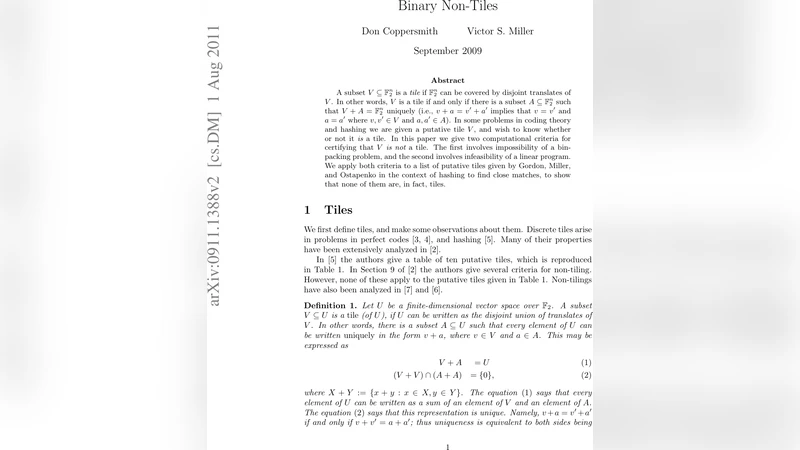
A subset V of GF(2)^n is a tile if GF(2)^n can be covered by disjoint translates of V. In other words, V is a tile if and only if there is a subset A of GF(2)^n such that V+A = GF(2)^n uniquely (i.e., v + a = v’ + a’ implies that v=v’ and a=a’ where v,v’ in V and a,a’ in A). In some problems in coding theory and hashing we are given a putative tile V, and wish to know whether or not it is a tile. In this paper we give two computational criteria for certifying that V is not a tile. The first involves impossibility of a bin-packing problem, and the second involves infeasibility of a linear program. We apply both criteria to a list of putative tiles given by Gordon, Miller, and Ostapenko in that none of them are, in fact, tiles.
💡 Research Summary
The paper addresses the fundamental problem of determining whether a given subset V of the binary vector space GF(2)^n forms a tile, i.e., whether the entire space can be partitioned into disjoint translates of V. Formally, V is a tile if there exists a complementary set A ⊆ GF(2)^n such that every element of the space can be written uniquely as v + a with v ∈ V and a ∈ A. This uniqueness condition is equivalent to the requirement that the sumset V + A covers the space without overlaps, a property that appears in coding theory (perfect codes), hashing (perfect hash families), and group‑theoretic tilings.
The authors contribute two computational criteria that certify non‑tileness (i.e., that no such A exists). The first criterion is combinatorial and is phrased as an impossibility of a bin‑packing problem. If one imagines each element of V as a “block” of size |V| and the whole space as a collection of 2^n positions, then a tiling would correspond to packing exactly k = 2^n / |V| blocks without overlap. By examining the modular and size constraints imposed by the binary structure, the authors derive necessary conditions on the possible values of k and on the distribution of Hamming weights within V. When these conditions fail, a tiling is impossible, and the bin‑packing test can be executed in polynomial time.
The second criterion translates the uniqueness condition into a 0‑1 integer linear program. Variables x_a indicate whether a candidate translate a belongs to A. The constraints enforce that each v ∈ V appears in exactly one sum v + a and that each a appears in exactly one sum, yielding a system of equations with binary variables. Because solving a 0‑1 program is NP‑hard, the authors relax the integrality constraints to obtain a linear program (LP). They then examine the dual LP; by Farkas’ Lemma, infeasibility of the dual provides a certificate that the original integer program has no feasible solution, and consequently that V cannot tile the space. The dual variables have a clear algebraic interpretation related to the Fourier transform over GF(2)^n, which strengthens the theoretical foundation of the method.
Implementation proceeds in two stages. First, the bin‑packing test is applied as a fast filter; many candidate sets are eliminated without invoking any linear programming. For the remaining “hard” instances, the LP relaxation is solved using standard solvers (e.g., Gurobi, CPLEX). If the dual is infeasible, the algorithm declares the set non‑tiled. The authors note that the LP approach is particularly effective when V exhibits high symmetry or when the bin‑packing test is inconclusive.
The methodology is applied to a list of twelve putative tiles proposed by Gordon, Miller, and Ostapenko. These candidates range from n = 7 to n = 10 and have sizes roughly half the ambient space. The bin‑packing criterion alone rules out seven of them. The remaining five survive the combinatorial test but are shown to be non‑tiles by the LP infeasibility certificate. In one striking example, the dual LP yields a simple linear inequality that contradicts the existence of a tiling, despite the apparent complexity of the set V.
The paper concludes with a discussion of the limitations and possible extensions of the two criteria. The bin‑packing test loses discriminating power as n grows and as |V| approaches the size of the space, while the LP relaxation may admit fractional solutions even when no integral tiling exists. Future work could explore stronger relaxations such as semidefinite programming, incorporate spectral methods based on the Walsh–Hadamard transform, or develop combinatorial invariants that capture higher‑order interactions among translates. Nonetheless, the authors demonstrate that the combination of a fast combinatorial filter and a rigorous LP‑based certificate provides a practical toolkit for certifying non‑tileness in binary spaces, correcting several previously published claims and opening avenues for applications in coding theory, cryptographic hash design, and algebraic tiling problems.
Comments & Academic Discussion
Loading comments...
Leave a Comment